
Well: since an art salon with two significant prizes was organized in Colombia around two-dimensional space, we should start by asking what are we saying when we talk bout two-dimensional space.
We could follow Georges Perec and his book Species of space and say that a two-dimensional space is a borderline and in consequence one is forced to see something inside. It is at least a finite space; it is not an infinite space whose silence ends up provoking something that resembles fear. It is not an intergalactic or interplanetary space; in the end, it is a space near us.
We could also appeal to common sense and say that two-dimensional space can be touched, moved from one location to another, and hung on a wall. However, these simple characteristics have become accusations, and Russian artist Ilia Kabakob has called him “autistic,” because according to him two-dimensional space is only interested in the story it tells within its framework without paying attention to what happens around it, and also accuses it of being bourgeois because it becomes a possession, “a thing,” an ornament to be hung on the wall.
Ilia Kabakob and Georges Perec, as always, are both right: sometimes two-dimensional space is a given fact and most of the participants in this salon entered it without testing two-dimensional space with new experiences; they came without surprises and filled the salon with stereotypes. Others, it would seem, paid close, interested attention to its particulars, and took advantage of them.
That two-dimensional space can in the end be close to us in some wall in our house, transformed into a pretty ornament —and nothing “prettier” than flowers—, is something María Elvira Escallón knows well. She decided to take advantage of this social circumstance of two-dimensional space and make what’s close, distant. She photographed two flowers planted in garden plots, one of them subjected to fumigation of the kind used against illegal crops. She photographed them daily, which allowed her to show the effects of the kind of fumigation to which our country’s natural reserves have been subjected. It allowed her to make evident in close up and in her own words “large-scale, distant, invisible actions.”
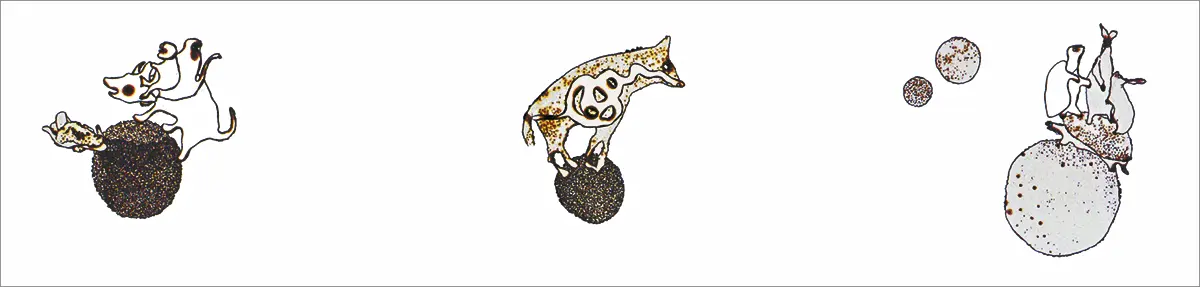
Because two-dimensional space can be moved from one place to another, it is ideal to transfer the experience of segregation and abandonment of urban spaces and human groups to the gallery’s more “illuminated” and bourgeois vision. Miguel Ángel Rojas has always been aware of art’s potential to display experiences that create awareness. His work, Sub-urbano, was a rubber and aluminum assemblage with seeds. The artist writes: “Ciudad Bolívar is a suburb of the Colombian capital where a population of over two million lives in subhuman conditions... the image of two leopards facing each other is a Colombian emblem, in this case of brother fighting brother.”
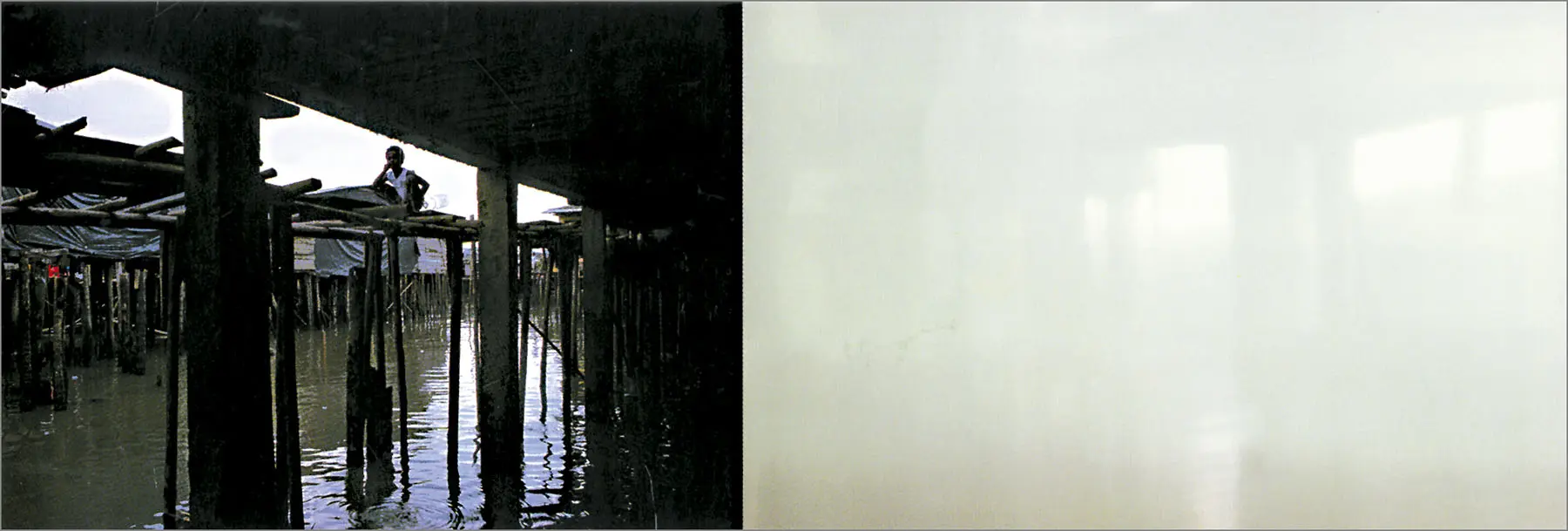
Precisely because the content of space with such precise borders needs to be chosen carefully, Jaime Ávila used it to confront two very powerful images: houses built on stilts, the solution found by the inhabitants of Colombia’s Pacific coast in order to survive floods and precariousness, and the marble floors of New York’s MoMA. Two photographs facing each other are presented as evidence.
Two-dimensional space can become a “thing”; Fernando Uhía takes advantage of this fact, and there is nothing more ironic, and nothing more loaded with memories, than leaning on the wall one of his technoesmales: with these doors, more than 2-meter tall and dripping enamel in the color of the merchandise, Uhía seems to be reminding us that the latter is in charge of our visual education, and at the same time asks us to take into account the experiences in painting of artists like Morris Louis, who expressed a sincere attitude towards the nature of the act of painting.
It is possible then to use two-dimensional space to declare the closest influences. Nicolás Consuegra’s paintings on glass, covered in black enamel and small silver lines, resemble an essential distillation of Niepce’s and Daguerre’s experiments on glass.

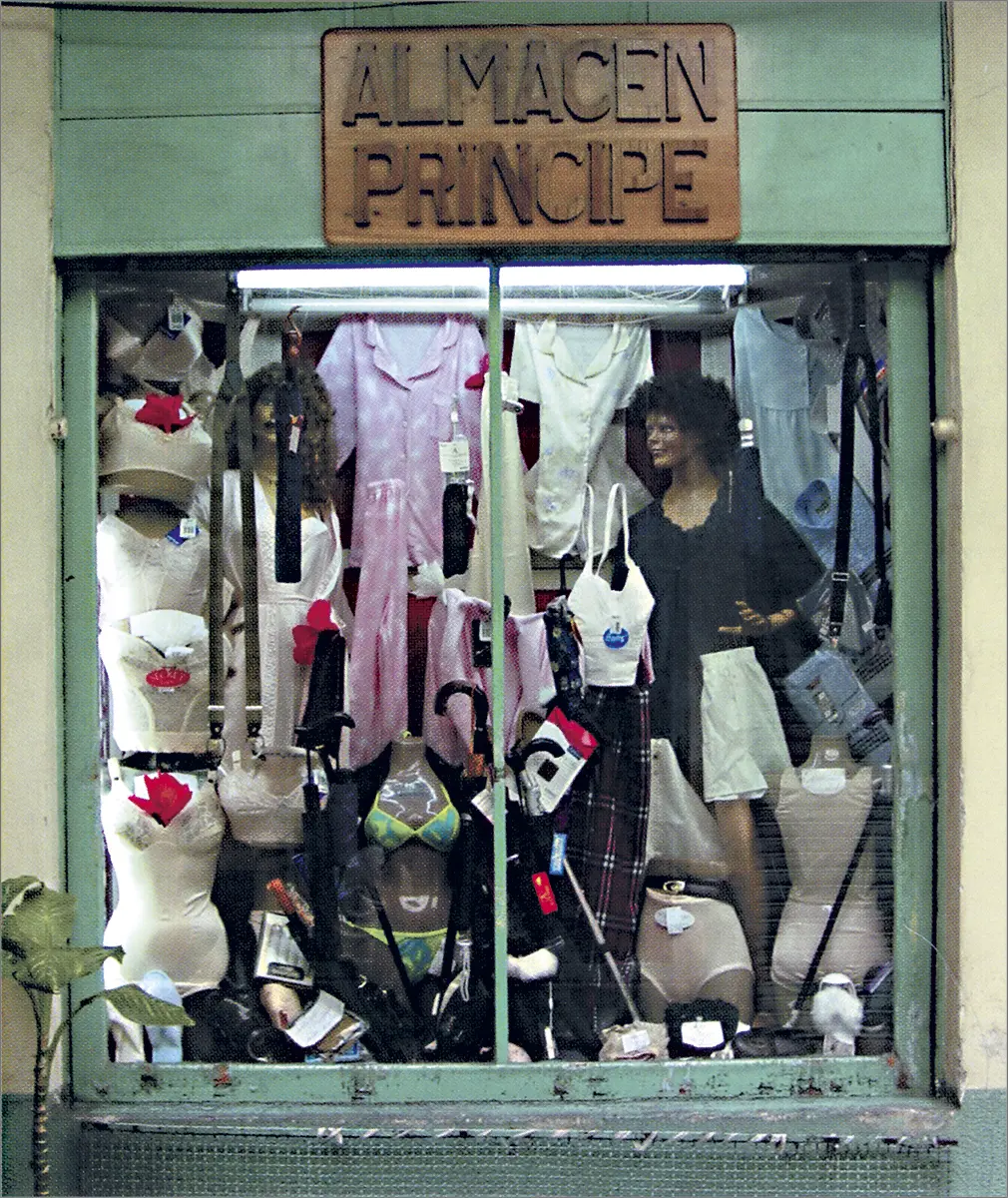
And when it comes to photography, the camera’s viewfinder in front of the eye is like an archive’s drawer; it is the border par excellence, since it forces us to see “something inside.” With its help. Barraya found random artificial leaves and flowers on the ground and started an herbarium of artificial plants. Photography then can be the space for an inventory of the military powers that nevertheless become borders of surveillance; I am talking about Juan Fernando Herrán’s photographs of planes. Inventory spaces of the things of the world, like María Isabel Rueda’s series of modern buildings, framed on the fly, as if she were surrounded by thousands of them, unfortunately like industrial packages of a different kind of segregation that asphyxiates difference. Two-dimensional inventory of a musical world preserved within Juan Mejía’s acetate discs, which only obsession can liberate. Also, an inventory of people: Rodrigo Facundo seems to pick and choose, from the news, the repeated protagonists of a daily drama, in order to transfer it to painting; and, what do we see?: military uniforms, laborer’s uniforms, and uniforms worn by displaced persons, and people in anguish, and some who ask for clemency.
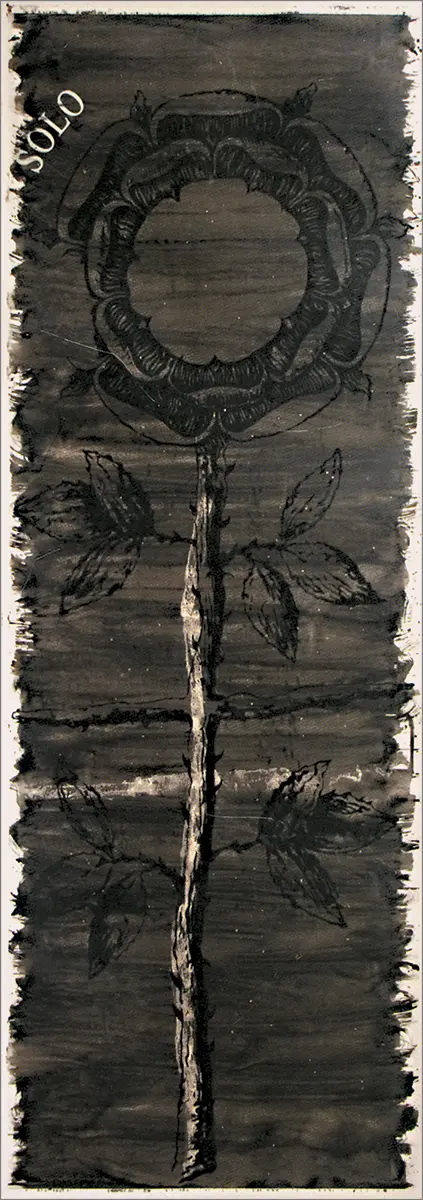
Two-dimensional space can appear with a word written on a wall or the sand by Mario Opazo. It can also take shape with the decision of defeating the power of the blank page and set for oneself the challenge of colonizing it or at least breaking its silence, forcing it to speak of the way we live: violently, in islands that Johanna Calle builds by burning paper, or with a question about reconciliation in Víctor Laignelet’s paintings.
The Salon prizes went to Mariana Varela for a drawing on black paper with smoke and ink; Morada III could be a metaphor for our living in an unstable world. The second prize went to Jaime Iregui’s Exhibición ideal, a series of photographs of display cases, places for collecting and exhibiting. Seventy-one artists participated in the Two-dimensional salon, which demonstrates both the artist’s attachment to tradition and the diversification of space into all the uses and experiences that art can explore.
NATALIA GUTIÉRREZ