
Valdir Cruz’s recent series of photographs depicts the carnival of Salvador da Bahia, a theme that could easily fall into stereotype or cliché. However, Cruz manages to avoid exoticism and instead portrays his subjects in emotionally direct ways, making possible a close identification between them and the spectator. Indeed, Brazilian themes have been a continuous presence in Cruz’s oeuvre, yet they are treated from the point of view of an insider. For example, his extraordinary series on the Yanomami, exhibited at Throckmorton in 2002, portrayed the indigenous people of the Amazon rainforest with a serious dignity that underscored their humanity.
Cruz’s latest solo exhibition at Throckmorton featured thirty-three black and white photographs of the carnival taken over a period of ten years, from 1995 to 2005. The series developed from the artist’s regular attendance at the event and his realization that he brought a different perspective to it than what was traditionally seen. He decided to document the carnival over the course of a decade and became aware of gradual changes that took place, as it began catering to tourists instead of locals. Such changes are not immediately visible in the selection of works at Throckmorton, particularly since Cruz’s emphasis is on the bahianos, but these changes will be brought into greater focus in a lengthier book project that the artist is planning.
The images in the exhibition included portraits as well as group and crowd scenes, most of which highlighted the chaotic nature of the carnival. Cruz exploits a range of grays, avoiding the extreme contrasts of deep blacks or harsh whites that often predominate in the work of photographers featuring people of color. The result emphasizes that this selection is not about race but about life and movement. Thus, many of the images are blurry or in soft focus, featuring people in motion, such as the haunting Folião V (2005), which depicts a person of ambiguous gender with chiseled facial features and a half-open mouth. The unfocused eyes peer eerily out of the picture, and the whole photograph has a silvery sheen that recalls the silver jewelry worn by the subject. Foliona IV (2004) and Foliona III (2003) are even less distinct, picturing women in the crowd who smile but refuse to stay still.
Cruz’s crowd scenes are also remarkable, as they capture the immense magnitude of the event. Trios eléctricos (1999), taken from a position high above, juxtaposes the indistinguishable throngs of people to the carnival’s makeshift architecture. Filhos de Gandhy II (2004) shows a sea of dancers clad entirely in white, cramming a city street, their hats contrasting with the uncovered heads of the people in the crowd. Timbalada (2005), featuring drummers in costume, is a beautifully composed work based on circular shapes: the drums, the musicians’ costumes, the heads of the people in the crowd, etc. For all the movement this particular image conveys, it is also one of the more sharply focused, with areas of high contrast that emphasize its formal qualities; it also has an interesting elevated point of view that gives the spectator the impression of floating above the multitudes.
Other images place the viewer in the thick of the action. Cena carnavalesca II (1998) immerses one in an exuberant dance, where boundaries between individuals become blurred in terms of both form and subject. Foliões (1995), an image of a shirtless dancing man from behind, seems to press the viewer against his sweaty body and evokes a multi-sensorial experience. Foliões em noite chuvosa (2001) allows for a bit more breathing room. Featuring dancing couples in the rain, it is an extremely sensual work in which glistening wet bodies come together with great stillness.
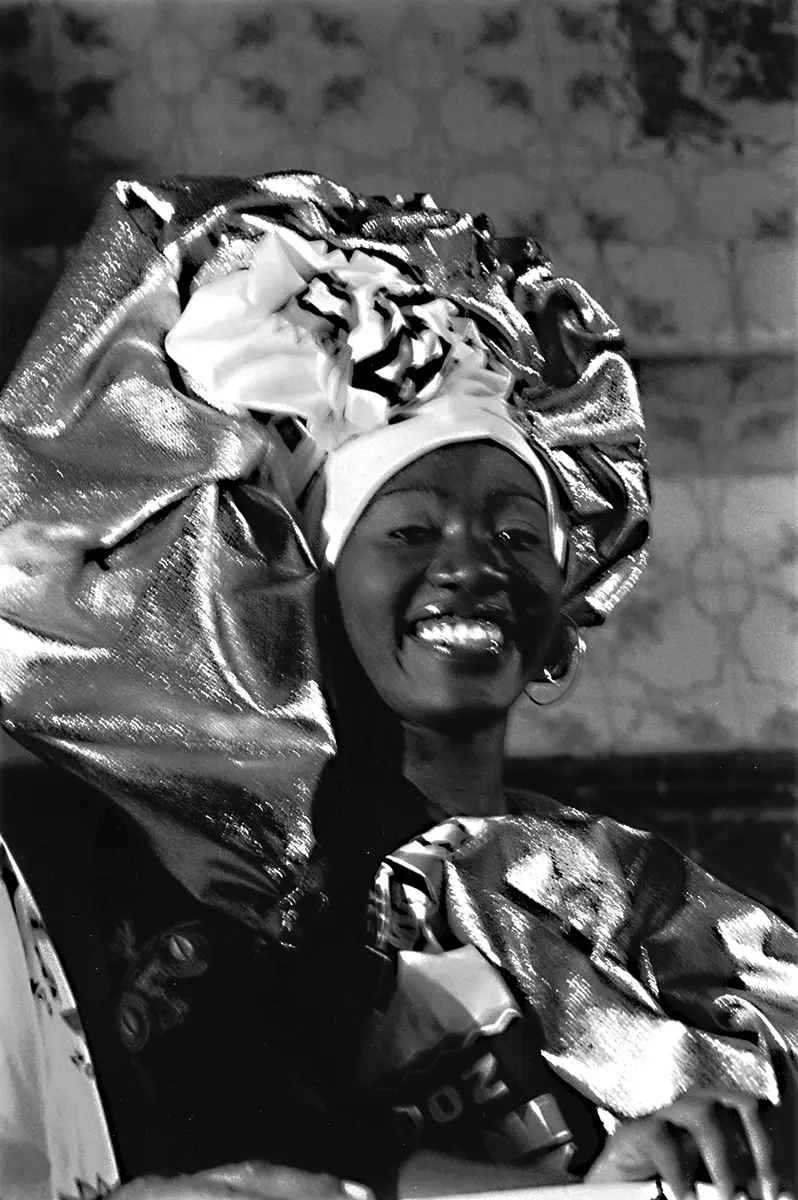
Photographs of the carnival’s performers were among the most compelling in the exhibition. Carlinhos Brown (2003) captures the musician in action, simultaneously dancing, beating on a drum, and singing while wearing an elaborate costume complete with headdress, face painting, and necklaces. Another photograph of Brown with Gilberto Gil (1999) is a candid depiction of the hypnotic energy and intensity of the carnival. Images of anonymous performers were equally captivating, however. Deusa do Ébano (2001) of a smiling dancer wearing a shiny costume and headwrap is imbued with happiness and tenderness, as is Foliona do Ilê Aiyê (1999), in which another dancer smiles broadly for the camera.
Overall, Valdir Cruz’s photographs give a human face to the carnival of Salvador da Bahia. These remarkable, memorable images document an extraordinary festival that will hopefully continue to maintain its local flavor despite the increasing pressures of the tourist industry.
TATIANA FLORES