
The third edition of the Valencia Biennial in Spain appropriated the theme of water because, as its director, Luigi Settembrini explained, water, due to its scarcity and contamination levels, has become one of the most serious environmental problems that humanity has to face nowadays. Since its beginnings, the Biennial has formed its projects around wider concerns than the merely aesthetic Settembrini continued to explain– and therefore it has adopted water as its main argument. Settembrini added that another consistent aspect of this event has been its interest in exploring the complex interrelationships that occur between art and the mass media, arguing that, from that perspective, water is a metaphor for the way in which contemporary mass media work: like water, these are fluid, ubiquitous, they tend to overflow repeatedly, and do not acknowledge any borders.
Settembrini’s thesis—intriguing as they are—contrasted nonetheless with the reality of a biennial that, in this edition, due to severe cuts in its finances, saw its scope and its potential dramatically reduced to one large group exhibition held at Centro del Carmen, accompanied by and a couple of urban interventions which were actually not very relevant. And water itself, as a direct and immediate topic or argument, wasn’t sufficiently represented either among the selected artists and works. It seemed as if Settembrini himself and mostly the two curators working with him, Franck Gautherot and Seungduk Kim, had assumed or interpreted the metaphor of water very loosely and they were able to find it in works that, at least in my opinion, appear to have nothing to do with it. Such laxity could be forgiven or accepted without much compromise in regard to One Million Years, On Kawara’s classic conceptual work is understood as an assumption of instrumental reason and its inconsistencies. Ultimately, the graphic litany compiled in thick volumes of numbers representing all of those years can be interpreted as the metaphor of a metaphor, or the allegory: one allegory of time, which, like the water of Heraclitus’s river, passes us by to never return.
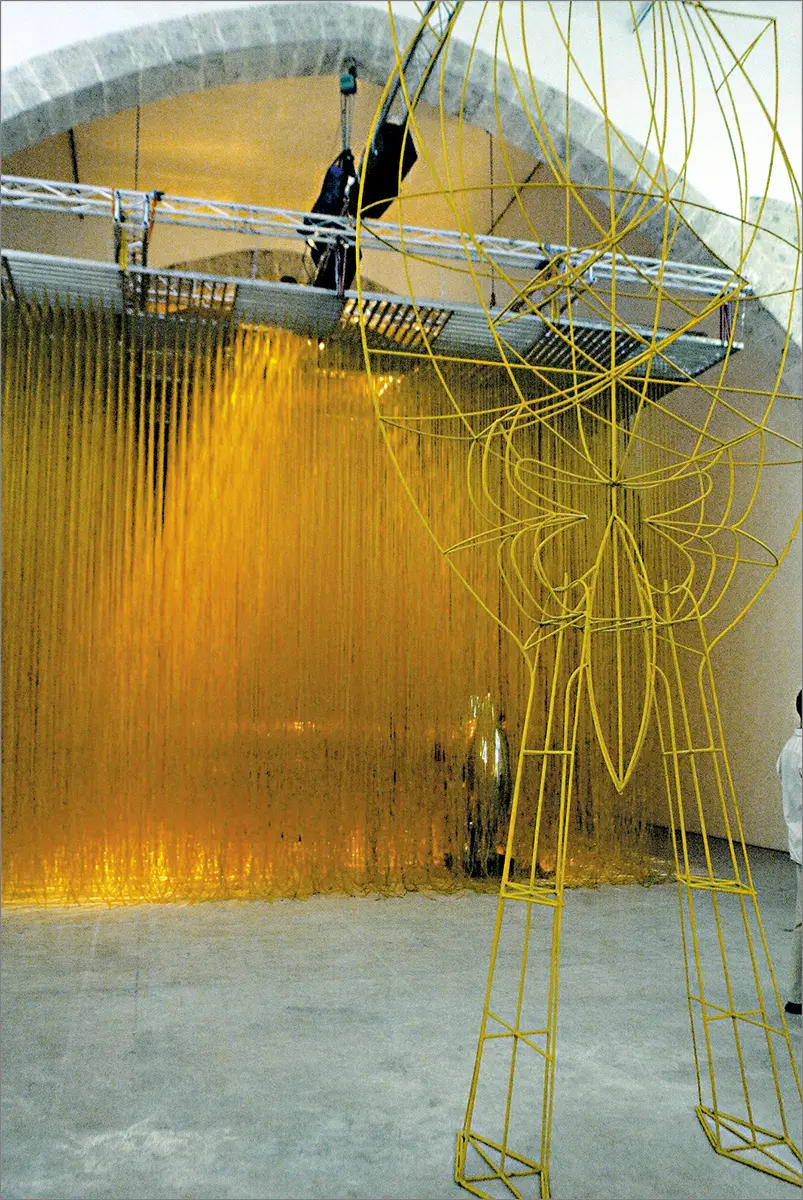
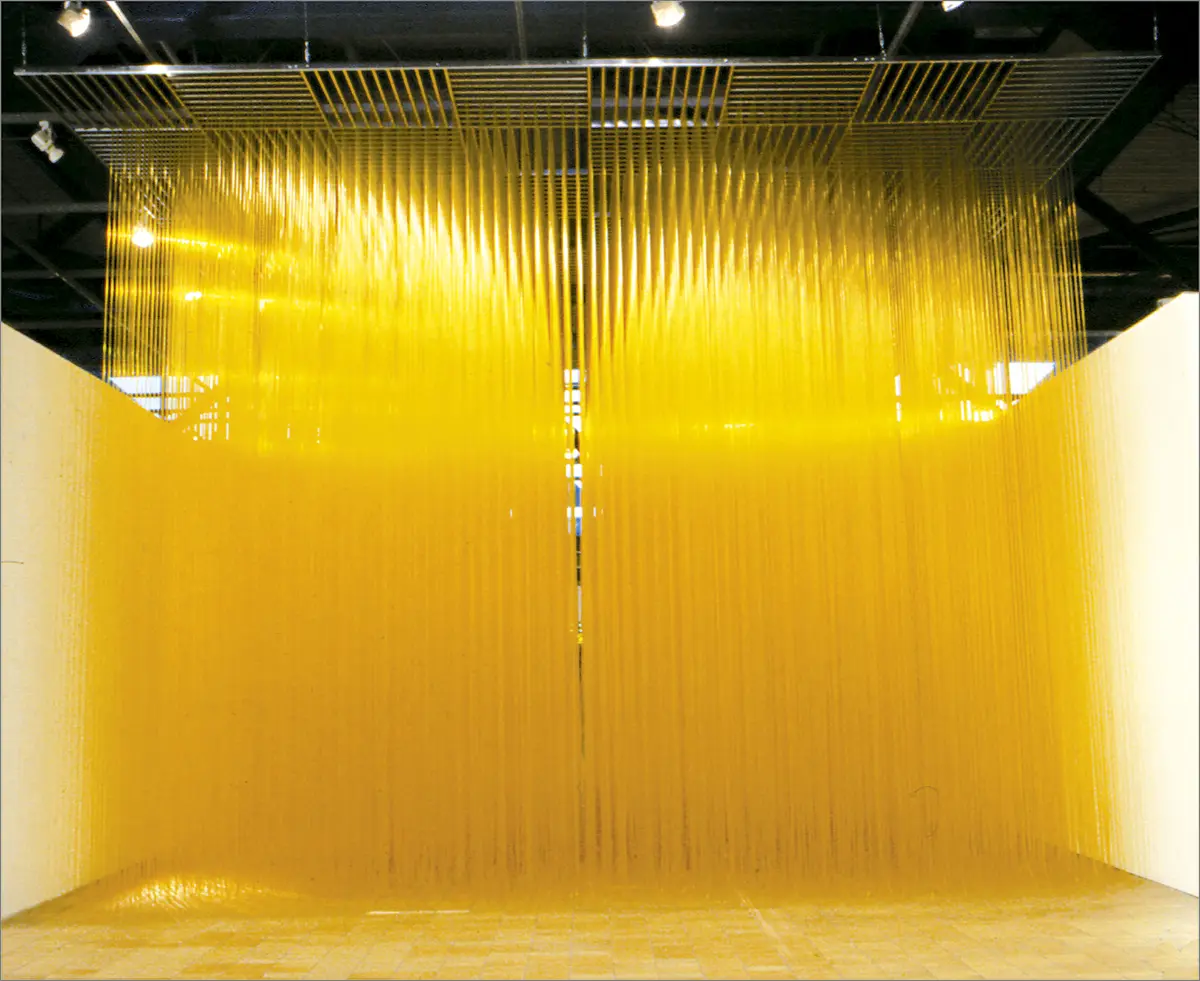
But, as I already mentioned, finding congruence between the topic of water and the works selected was often difficult in this Biennial. In most instances, what happened was the extreme opposite, as in the sculptures presented by Andreu Alfaro, Moon Shin, or Xavier Veilhan, which had little or nothing to do with water, considered from either a literal or metaphoric angle. Even such a significant work as Jesús Rafael Soto’s Penetrable de Lyon seemed at odds with the Biennial’s general topic, although it could be entered with the same ease as water. Was what the curators thought, when they decided to select this work, that its nylon threads, hanging from the ceiling, evoked rain or the flow of water from a showerhead?
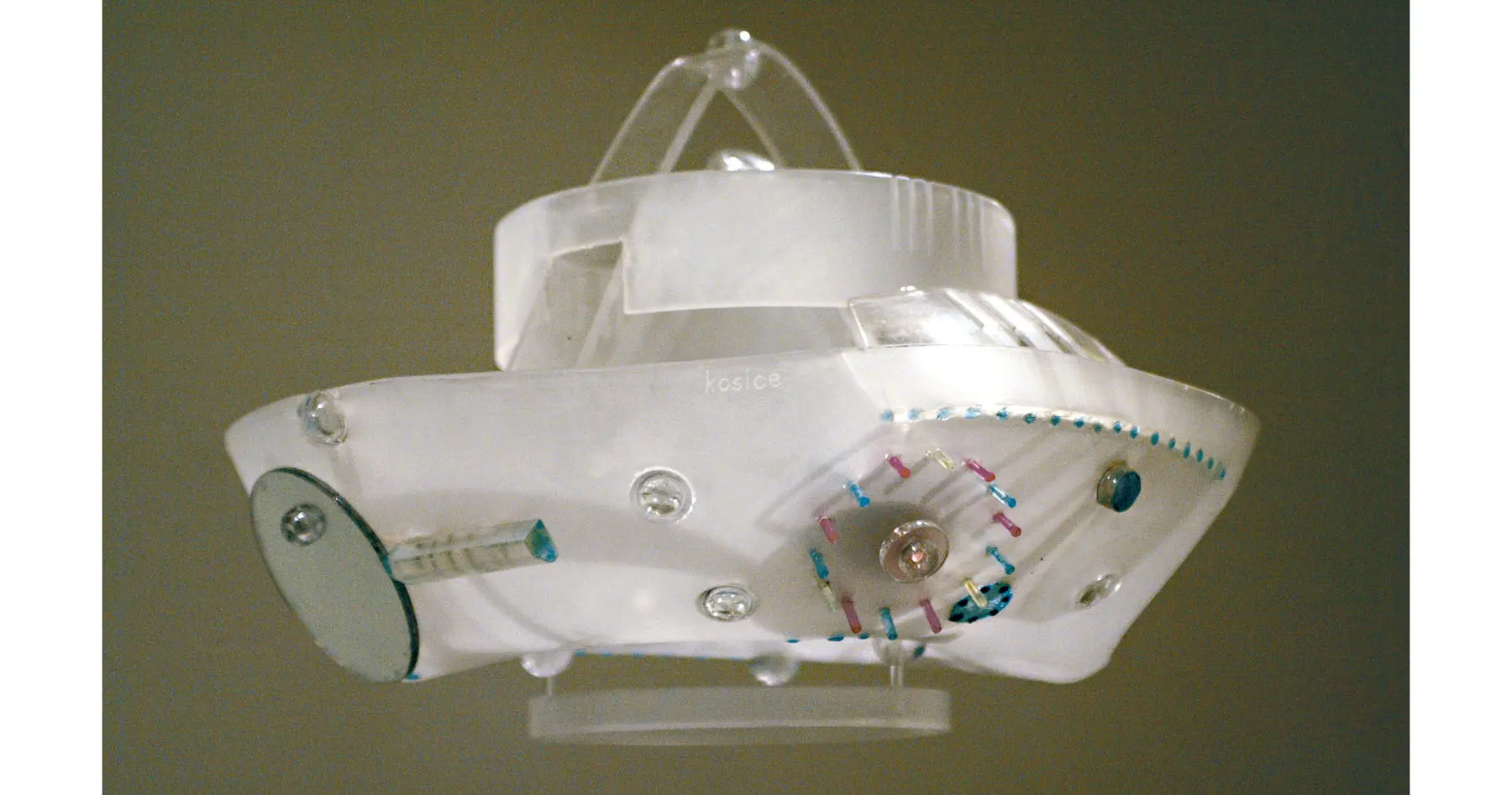
In this context of missed encounters, we can also situate the set of works exhibited by Gyula Kosice, the Argentinean artist, and theorist who in the 1940s and 50s was a founder and promoter of the Madí group, one of Latin America’s freest and most stimulating approaches to abstract and constructivist art, and utopianism expressed and explained in the manifesto La ciudad hidroespacial. According to this text, written by Kosice not too long ago, we find ourselves today in a situation of such environmental degradation that the only option left is to seriously consider the construction of cities that can permanently float at an altitude of 1500 meters, using revolutionary techniques capable of transforming the clouds’ vaporized water into a permanent source of energy. Kosice’s metacrilate models of the typical spaces in those hydrological and hypothetical cities are, also, a result of his old intention of fusing art and life. “In this way,” reads the manifesto, “our proposal is an art that belongs to all, not art for all. If we eliminate all intermediaries, art is tacitly integrated to the habitat, dissolves into it and into life, becoming its presentation, its modus vivendi.”
Those works that did assume the topic of water in an open and clear way, although a minority, were not lacking in interest. I’m referring to paintings like Robert Longo’s, inspired by famous photographs dedicated to surfers, where we see the tunnel formed by a large wave as it rolls on itself. There were images by Serse of water mirrors that distort reflections and images of skies covered by clouds that are nonetheless not water but gases.
In Hwang Jongmyung’s pieces from the series Swimmers, the heads and arms of men are visible as they swim in a puddle on the pavement or a hard cement floor.
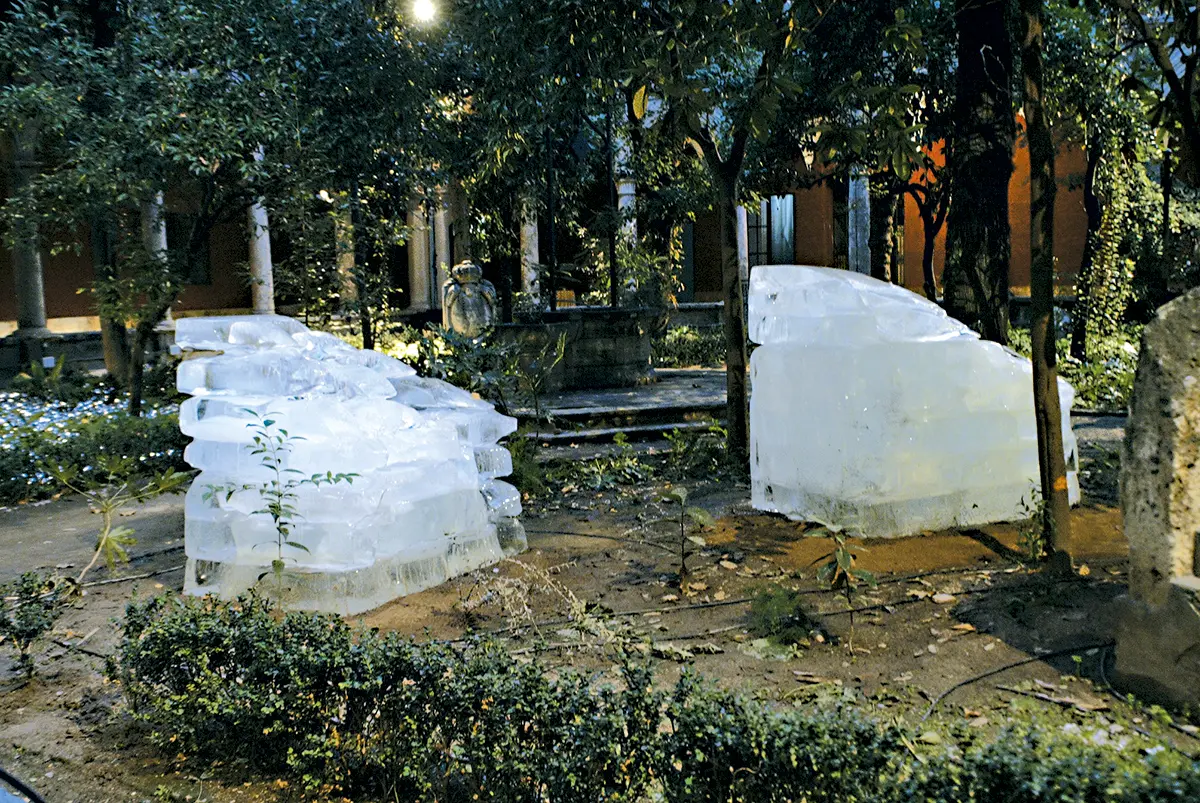
Another work that should be noted is Olivier Mosset’s Toblerone, carved on a block of ice that melted and evoked both the famous Swiss chocolate, a special anti-tank barrier built by the Swiss army during World War II, and also the melting of the glaciers due to climate change, which threatens to leave Switzerland without its characteristic ice-capped mountains. But it was Julie Atlas Muz who most decisively addressed the topic of water. For the inauguration, she dressed as a mermaid and interpreted one of her classic aquatic performances in one of the city aquarium’s largest and most populated fish tanks.
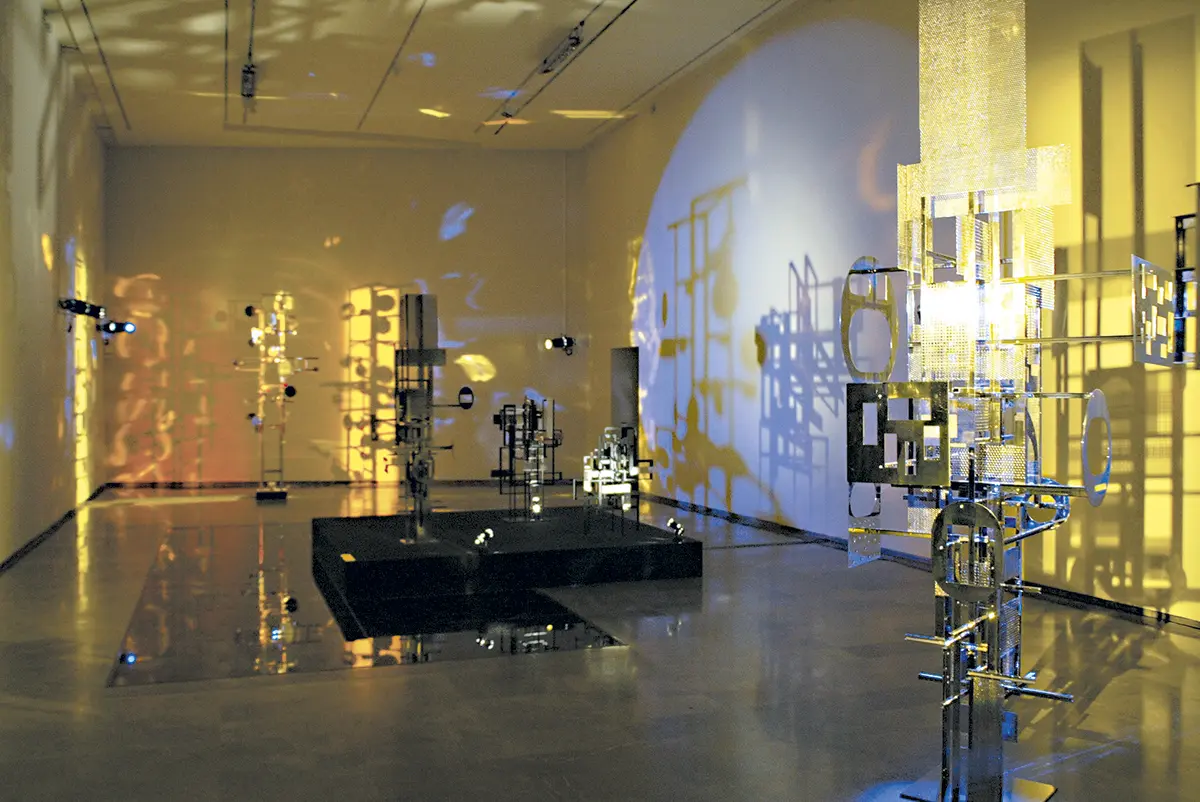
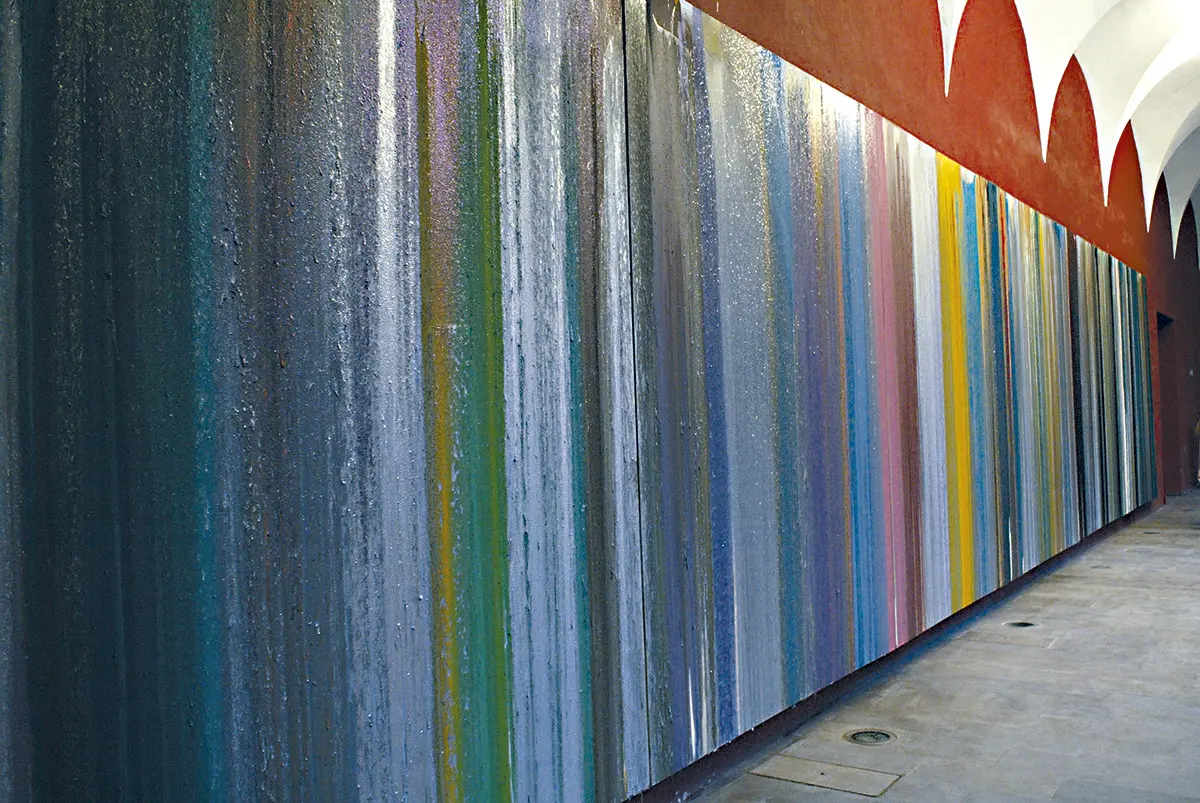
For their intrinsic interest rather than their hypothetical relationship to water, one must mention: Rafael Ronzedaal’s computer-generated images; Nicolás Schöffer’s luminous constructions; John Armleder’s large “dripping color” paintings; Marc Camille Chaimowicz’s photographic montages, full of abandoned shoes culled from sidewalks, streets, and public squares; Yayoi Kusama’s biomorphic sculptures; Lynda Benglis’s fragile sculptures and “expanded paintings”; Juan Bernardo Pineda’s “dances”; Angela Bulloch’s geometric light and color compositions; Duane Hanson’s hyperrealist sculptures; Richard Kern’s similarly styled photographs; and Terry Rodger’s paintings reproducing the social life of easygoing youths.
CARLOS JIMÉNEZ
Writer and art critic. Independent curator. Author of Strangers in Paradise. A Glympse at the Art of the 1980s (1993) and About Medusa’s Faces. Studies on Rethoric Photography (2003).