
The title of this exhibition is intriguing. Purposely lacking punctuation and conjunctions, it is intentionally ambiguous and, in the end, more lucid than the show itself. Curated by Jean-Hubert Martin and presented in the Padiglione d’Arte Contemporanea of Milan, Art Religion Politics acts as a second chapter or follow-up to his controversial landmark exhibition Magiciens de la Terre presented in Paris in 1989. In Magiciens, Martin tackled the issue of mainstream versus non-mainstream art, intending a respectful acknowledgment of expressions that occur outside the circuits of distribution controlled by the art centers.
Magiciens offered a powerful and sometimes overpowering introduction to artists almost entirely unknown to the international market.1The result was debatable partly because of the circumstances of the exhibit, which in some cases reassigned art definitions, but also because of the vagueness of the term “magician” and the awkwardness of trying to fit under this umbrella the wide range of artists Martin chose. Among the approximately 100 participants named ranging from Claes Oldenburg to Alfredo Jaar, Barbara Kruger, Lawrence Weiner, Enzo Cucchi, and Jeff Wall. In its breadth and eclecticism, that exhibition ultimately seemed less concerned with exploring wizardry than with making a cultural counterpoint, a project in which contradiction was almost inescapable. In the very act of calling attention to gaps and weaknesses in the art of the mainstream, Martin was positioning the work he was exhibiting as something akin to “new arrivals,” which only makes sense from the perspective of the mainstream, into which the new work is inserted as a “discovery.” Martin implicitly acknowledged this at the time when he commented, “Let’s not forget that I must think of this project as an exhibition."2 As timely and important as the 1989 show was, the production was caught in a contradiction that was bound to undermine its goals, irrespective of who organized it.
The current show in Milan, which includes four of the twelve artists from Magiciens, is consistent with Martin’s earlier exhibition in taking an anthropological approach to the organization of expression.3 The approach “forces one to think about differences and not similarities, heterogeneity against homogeneity."4 This is certainly a valid point, but it also carries with it the danger of casting the organizer of such shows in the position Johanne Lamoureux has called “curator-as-explorer,” viewing local cultures from an outsider’s perspective.5 But the current exhibition manages to avoid some of the pitfalls of the earlier show and addresses some of the issues raised there in a more focused way. The works exhibited, some of which are very powerful, share a common thread, and the essay in the catalog is successful in pinpointing the issues that are important to the curator. But the exhibition doesn’t deliver on the promise embedded in the show’s title. Rather than exploring close and direct connections between Art, Religion, and Politics, this is an exhibition that could have more accurately, if cumbersomely, been titled “Art With Religious Inspiration or Manifestations That May Have Political Implications.”
The exhibition consists of two distinct parts. The first concentrates on small pieces by Western contemporary masters, with works by Beuys, Flavin, Fontana, Klein, Nitsch, and Tapies. The second and larger section includes works by Bedia, Mestre Didi, Art Orienté Objet, Charo Oquet, Shiraga, Frédéric Bruly Bouabré, and Cyprien Tokoudagba, as well as works by several contemporary Australian aboriginal artists: Anatjari Tjakamarra, Mick Namarari Tjapaltjarri, Ronnie Tjampitjinpa, Walter Tjampitjinpa, and Warlukurlangu, a collective of 23 artists.
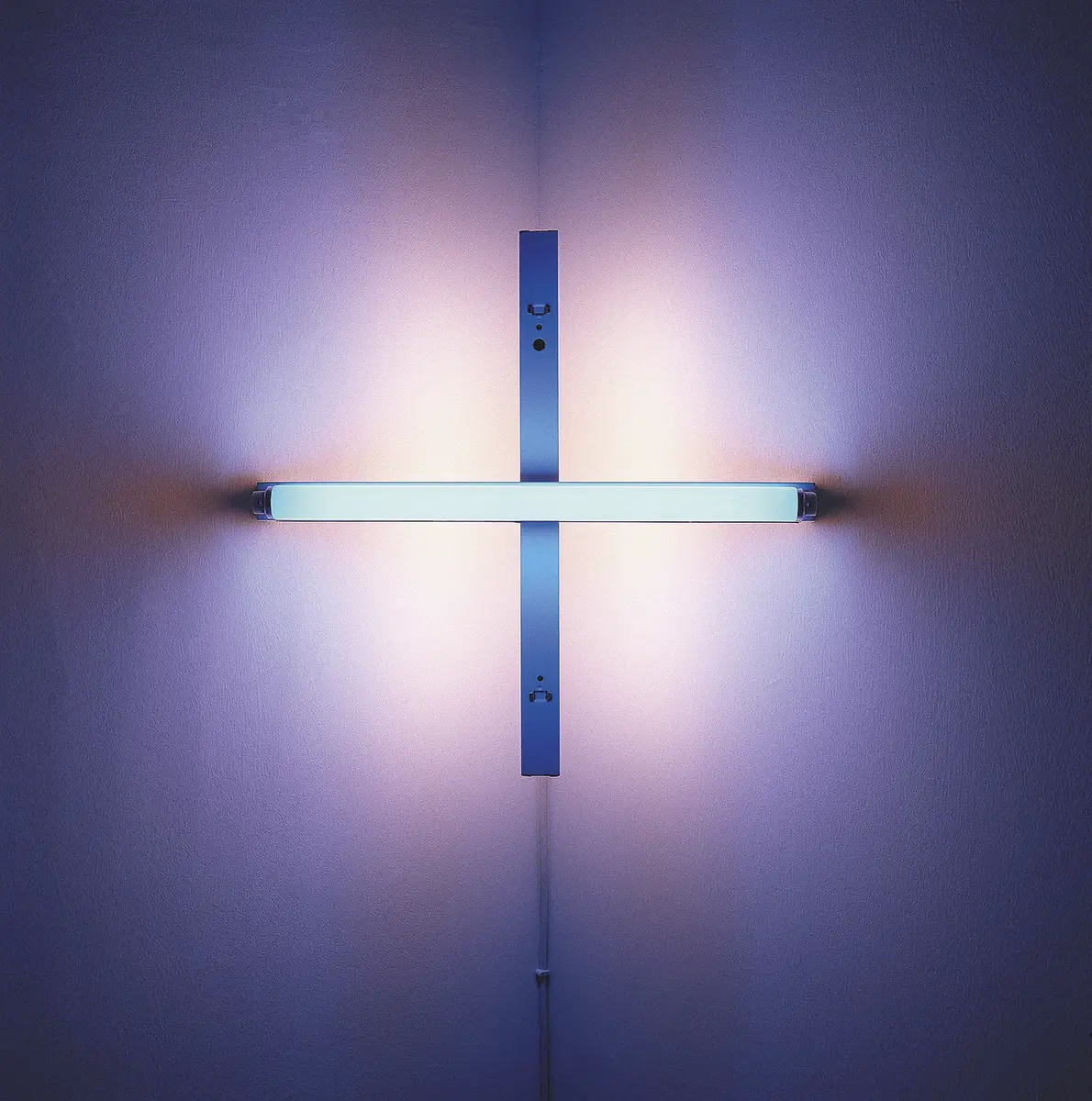
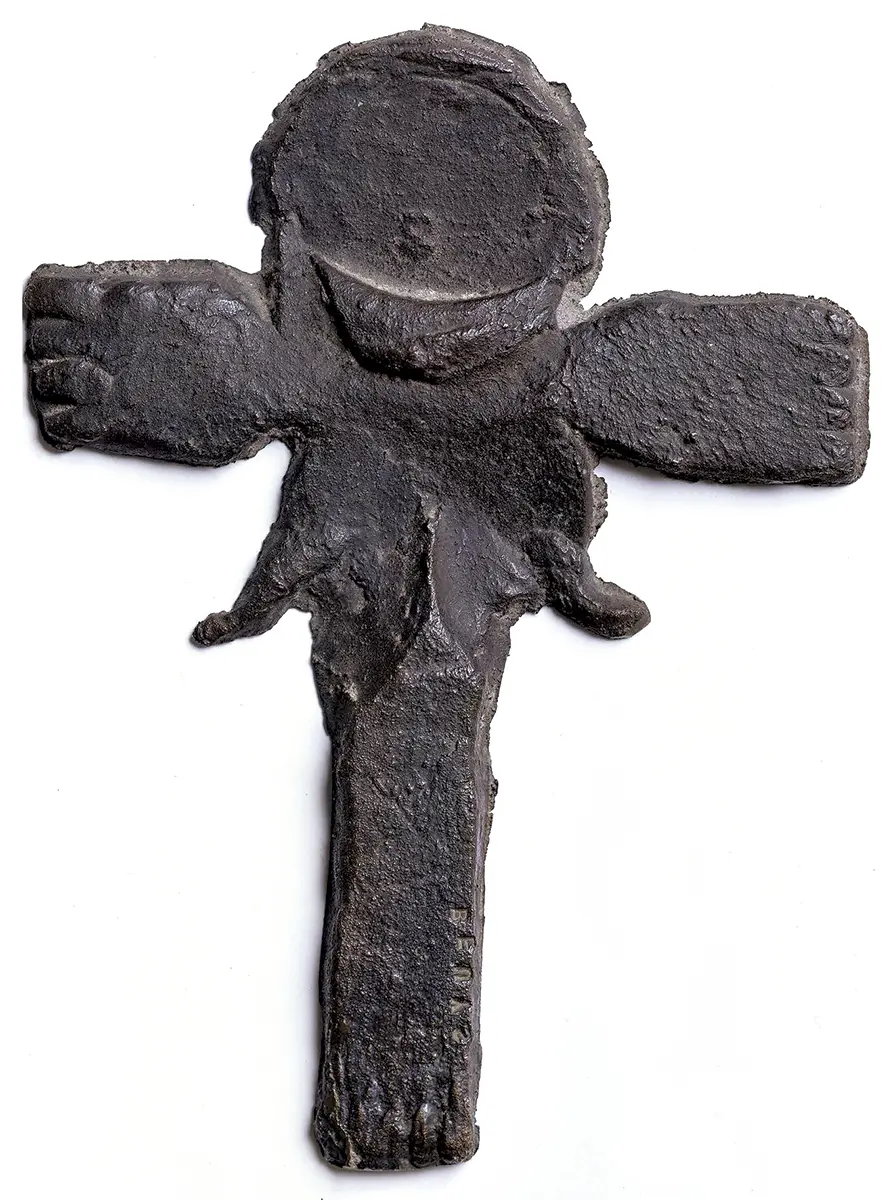
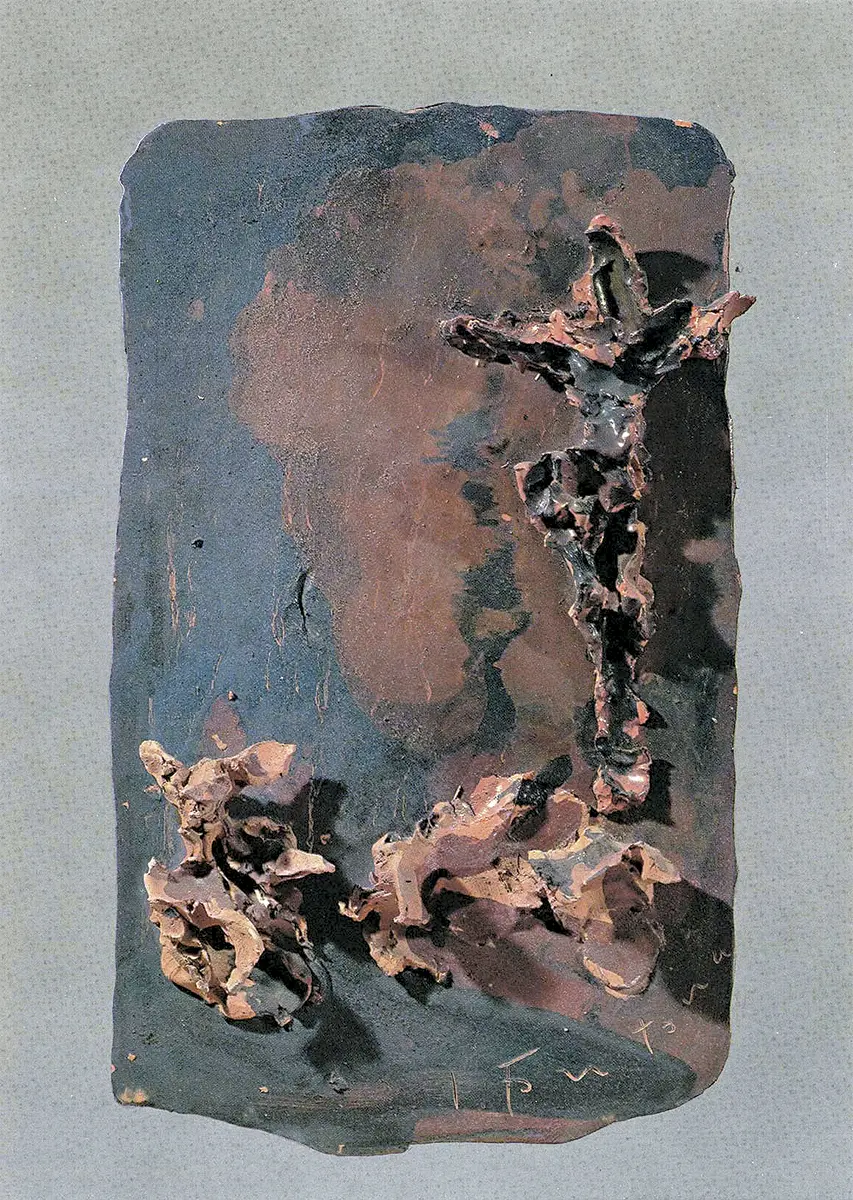
Among the Western artists, religion appears to be a footnote in the context of their signature works. The pieces in this section also appear disconnected from any clear political significance or consequence. The interest the work arouses has more to do with historical anecdotes. It is unexpected, even startling, to find an early Yves Klein drawing of a Christ carrying the cross (1951), revealing a Catholicism he evidently never abandoned even as he delved into Rosicrucianism and developed a commitment to Zen Buddhism. Fontana’s Crucifissione (1955), a relatively abstract version of parallel religious works he did for several chapels, is far removed from the interest generated by his spatial speculations.6 The pieces by Dan Flavin and Antoni Tapies are remarkable for integrating a religious aspect into the usual pointedness of their solutions. Flavin’s Untitled [My fluorescent tubes never ‘burn out’ desiring a god] (1971) consists of two neon fixtures with tubes forming a cross, one oriented toward the viewer and one toward the wall. Flavin had been a Jesuit seminary student, though without any major calling.7 His piece plays on the tension created by a highly charged mystical experience expressed without any formal pomp. Tàpies’ Peus (1995) is probably the most ambiguous piece in the exhibition. It is a cardboard collage in which a cross can also be read as a letter T, and the feet emerging from beneath (the Spanish word for feet is pies) all make a pictogram of his name even as they allude to a crucifixion. One doesn’t know whether the intention is sacred or sacrilegious or just a pun on his name. Pilate-like, the artist engages in a multiple and elegant play which has the effect of shifting responsibility to the viewer.
In the second and larger section of the exhibition, the proportion of art, religion, and politics varies greatly between artists. By definition, of course, all the work exhibited here is art. And to one degree or another, each of the works expresses an awareness of the sacred or a perspective on religious practice. It is worth pondering, though, about the extent to which there are clear political implications as well. If politics is seen as the expression of power relations, every human act can be interpreted politically, as having political implications and consequences, art included. The question is who is making the connection, and on what foundations. The title of this exhibition suggests that it is the artists assembled here who are making the connection. But this is a stretch, for much work in this show seems to be addressing religion in the absence of a political consciousness expressed in the work (such as that of Shiraga and Mestre Didi, just to mention two). In general, one gets the impression that, for Martin, the mere fact that there is a religious voice in the art is sufficient to have it stand as a political statement if the certain religious activity is being suppressed, penalized, or treated as subversive in the larger social context in which the work has been produced. But this confuses the intent of the artist with the intent of the viewer or curator. If, for the art-maker, the work is intended as an expression of the sacred, the connection between art and religion is clear and direct, but not the connection to politics. It is only what happens after the art is made that reveals the political implications. Repression of religion makes religious art a political event even if it is intrinsically devoid of any political consciousness or intent.
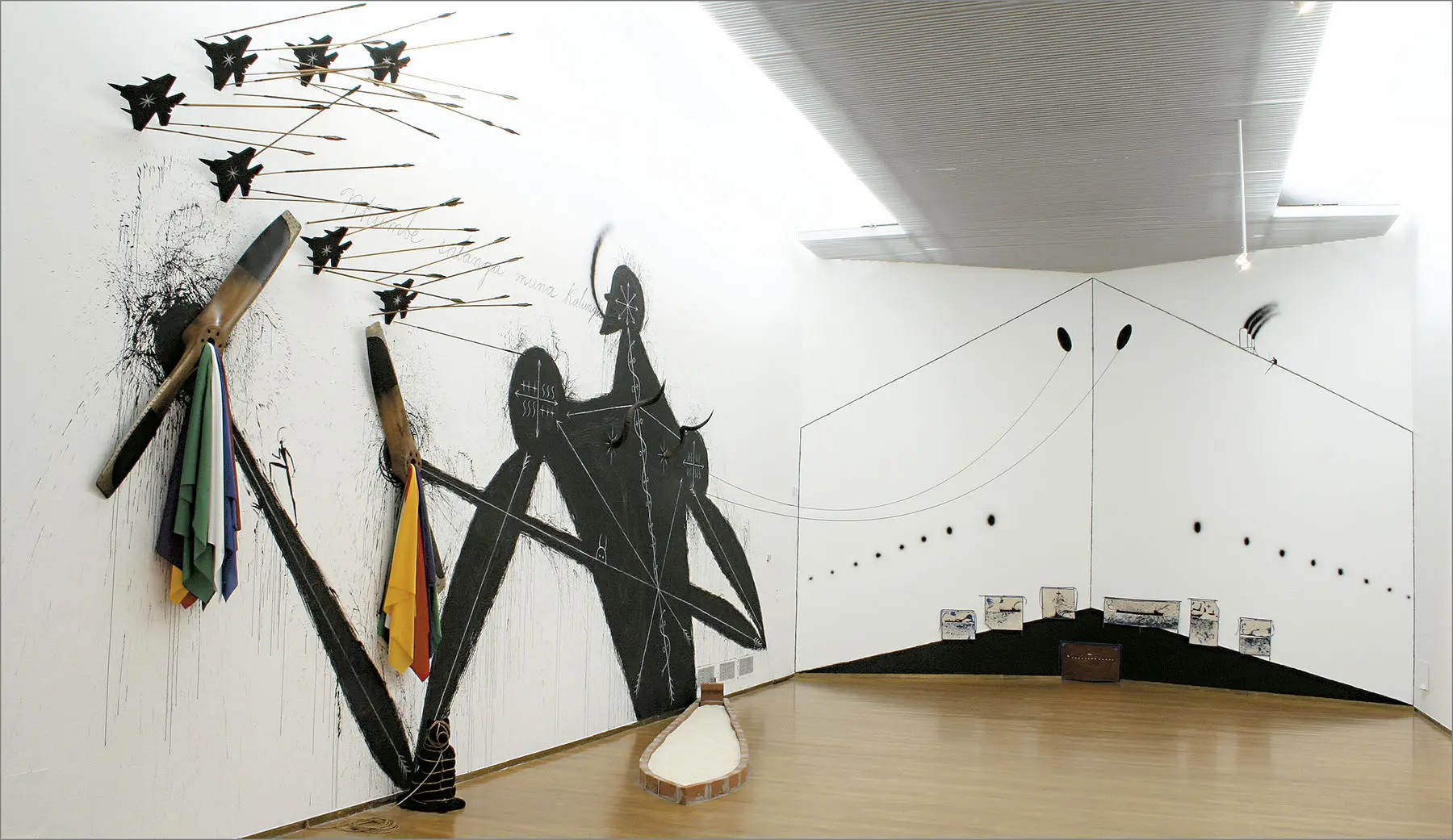
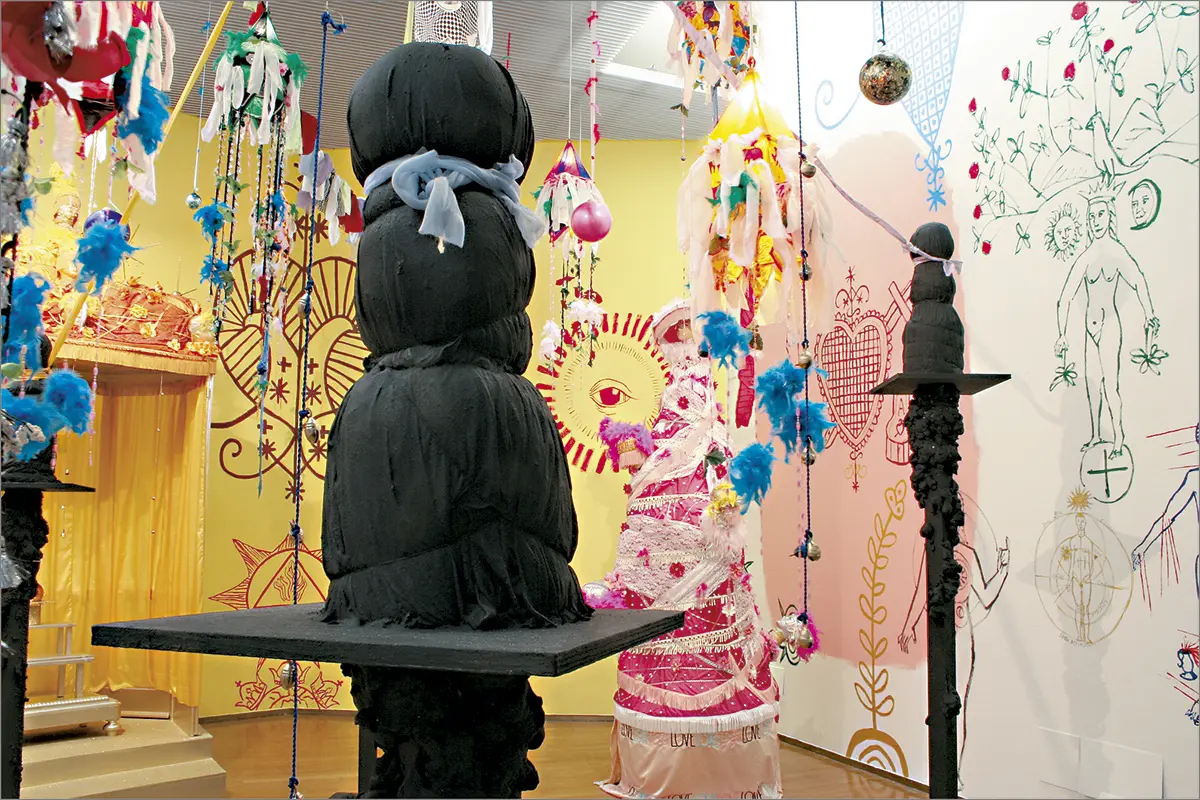
Visually speaking, the most powerful work in the exhibition is Bedia’s Mkumbe salanga muna kalunga (The boat is arriving from the sea), an installation made especially for this show. It is in line with the best of Bedia’s installation work—concise, humorous forms that look like Stealth planes are effectively penetrated by arrows—and, above all, magical. The room ends in what looks like the bow of a big ocean liner, and the viewer is as much travelling as watching a mystical trip of resistance. It is possibly the most successfully integrated piece in the exhibition, addressing abuses of power with iconography that is both sacred and concrete. “Civilization” is being questioned in its foundations.
Conceptually speaking, it is Frédéric Bruly Bouabré’s work that should be highlighted in a review of this show. Bruly Bouabré had a vision in 1948 during which he was instructed to compile all the knowledge of his people, the Bété in Ivory Coast. “All knowledge” means all knowledge—the spots on maturing banana peels, cloud formations, astronomical observations, advice on morality, speculations on geometry and the creation of an alphabet of 401 pictograms to serve as a living record for a people without a written language. The only other artist who comes to mind as taking on a project of such overwhelming scale is Adolf Wölfli, and it is perhaps significant that both are “outsiders” from the point of view of the art centers: Wölfli died after spending three decades in an insane asylum, and Bruly Bouabré lives on the geopolitical periphery; Wölfli was “discovered” by his psychiatrist,8 and Bruly Bouabré was introduced to the Western world by Martin in Magiciens. It is revealing that in the catalogue of the show, Bruly Bouabré’s artistic biography starts in 1989, the date when he was shown in Magiciens, and not in 1948, when he started to produce his work.
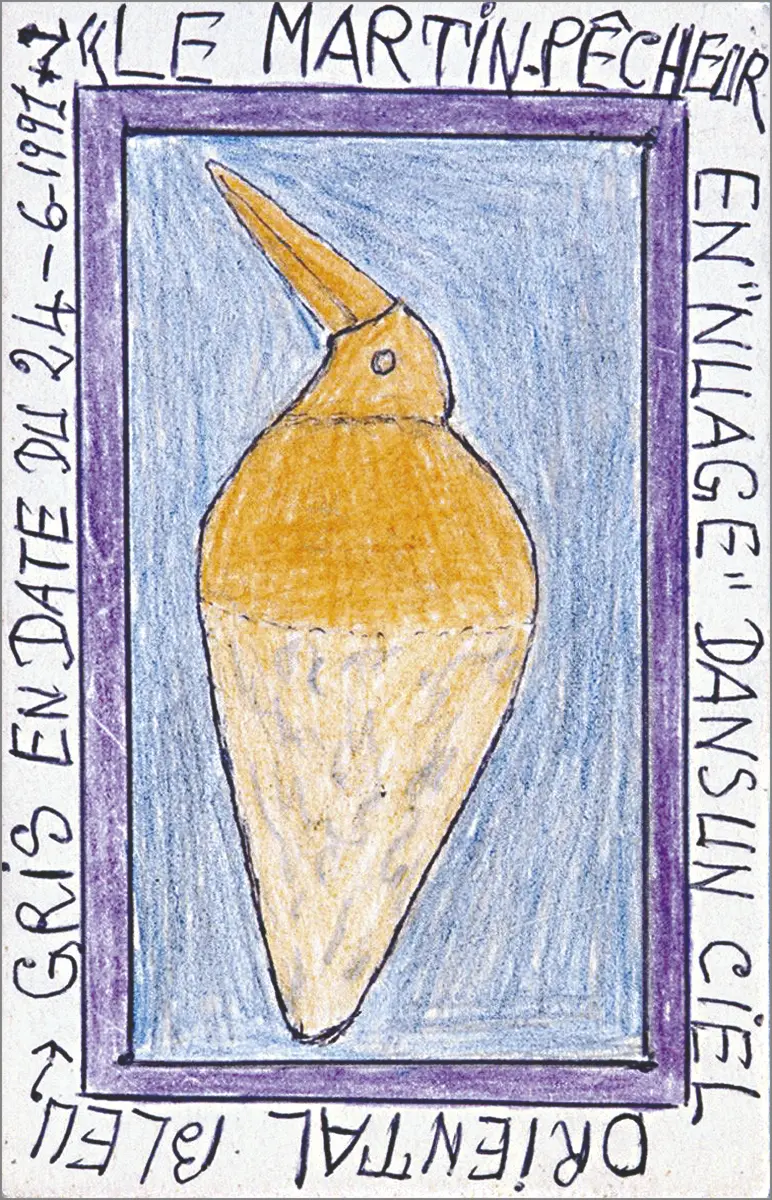
Bruly Bouabré has explained that his lifetime project is in fulfilment of a deeply felt obligation or calling: “...like Jesus Christ, and also calmly and with as much joy the prophet Mohammed felt in front of his vision, I will dedicate my life to the atheist who demands it,"9 but while he compares his work to the work of prophets, he is addressing issues of significance to a culture that is deeply religious rather than reproducing religious ritual.
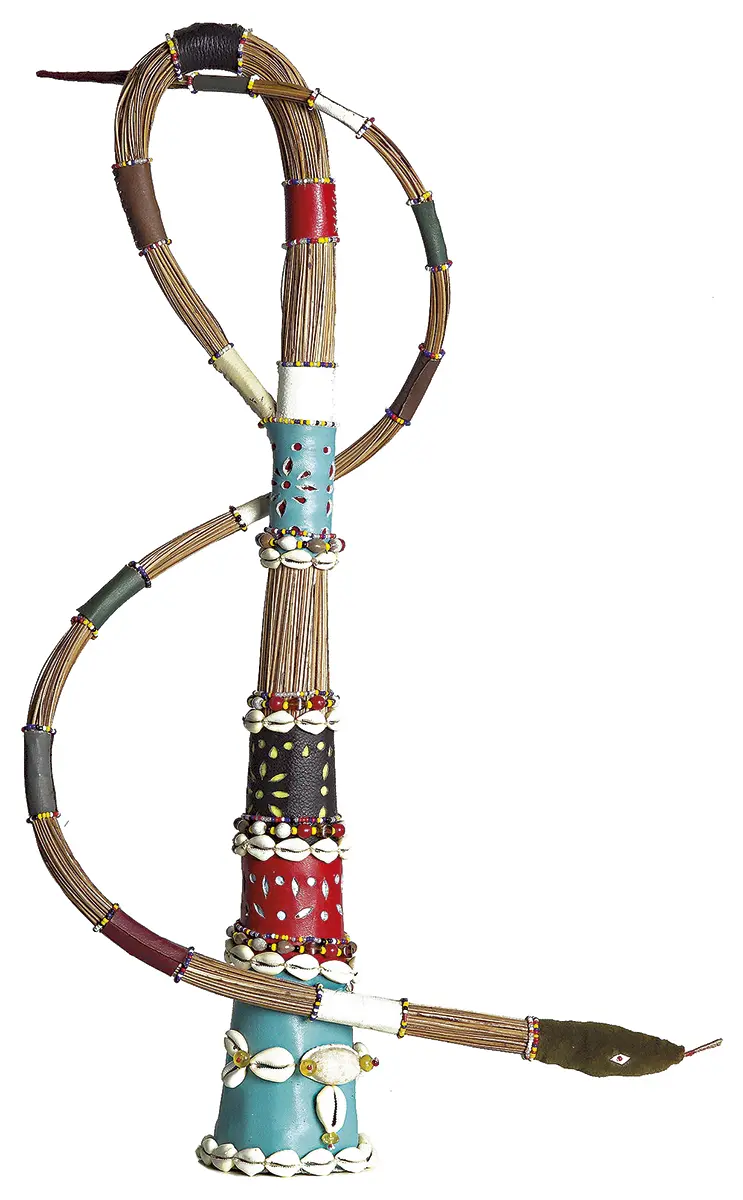
The work of Mestre Didi (Deoscoredes Maximiliano Dos Santos), a Brazilian artist/priest within the Yoruba cult Nago, is overtly religious both in its origin and in its function, even if it is also an ultimately cultural project. Didi uses traditional materials such as reeds, grasses, and shells, to produce spear-like sculptures evoking sacred principles of life—male and female, wizard and demon. His pieces are probably the clearest example of religion-focused art in this exhibition. Not averse to incorporating religious symbols from native Brazilian tribes, Mestre Didi nevertheless consistently employs African techniques and interpretations as well. The resulting pieces are at once elegant and sacred, wonderful counterparts to Dan Flavin’s cross.
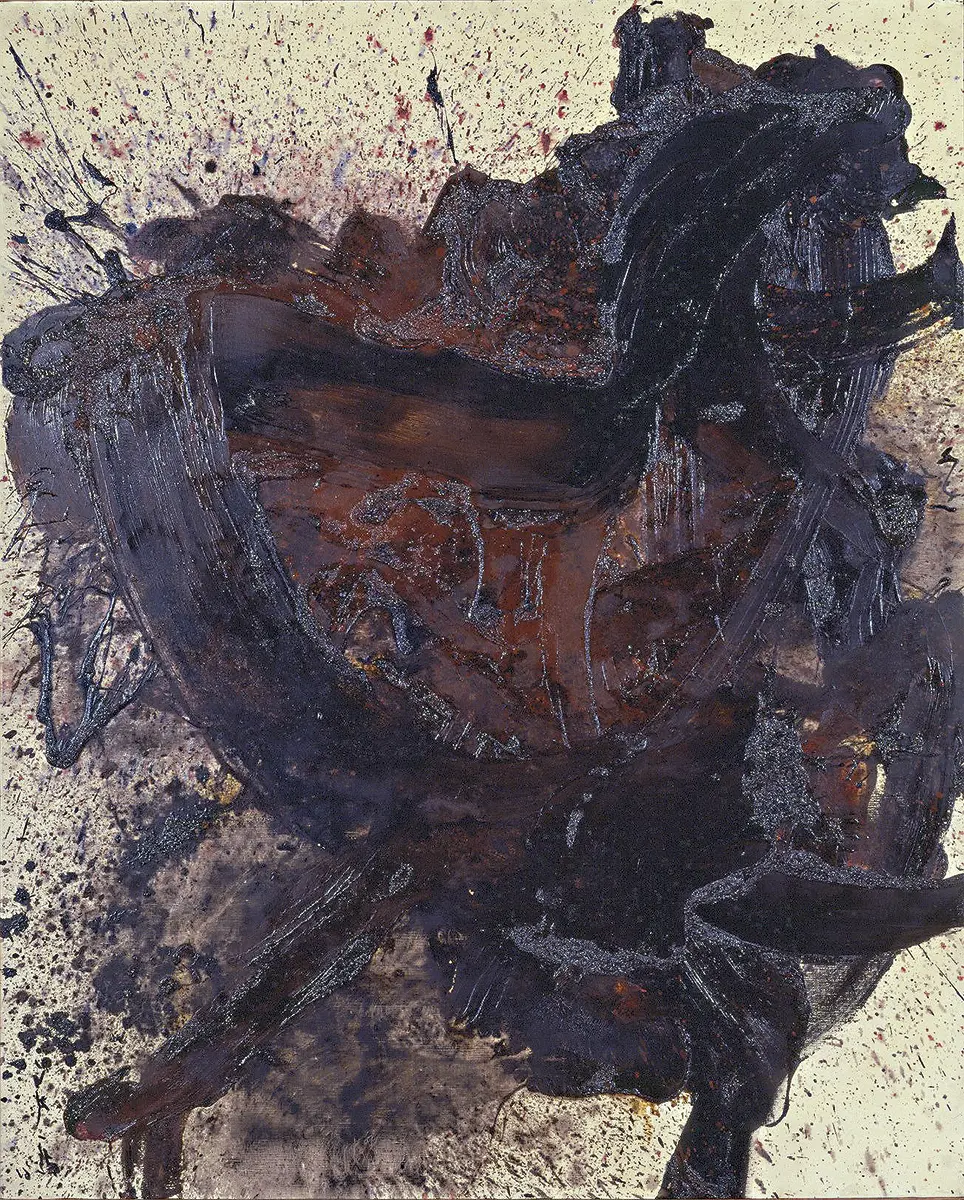
A more awkward example of religious art in this exhibition is that of Kazuo Shiraga, one of the original members of the Gutai group in Japan in the 1950s, who became a Buddhist priest in 1971. The paintings exhibited here, and the discussion about Shiraga’s art in an interview in the catalog, reflect only the work of his earlier Gutai period, and no connection at all is made to his Buddhist beliefs. Thus any direct link between the work and religion is absent.10 Nevertheless, the paintings are wonderful—powerful examples of Gutai’s answer to Informel and of their performative quality. The exhibition includes large photographs showing Shiraga’s performances in the making of the paintings, swinging over the canvas and moving the paint with his feet.
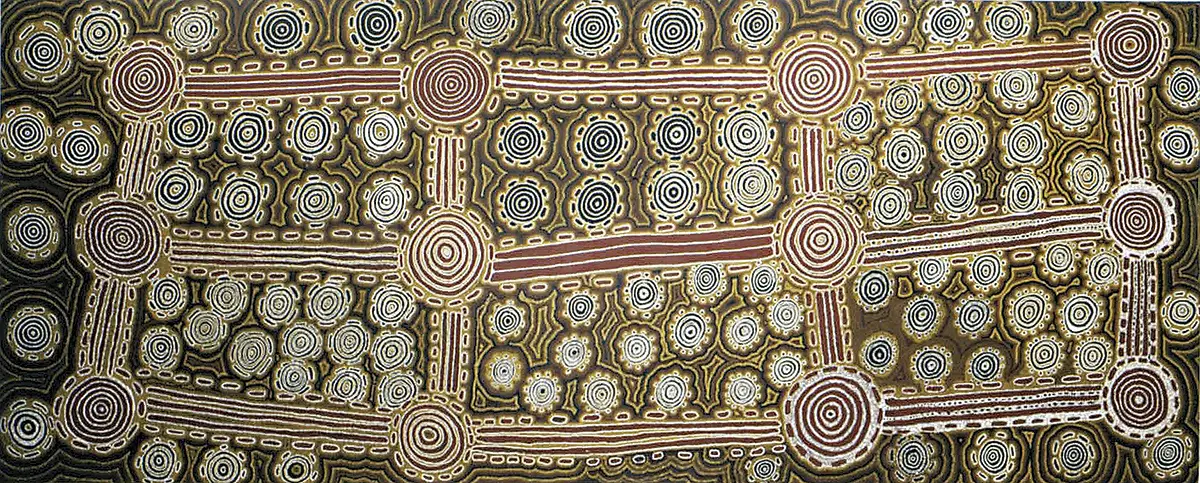
In some ways, the most interesting political piece in the exhibition is that of Warlukurlandu, a collective of artists from Yuendumu in Australia. Flying Art Dreaming, (2000) is a huge painting (2 x 5 meters) seamlessly executed in spite of the large number of participants. It refers to “dream lines,” spiritual connections between the geographical sites of different clans over hundreds of kilometers. Translated into Western cultural terms, both the paintings, which are a form of mapping, and the right to paint them, which is a sacred prerogative, are titles to possession of the land, and have come to be used as legal documents in the struggle of the aborigines to protect and regain property rights against the Australian government.
In his essay, Martin laments the dissociation that exists in contemporary Western art between politics and religion. Politics are presumed to be secular. He correctly points out that in the Third World this separation often doesn’t exist, and that gathering around traditional religious rituals can be used as a tool to oppose colonialism and construct authentic independent political structures. In this context, as Martin argues, it is really inappropriate and simplistic to “dismiss visual expression deriving from religious activity as archaising and obscurantist."11 Martin stresses that Third World artists suffer a double rejection. They may be rejected by the mainstream, either because they incorporate the pre-colonial religion that predated their community’s encounter with modernity through Christianity and agnosticism, or because they seem to have lost “authenticity” by rejecting traditional religion and following modernist secular ideas. As a consequence, in Martin’s eyes, the reclaiming of local religions by oppressed minorities becomes an act of political resistance and the basis for “a veritable cultural renaissance.” He further argues that today “[T]here are as many wars of religion as there ever have been” and that “the ‘liberating’ qualities of Enlightenment philosophy... have proven to be Utopian” and concludes that the recovery and reawakening of religious rites “should be seen in its dialectical relation to modernity, wholly aware of modernity [where] these art forms often attempt to appropriate it.” In this spirit, Martin asserts “the purpose of this exhibition is not to show this resurgence of religion... but rather to show how other cultures weave unexpected links between the three parameters of art, religion, and politics.”
Martin points out that “globalization” is a condition that has evolved out of conditions produced by “the ravages of colonialism” and that it is therefore marked by the “domineering values of European culture.” He warns: “whenever a work is condemned as craft or folkloric, we need first to scrutinize this tendency carefully and question the ethnocentric judgment involved.” He sees the religious community and the community of art-lovers as generally separated by different rites and hopes for an “interrogation of the limits of modernity” through “the acceleration of intercultural relations.”
Extensive quotes are important to a review of this show precisely because Martin’s essay goes beyond commentary regarding the visual and quasi-formalist pleasures of the exhibition and tries to put many important questions up for discussion. On this more ambitious level, one can definitely sympathize with Martin’s intended political project. But one might also criticize him for focusing too narrowly on artists who could be classified by the mainstream as exotic. In the exhibition’s counterpoint between West and non-West, there seems to be an exaggerated polarity. One wonders why, if he accepts the religious art Fontana made during his sojourn in Italy, he didn’t also include the highly mystical work of Mathias Goeritz. Presumably, Goeritz might be too European, not exotic enough to be classed as a genuine Mexican artist. Or he might not be European enough to be placed next to the other “Western” artists featured in the first section of the show. Meanwhile, Fontana, an Argentinian who worked in Italy, is evidently sufficiently European to be included in the Western section of this show, perhaps because Italy has honored him as an Italian artist.
It is in-betweenness, however, this not-being-fully-here-or-there, that best defines the challenge Martin seeks to address: the limitations of modernism. A more satisfying exploration of this issue would take a less schematic view than the one informing this exhibition. Martin seems to cling to the old-fashioned notion of ex-centricity as opposed to centricity, which misses the point that in-betweenness is a subversive contradiction, on the one hand reflecting and reinforcing the very classifications that modernism articulates, and on the other, providing a foundation on which to subvert modernist dogma. Liberation Theology is probably the clearest example of a cultural idea in which politics and religion were merged in pursuit of a progressive social agenda. Though eventually crushed by the religious and political fundamentalisms of the center, Liberation Theology testifies to the potential that exists for syncretic solutions to the problems of our time, harnessing traditional identity to progressive projects. Liberation Theology did not generate much art (unless one wants to consider Ernesto Cardenal’s Solentiname project). Latin American militant conceptualism preceded or was parallel to politicized religion, and thus cannot be seen as its offspring. But outside the circle of Liberation Theology, there exist artistic projects merging religion and politics, which one misses in this show. I am thinking in particular of the anti-clerical works of León Ferrari.
In spite of the fascinating issues raised by Martin’s exhibition, in spite of the many pleasures involved in viewing the works brought together here, in spite of the feeling of freshness much of the work conveys, this is an exhibit that leaves out too much to be fully satisfying and forces some connections that are not persuasive. The show is built on a premise that there are fundamentalisms in conflict. Implicitly it leads to taking sides—sympathizing wholly with the one that appears to be closer to one’s interests, hating and rejecting wholly the other. But this is confining. What about preserving the right to be against any fundamentalism? If we don’t protect the right to resist fundamentalism entirely, we will never escape from the condition of endlessly recycling different power holders within an unchanging structure of power. It is the structure of power that needs attention. Martin’s position, no matter his good intentions, fails to make this clear.
Edited by Selby Hickey.
NOTES
1. I was not able to see Magiciens and my comments are based on the catalog and on reviews that appeared at the time of the exhibition.
2. “The Whole Earth Show, an interview with Jean-Hubert Martin by Benjamin Buchloh,” Artforum (May 1989).
3. Bedia, Bouabre Bruly, Mestre Didi, and Tokoudagba had been included in Magiciens.
4. Jean-Hubert Martin, Introduction, Art That Heals (New York: Apexart, 2002).
5. Johanne Lamoureux, “From form to platform: the politics of representation and the representation of politics,” Art Journal (Spring 2005).
6. Fontana produced many religious pieces; one was for the competition for the fifth door of the Duomo of Milan (1951), in which he tied with Luciano Minguzzi. Minguzzi’s project was finally chosen because Fontana refused to negotiate conditions.
7. Diego Sileo, “Dan Flavin,” Art Religion Politics (Milan: 5 Continents Editions S.R.L., 2005), p.34.
8. It should be said here that in his introductory essay, Martin warns against the temptation to class certain Third World artists as “outsiders” since they are integrated into their local communities and art markets.
9. Frédéric Bruly Bouabré, On ne compte pas les étoiles, (p. 52), cited by Denis Escudier, “Chercheurs découvrez aussi ‘l’homme’ ce roseau pensant,” in Bouabré, La légende de Domin et Zézê (Paris: Hazan,1994), p.181.
10. Art Religion Politics, pp. 88–92.
11. This and subsequent quotes are from Jean-Hubert Martin’s introductory essay to the catalog Art Religion Politics, pp.15–21.
LUIS CAMNITZER
Uruguayan artist, emeritus professor at the SUNY College, Old Westbury.