
In the old horse stables of the Ballajá military fort, to one side of Plaza Quinto Centenario in Old San Juan, an army of skeletons camps out, posed as ballerinas, local and international political personalities, supermodels, and soldiers. One of them, wearing a helmet and holding a cell phone, exclaims, “Mama, papa, I’m OK… we won di War!” Secretary of State Condoleeza Rice appears as the “Devil’s Emissary” whose hairdo, despite her cadaverous condition, is untouched. A skeleton dressed as Miss Puerto Rico U.S.A. condenses in one gesture the military-parade step and a fashion model’s typical stride on a catwalk. Another group of skeletons, finely dressed, surrounds a coffin draped with the U.S. flag in Para los pendejos.
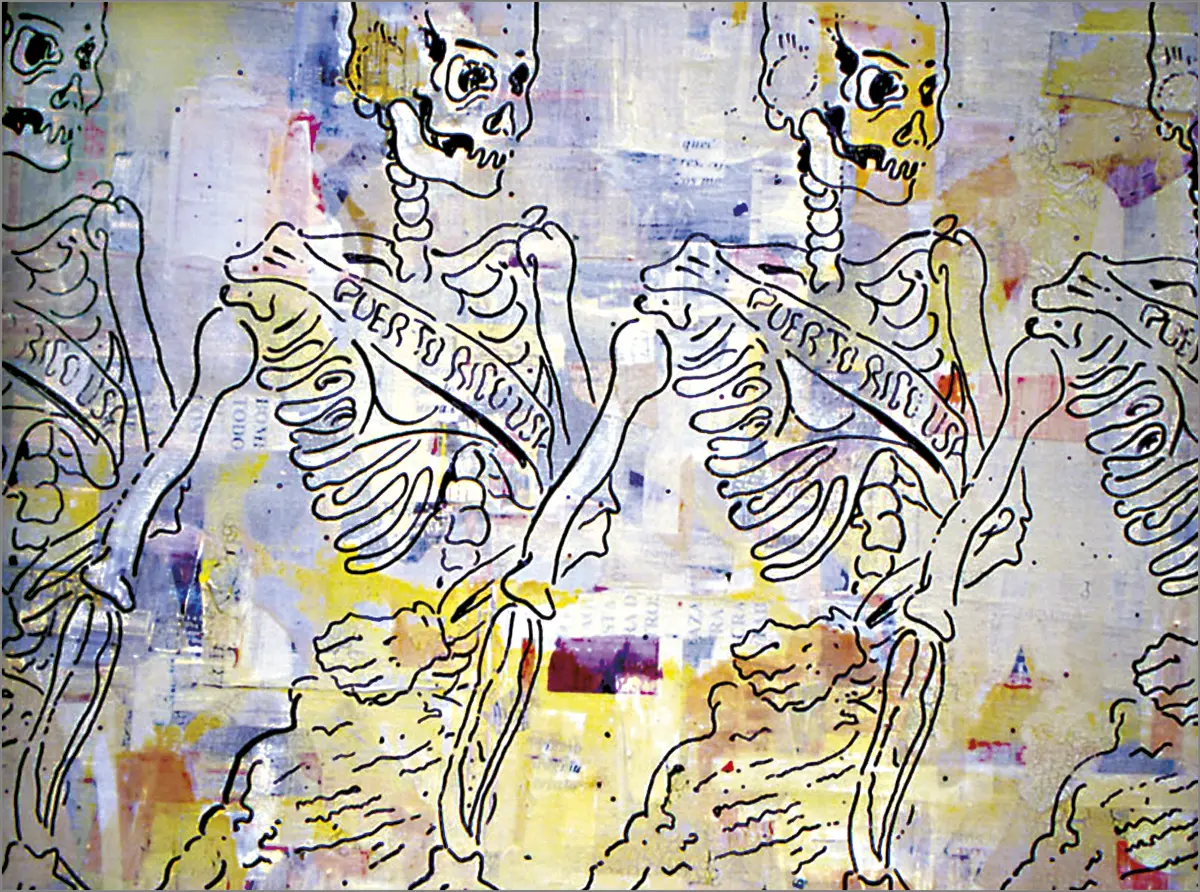
These are drawings by Carlos Fajardo, created with a Flair felt-tip pen on transparent paper that is superimposed on previously-printed sheets. Later these are photocopied on a Xerox machine and framed in black wood, like funeral notices. The artist does not hide the effects of this process. On the contrary, often his images seem cut in successive copies —the one he sent the curator, the one he decided to give a friend— or burned and oversaturated by the photocopier’s black toner. Either festive or decorative, Fajardo’s drawings are copies of copies, the reflection of a society that multiplies its poor origins.
Several of these graphic motifs occupy a central place in the roughly forty paintings that compose the show Obras disloplasmáticas. Fajardo projects the images on the canvas, taking advantage of the transparency of the initial drawing, and then he makes combinations. For example, a long-haired ballerina is in the arms of a soldier and then inside a vase that has been left atop a pile of car tires in Florero de goma. Miss Puerto Rico U.S.A. or a pair of dancing soldiers is repeated on the canvas. The tire dumpster moves from an idyllic landscape in the country to a beach. This mobility—or promiscuity—of motifs is consistent with Fajardo’s work; he camouflages the different origins—clippings from advertisements, stickers, newspapers, and magazines—using a collage technique mixed with acrylic, putty, enamel, and flipchart markers.
The artist uses traditional genres such as landscapes, portraits (often a caricature style), vases, and historical and social chronicles. However, he presents them as self-consciously bad: “decorative painting,” “plastic avocados,” neo-liberal painting,” or a “censured still life.” This brings up the banquet of titles in Fajardo’s exhibition, for which the paratext—those elements that are external to the work but mark its reception—is as important as the work itself.
Fajardo’s titles are like detonators of meaning and can cause “collateral damage” in the viewer. To the aforementioned examples, one can add Paisaje agrandado, displaying a super-sized Ronald McDonald; an illiterate Curtura; or the titles of the exhibitions. Obras disloplasmáticas was preceded by titles in a similar vein: Bodegones conservadores, Bodegones totalitarios, 30 dibujos honestos, and 30 pinturas malas.
One could, perhaps naively, relate Fajardo’s work to the necro-fantastic cinema of Tim Burton, but while Burton refines an aesthetic reward in his macabre representations, Fajardo uses them as a plain sampler of the obscenity that is the United States’ domination of Puerto Rico and, ultimately, of the world. Fajardo has said: “In reality everything is pantomime and glitz, awards and monkey dances, hypocrisy, cliques, snobbery... Living to copy. Living to lie. Living to screw people over. Living to exist. Living to shit.” The Iraq war—in which dozens of Puerto Ricans have died—is the climax of this obscenity.
A number of outstanding figures have emerged in the critical tradition of Puerto Rico’s visual arts since it came to prominence in the 1940s and through its consolidation around 1970. After the death of Filiberto Ojeda Ríos, the legendary leader of the “Macheteros,” the Boricua Popular Army, during an F.B.I. raid in September 23, 2005, many artists have abandoned the routine of their workshops—where they could just as well have produced easel paintings and conceptual works—and have returned to the critical field. In this landscape, Carlos Fajardo appears as a mature practitioner. His work brings together protest gestures in traditional media that younger generations often dismiss out of hand. As Héctor J. Huyké points out in the catalog: “Colors sometimes jive with forms, and sometimes they don’t. In this world of contradictions, the painter is not after precision. He doesn’t want to do things “as God prescribes.” There are no prescribing gods here.
ELVIS FUENTES