
Santiago Cárdenas’s wire hangers and electric plugs, Álvaro Barrios’s postcard- and comic-book-like drawings, and Beatriz González’s furniture, taught Colombian artists that everyday objects can also be elements of art. For today’s artists, this is a given, and Carolina Rojas’s show at cu4rto nivel gallery meshes with contemporary art’s vocation to point out the importance of the quotidian. In the show, titled Order Vs. Disorder, the gallery walls were taken over by a series of impeccable large-scale drawings in black and white that, with their delicate handling of tone, reveal their origin in photography. The drawings’ motifs are the utensils of a modern, functional kitchen. In some of the images, we see plates piled up with millimetric precision, located next to other household items such as a blender, a coffee maker, spoons, and bowls. In others, the perfect distribution is altered by a kind of disorder, with objects strewn about large tables in an arbitrary fashion.
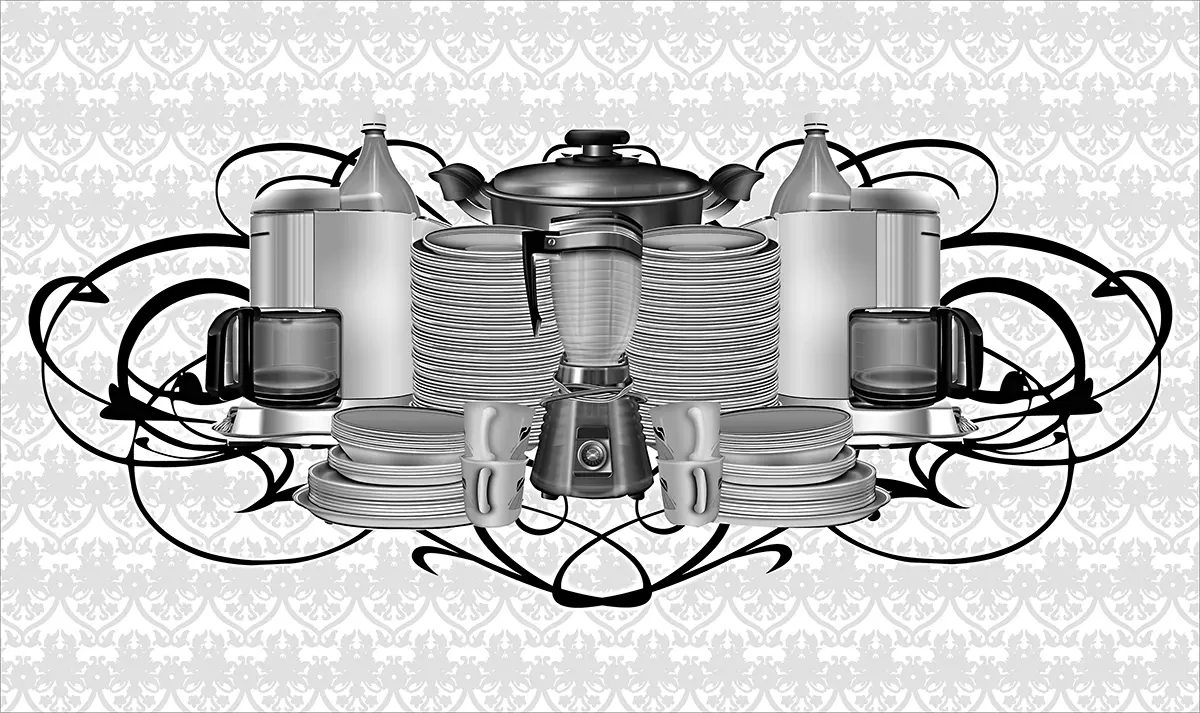
These drawings were started from digital photographs taken by the artist and manipulated in a computer. The first operation, according to Natalia Gutiérrez, the show’s curator, was cutting and pasting, placing the rooms’ four walls next to one another to build panoramic views in which accidents start to appear. In these new spatial constructions, some objects, especially those that were in the corners, are fragmented and combined. Afterward, Rojas drew and painted, and, using her software tools “as though drawing with a marker,” she altered light and shadow, widened the range of grays, erased the borders between objects, exaggerated, amplified, explored possibilities (whether the percolator on top of the oven could be a new machine, for example), and shifted points of view.
A place as domestic as a kitchen implies the presence of family life and the figure of a mother, and for this reason, the show reminded me of Michael Cunningham’s novel, Flesh and Bones. In that book, the writer explores the intimate spaces of four characters that form a classic family. One chapter takes us into the world of Mary, a typical homemaker. In this chapter, the kitchen, spotless and well organized, becomes a place for the projection of the protagonist’s desires, frustrations, and obsessions, as well as the space in which she is able to impose her own order. One night, as she prepares a Christmas dinner, she enjoys her domestic dominion; she basks in the perfection achieved in every one of her plans and suddenly falls victim to great pain. Mary breaks down and starts crying over the fact that when her children arrive for dinner the whole order—the harmonious balance she has created between the various dishes that comprise her meal, the arrangement of silverware and plates on the table—will be destroyed. Her world is shattered by the threat of a sudden disorder, the chaos that will occur when others enter her space.
The disorder that disturbs Mary’s world is Carolina Rojas’s topic. What we often understand as a form of order, according to Gregory Bateson in a text circulated by the artist during the show, is a privileged form arranged by a subject in order to organize objects in the world.1 It is a unique form that faces as its adversary many forms of the mess and admixture of life’s constant flow. With her drawings, using a computer, Carolina Rojas organizes and disorganizes the world, creating a series of images that, thanks to their size and their extremely photo-like appearance, evoke the language of Pop art and bring to mind the Colombian artists who helped us acknowledge the value of the quotidian.
NOTE
1. Gregory Bateson, “¿Por qué se desordenan las cosas? [Why do things get in a muddle?]” In Pasos hacia una ecología de la mente [Steps to an Ecology of Mind]. Argentina: Loholé-Lumen, 1998.
MARTA RODRÍGUEZ