
If the last few decades have expanded art practices in every direction, they’ve also opened fresh and often contradictory channels for conservative critics. Artists who produce eccentrically personal works are characterized as indulgent narcissists. The makers of highly aestheticized objects are called elitists. And those who work in socially engaged, non-material forms are scolded for making political statements, not art. Chemi Rosado Seijo’s practice could easily fall into the last category and acquire an extra strike against it for aiding and abetting so-called delinquents, namely skateboarders.
The San Juan-based Seijo has consistently focused on this social group that in many ways embodies the renegade spirit now largely absent from the global art world. Skateboarders, like artists of earlier generations, are often viewed as a public menace and are left out of civic dialogues, and yet they are the practitioners of a dangerous, defiant, and beautiful art form. To be fair, these misunderstood “artists” guard their outsider status in order to protect the independent spirit of their practice.
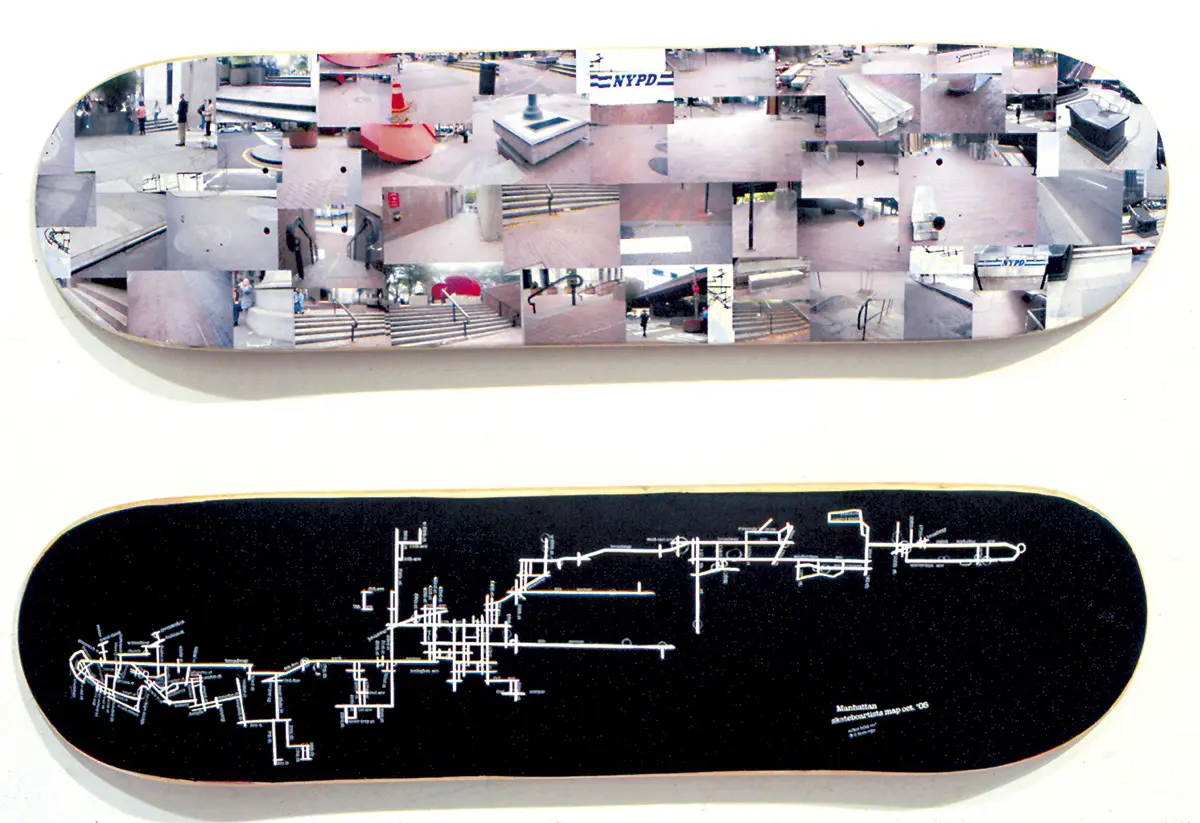
Seijo’s Historia Sobre Ruedas (History On Wheels)—produced during his fall 2005 residency at Art in General—explores many aspects of this dynamic as it plays out in the urban landscape of New York City. With the larger goal of creating a skateboarding map of the city, Seijo gathered an astonishingly lucid, ground-level document of the city’s built topography, while interacting with and networking the city’s myriad communities of thrashers, or skateboarding enthusiasts. Seijo took hundreds of photographs of public plazas and less-formal open spaces, carefully noting features that are of particular interest to skateboarders—wide steps, railings, and areas of flat or inclined concrete, which directly shape the choreography of skateboard movements. These photographs were assembled at Art in General into collage-like landscapes or merely stacked in groups for visitors to peruse.
Often, these locales were photographed without skaters, which leaves the viewer to imagine the incredible feats of these urban athletes while focusing on the surfaces they activate. This is the underlying message and beauty of Seijo’s project. As a New Yorker, one can view these collages of architectural details and empty spaces and recall the remarkable grace and palpable risktaking on display throughout the city on any given day in Union Square, Washington Square, Battery Park, Hudson River Park—everywhere that skateboarders enliven the city with their specific, highly evolved performance art.
Of course, this is the reason skateboarders pose both a threat and a liability to property owners and the city. Their presence is real and has an impact on property values and public safety, as well as the social and aesthetic life of the city. Seijo’s project created an unofficial forum for bridging these various concerns. During the run of the residency, skateboarders visited Art in General and hung out in the studio-cum-gallery provided for the artist. Books, skateboarding videos, and beanbag chairs were provided for the public to make this space a comfortable place to gather and learn about skateboarding. Skid marks on the wooden floor attest to the demonstrations and activities that took place here during the residency.
The product of Seijo’s touring, research, documentation, and interaction was the creation of a clearly designed map of the most active skateboarding sites in the city—from Downtown to Midtown, to the Upper West Side and northern Manhattan. Depicted as a network of lines with branches, the skateboarding map lays over a standard city street map, with circles specifying prime destinations for New York City thrashers. This map was grandly recreated with black electrical tape across one long gallery wall and on a smaller scale as a decorative decal for skateboard decks. Discussions are underway with a local skateboard manufacturer to produce the map and custom skateboard design for wider distribution. As Seijo notes, the map is “an homage to the skaters of the city... I want to keep it conceptual, not officialized.”
Seijo is active on the international art scene and was included in the 2005 S Files at El Museo del Barrio, 2004 Bienal de Cuenca, and 2002 Whitney Biennial. He has already explored relationships between the histories of art and skateboarding in previous exhibitions. Seijo’s map points out that some of New York’s most active skateboarding sites are the plazas and steps surrounding art museums, a telling coincidence not lost on the artist or his audience.
JOHN EWING