
Inaugurated October 20, 2005 and running through May in the terrace of the Museo de Arte Latinoamericano de Buenos Aires (MALBA,) Ezeiza Paintant is a giant site-specific work by Argentinean artist Fabián Marcaccio (Rosario, 1963,) curated by Inés Katzenstein. It is a highly complex pictorial, objectual, and post-photographic weaving that includes a variety of unexpected manual and textural inscriptions, with a strong basis in painting and the use of digital images, silicones, oils, polymers, acrylics, pigmented inks on vinyl fabric, mounted on a large metal and wood structure. It is important to point out that, for Marcaccio, taking a digital photograph is the same as mixing magmatic, fluid matter, with brushes or spatulas, because his interest centers on creating a “composite” of analog and digital painting. This range of opus has the continuity of a single narrative text, and follows the modality of a “paralyzed film,” but with such a sensorially, semantically, and a syntactically dense plot that it resembles the strategy of palimpsest. “In this way, instead of privileging a linear specialty,” says the artist, “the work stretches and expands to produce situations of unbalance because you never know where its center is to be found.”
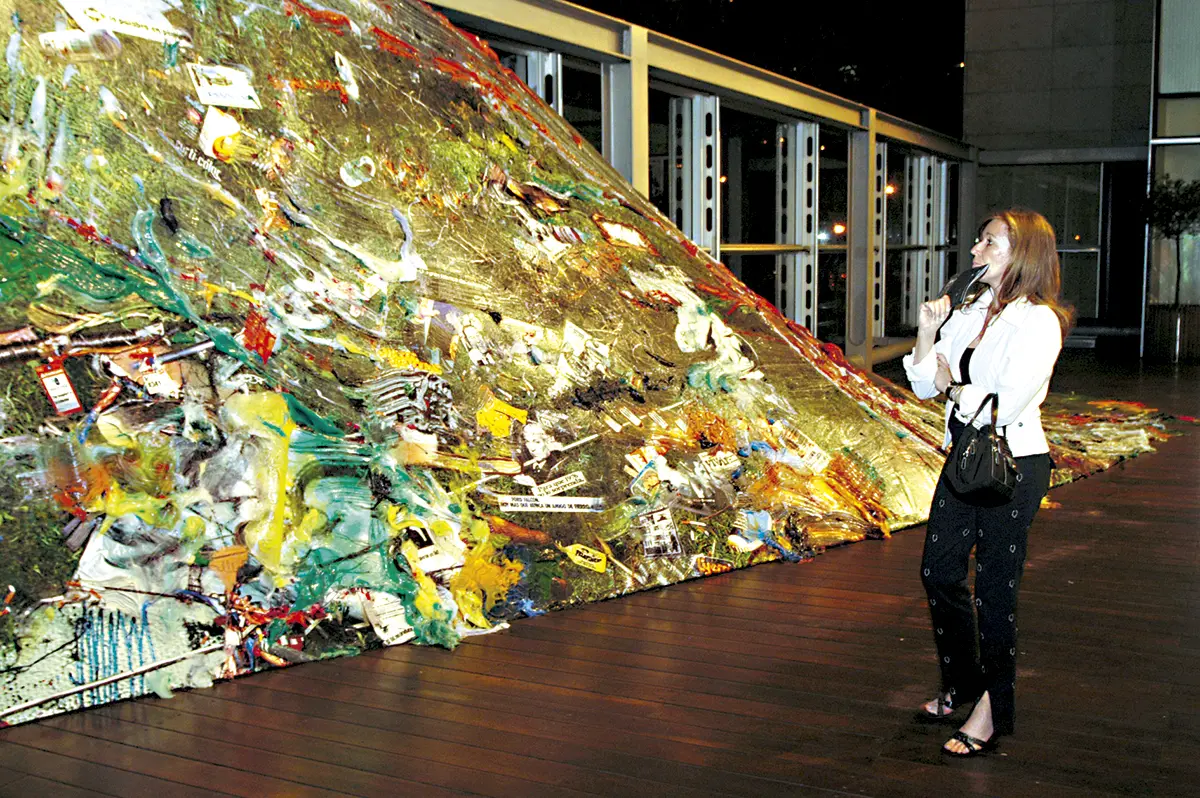
Regarding the aesthetic of the production of the Ezeiza Paintant, Marcaccio says that he wants to generate “an emotional connection between painting and history.” For that reason, between 1995 and 1996 the artist coined the neologism “paintant” to name a potentially infinite pictorial zone that establishes itself per se. In the “de-situations” and “de-localizations” promoted by these works we note a dual-meaning affective inscription: author/viewer, beyond its sensorial, signic, and cognitive aspects, alongside a spot-on appropriation of the concept of expanded field in order to deterritorialize the discourse of orthodox painting with works that are full of protrusions, excrescences, salients, of an unquestionable materiality in their support. Here the plane acts as a kind of “total screen,” taking into account the fact that Marcaccio begins by designing in his PC, and his images are printed on various qualities of surfaces a posteriori. Gradually, since the mid-1990s, his works have grown larger and larger, and the idea was installed in them of generating some kind of agreement or spatial efficiency with architecture. And instead of fixing his paintings or attaching them to walls, following the centuries-old tradition of the mural, Marcaccio executed a “Copernican turn,” maintaining a paradoxical and antagonistic posture: the pictorial text is capable of creating its own space, intermittent between the second and third dimensions. A space that is “other,” a post-organic praising of painting as skin, membrane, epidermis, lax flesh, coursing around the intervened topos without ever being predetermined by it.
Starting with Ezeiza Paintant, without losing their primacy as large self-writing of a proliferating gesturality, it is very likely that these new paintants have become intentionally more narrative and iconic, due to the inclusion of the analog register and the mixing of expressive languages.
In the Ezeiza Paintant we see a recuperation of the legacy of two great Rosario artists: Antonio Berni’s neo-realist spirit, and a “dive” into various kinds of spatialism (Lucio Fontana) that coexist without canceling each other, in a totalizing three-dimensionalized spatial painting.
Marcaccio has lived and worked in New York since 1986. In 2000-2001 he exhibited his Paintant Stories at the Stuttgart Kunstverein and at the Cologne Kunstverein, in Germany. In 2001 he participated in the Istanbul Biennial. In 2002 he was invited to exhibit his Multiple Site Paintant at Documenta XI, in Kassel, Germany; this work seemed to “caress” the Documenta by means of a topological situation as singular as the inside/outside. There, Marcaccio chose, as in Malba, a specific site, located simultaneously between the institutionalized space of art and the public space. It was a wide zone of imprecise borders and transitions that intentionally marked a change in progress, a mutation. Later, he presented a similar work for Summer Projects 2002, at PS1 Contemporary Art Center in New York City. In 2003, at the Triennial for Art by the Sea – Seascape in Confrontation (Beaufort, Belgium,) he exhibited his Confine Paintant. In 2005, Marcaccio had his first retrospective at the Kuntsmuseum Liechtenstein and traveled to the DA2 (Domus Atrium) in Salamanca, Spain.
Three decades after the fratricidal massacre at Ezeiza (1973) and the killings in Trelew (1972,) the implied meanings of those terrible events in Argentinean history, from the perspective of a diaspora artist, are many. This intervention has an allegorical shade, acting as it does as active memory of the absent bodies and of wounds that are yet to close in contemporary Argentina. The Ezeiza Paintant makes reference to the clashes that took place in the Ezeiza airport when general Juan Domingo Perón returned to Argentina after 18 years of exile in Spain. Shortly after his landing, a bloody armed confrontation arose between the two factions, opposed at the time of the Justicialista party, the Peronista Youth, lead by the Montoneros, who believed that Peron’s ideas were socialist and chanted the slogan “Perón, Evita, the Socialist Fatherland,” and in open opposition from their privileged balconies the CGT union officials, who represented the right wing and held power at the time as Peronismo’s central column. This group chanted: “Cámpora in the government, Perón in power.” The dispute was for access to the balcony, and both groups carried weapons, but the more traditionalist side had the support of the Triple A (Argentinean Anti-communist Alliance,) lead by José López Rega. The conflict became a riot and left more than one hundred dead. The Trelew massacre (1972) came about when a group of guerrilla fighter arrested by the military, from the Montoneros and the ERP (People’s Revolutionary Army,) decided to capture the military base of that name. Many of their leaders were able to flee by plane, to Cuba and Chile, but the rest was murdered in cold blood in prison.
CLAUDIA LAUDANNO