
The heliograph exhibition at hand is, undoubtedly, the medium for a discourse of deep social concern that is nevertheless not devoid of the aesthetic experience provided by this original artist. This is not just another photography show. This is not one of those shows that just push the limits of printing and technique. Neither is this a show where photography is an auxiliary means for the presented spectrum. From national history —which in Argentina evokes tragically sharp and throbbing memories— to the immediate history of auteur photography, Graciela Sacco has created a path that had never before been trodden. We can say that her works are objects, photographs, installations, interventions. What we cannot say is that they will go unnoticed. They have a life of their own. They are alert to human existence.
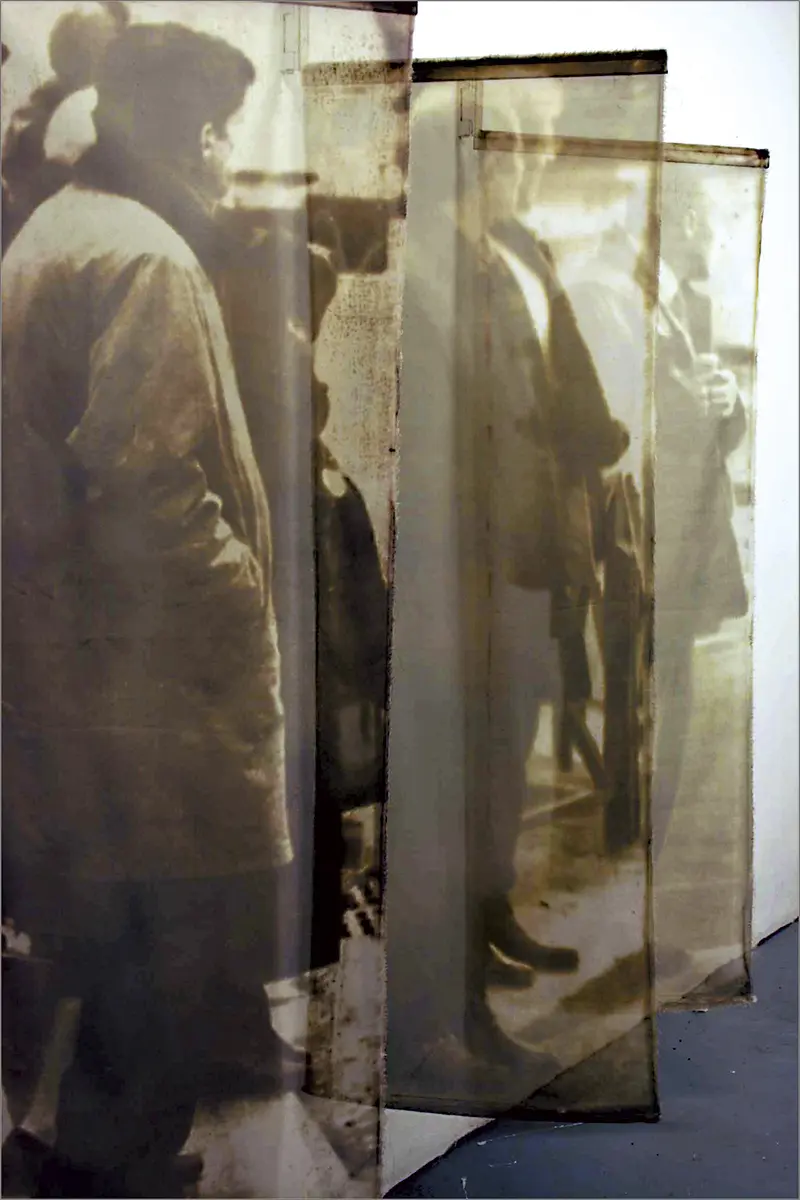
The title is Sombras del sur y del norte. As a title, this may seem innocuous. But only a negative exercised with a deep desire not to see can obviate the borderline situations referred by the artist. These are shadows of the regrettable things that occur both in the South and in the North. Can there be a doubt that a pair of shoes are charged with history? The artist “illuminates” this situation, bringing to the fore what would otherwise we would have to assume, guess, attempt to understand. Curtains, shoes, wood, plexiglass, non-traditional supports are silent witnesses of the world in which the things that rile us up and the artist points out to take place. In her participation in biennials, Graciela Sacco has dealt with open spaces, let’s say… in the exterior or outside of a focalized space, where the work is not subjected to determining parameters controlled by a single architectural frame, by one or two galleries. The de-materialization of the work of art —like the lack of respect for human life— leaves its traces. It is not a square or a rectangle imprisoned inside a frame. In that sense, Sacco’s work pays attention to lived experience.
From a technical perspective, the mediums of heliography and photo-serigraphy are currently used with a certain frequency. But the conceptual channels navigated by Graciela Sacco differ from the general use. If we think of photographic emulsion on supports other than paper, we have to hark back to the origins of photography itself, and beyond that reference, we are confronted with those who printed on marble and wood in the 70s and 80s: Siegmann. They created their works with different concepts and different aesthetic results. In terms of the use of photo-serigraphy, we know that Edith Adi presented notable proposals printing on volume. Unlike all of them, Sacco has developed de-materialization. This is the area the artist masterfully proposes, as was evident in her show. The dimly=lit gallery, the installation of the 2004-2005 series Sombras del Sur y del Norte:… de la espera, placed at the back right across from the entrance door, with seven photo-serigraphically printed plexiglass fragments invisibly suspended, ready to move with the slightest breeze or as people walked by.
From a distance, one had to guess it; close-up it was a luxury that highlighted evanescent situations... The less we see, the more we want to apprehend the image; the less is said —but what is said is what needs to be said—, the more we want to know.
Nine works, among which Sombras del Sur y del Norte: línea de gente, 2004, 150 x 50 cm, is another heliograph printed on “non-paper.” Formed by three pieces of transparent fabric, it explores the topic of people, often present in Sacco’s work, which often moves away from the framework of figurative representation. Sombras del sur y del Norte: vistos, 2004, is an installation on DVD and plexiglass fragments. As we mention it, we must point out that the placement of the installations was well planned, articulating triangles of experiences for the viewer, generating different rhythms as they were interspersed with smaller works. The installations generate a sensation of amplitude, the other works, a concentration of the gaze. Of several works containing shoes, we can summarize the effect of correspondence, of integration, of “visual contagion” developed by the artists by printing them with the grid of the floor's small tessera. In conclusion, it is not only human beings who leave their trace, we know well that the environment marks us. The protest work produced since her beginnings by this artist born Rosario, Santa Fe, Argentina and recently settled in Spain, integrates itself to the urban, it speaks of the movements, the rhythms, and the saturation of cities. These are not socially-charged works that act in an inflammatory fashion. The show reaffirmed her accelerated glances at situations and spaces that are in constant movements, like islands that de-materialize: coasts devastated by political tsunamis. Sacco “writes and unwrites” in light.
GRACIELA KARTOFEL