
While speaking of characteristic elements in current art is an impossible task, certain signs have insistently reappeared in a number of artists. One of these signs, which can be found in Ignacio Iturria’s work, deals with the recovery of communication. In previous decades, one consistently found certain forms of hermetic, and interpretive obscurity was in direct proportion to quality. In principle, Iturria’s art seems close to the everyday world, both in the materials he uses and in the instances he presents. We will see that, far from being facile, these are new commitments to clarity.
It is commonplace to seek an artist’s origins and traditions. This is rather absurd, given the necessarily de-territorialized condition that accompanies all responsible artistic production. But it would not be hasty to draw similarities between Iturria’s communication techniques and those of older Uruguayan artists such as Pedro Figari, contemporaries like Clever Lara, and younger ones like Pablo Damiani and even Federico Arnaud. Apart from the differences in forms, themes, content, and even intentions, there is a common element of irony, but not sarcasm—which includes, of course, naiveté—devoid of any geographic anchoring. In all of them, we intuit an allegorical relationship to belonging or to the search for it.
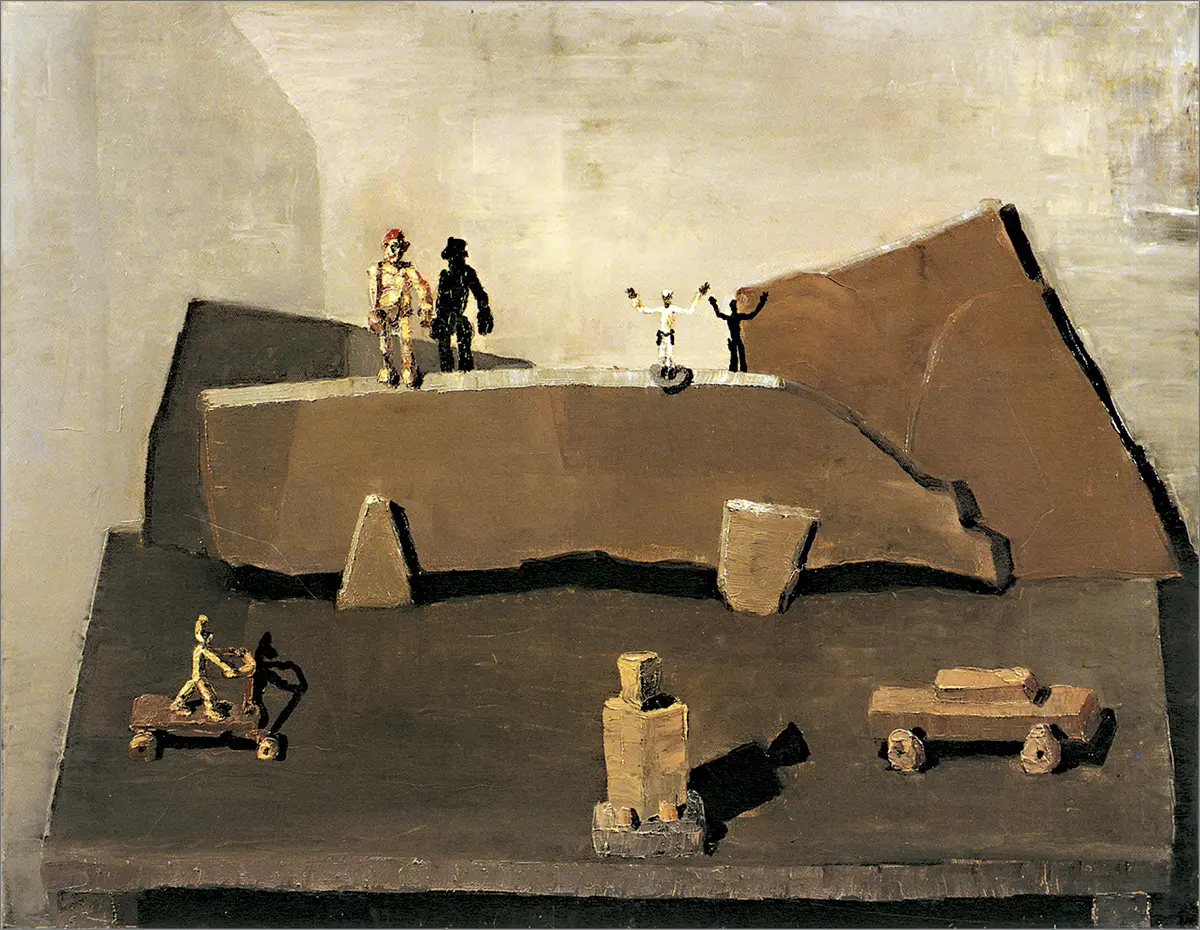
In Iturria’s work, stones are extracted from the deepest quarries and are integrated into the landscape to create a semantic field that alludes to a recognizable world. Spaces are barren and austere, and memory insists on a country that gives certain remembrances place of pride. Thus, Gardel is present in absentia, by way of the stones of his supposed place of birth. His Lunfardo expressions (from an Argentinian dialect) sound obsolete and alone, in places of silence interrupted by his unmistakable voice.
There are signs that contain many signs. The Big Table contains a surplus of objects, objects that resemble men. Amidst the hegemony of technology, human beings are even more alone; thus the metaphorical force of Fangio’s car, associated with car racing but of a different time. It is as if haste had already triumphed, as if this “now” of today committed us to a spontaneous frugality, to the petrifying recovery of speed. As if Francis Picabia, in his convertible, were the new classicism.
Marcel Broodthaers’s Table and Cupboard with Egg-Shells exhibits empty eggshells in an ivory-white cupboard. The work disguises itself, complicit with a traditional aesthetic, in order to denounce the most vulgar aspects of aesthetic de-humanization, the grotesqueries of the bourgeois quotidian, the path of familial-reproductive consciousness as aporia.
In Iturria’s work, the cupboard is a large birdcage for erratic birds. Disfiguration, of figuration inasmuch as of figures, teaches that the clock is wrong, that imaginary invention is excessively fallacious or at best anachronistic. It invites us to rethink that dynamic, circular construct we call reality, morphing it —with its paradox— through something “real,” like stone.
But this is not a return, neither eternal nor transitory, nor is it an apology for the Noble Savage. It is the need to connect to something transcendent in the names that designate things. In "Crito", Socrates debates with Hermogenes about etymological points, a debate that contemporary linguists, from Saussure to Chomsky, insist on resignifying.
For some, the birth of national consciousness is an episode of 1911, the Battle of Las Piedras. Iturria is less confrontational, but he does not ignore the etymological relevance or at least the “original.” European immigration to Uruguay was such a totalizing phenomenon that the artist cannot help but think of a “before” because there was one. Homer had a Homer; things are always preceded by things.
Georges Bataille, in La somme athéolo-gique, thinks that “inner experiences”— ecstasy, anguish, knowing, not knowing—represent the experience of the limits encountered by one who, having ceased to want to be everything, understands himself as imperfection, incompleteness, and despair. And, in that finitude, one finds greatness and salvation.
Iturria is not averse to imperfect materials, indefinable instances, or any finitude. Neither does he seek refuge in comfortable symbols, in taking on national baggage. He gives shape to metaphysical loneliness that is universal. But his creative vision drives him to underscore certain icons, which become recognizable—not without a degree of arbitrariness—for those who search for something that will take them to something else. Since Francastel, we repeat that sensibility is socialized, that it exists in a perpetual state of dialogue with the social body. Beyond confirming or rebuking this, Iturria achieves a space that refers to us, some aspect of us, of one of our many aspects.
FERNANDO LOSTANAU