
Baroque aesthetics reevaluate and develop the Classical conception of art as mimesis or imitation. Art is indeed representation, but the aim of representation is not merely to present the object transposed onto canvas or to space. It is to impress, to move, to persuade. But to persuade in what manner? Maybe in none at all, since truth and beauty cannot simply be imposed, as can a building, a picture, a film, or a sculpture. In fact, art exudes from the imagination. This is most important since without imagination there is no salvation. Imagination carries us beyond our daily reality, to overcome all limits. Otherwise, anything would seem small, pent-up, and colorless to us, while imagination can take us in the opposite direction. The artist is interested in nature and history only as much as the thought of nature and history allows him to go beyond the limits of what is real and to extend his experience and sense toward what is possible.
Thinking of the sculptor Javier Marín’s search with respect to the body, it is helpful to read Dámaso Alonso’s interpretation of the writings of the poet Góngora. Alonso’s process sets aside the elements of reality and substitutes them with corresponding entities in the physical and spiritual world of the great Baroque writer. This is a practice of détournement, which allows for the creation of enigmas. Marín channels toward salvation the fermentation of raging forces that dwell within his sculptures. He places the enigmatic relationship between unleashed emotiveness and momentary stillness at the center of his own baroque style, which contains Impressionistic traits and is saturated with reminiscences of Mexican Baroque.
Marín is aware that the Renaissance is dominated by an unquestioning admiration for Classical antiquity, making it an almost unattainable ideal. The Baroque, on the other hand, introduces an interest in newness, which leads to modern art. In fact, adjectives such as “capricious” and “extravagant” are adopted for the work of art. However, the most important thing is that the feeling for the present, a necessary condition for any militant culture, is stated. In Marín’s creations, the sculptural masses cannot remain enclosed by hard and precise lines. Our gaze is carried into enigmatic depths, in plays of light and shadow that escape every law, deliberately searching for dissonances. Each body manifests an emphatic action as if an impetuous effort were needed not to abandon itself to a painful and definitive downfall. Marín rejects classicism but cherishes the marks of Hellenism; he rejects the exemplary character of humanism, which values each form according to Greek standards. In that way, he denies the notion of decadence, recognizing the germ and flowering of a new art form, among the signs of agony and corruption of matter/flesh.
The legacy of the seventeenth century, of modernity and mass culture—it is interesting to note Marín’s use of resin, so ductile and similar to the eroticism of wax—are interwoven and take on a deeper significance. Mastery in modeling form and command of technique goes hand in hand with a cult for possession, a cult for ecstatic passion, for the emotion of the subject in the face of mystery, delight, and vertigo in the presence of the body.
Let us remember that possession is radically different from obsession. While obsession is born from a mental and emotional disorder clouding the mind, possession is a condition for mental and psychic health inasmuch as it transforms our relationship to the irrational.
What gives Marín’s thought and work an essentially erotic character is precisely the simultaneous presence and perhaps even indissoluble character of beauty and conflict, of plastic joy and interest in social matters, of openness and technical prowess. Displaying a fecund inventiveness, his hands work to fascinate us, to stimulate and hold our attention, to call upon our receptivity.
The practice of projecting the body into space, deprived of the embellishments of clothing, becomes a necessary and even dangerous problem for the artist. The uneasiness of our civilization constricts the eye, rendered incapable of recomposing the figures that give the body its concrete appearance, through a form that is totalizing. The body gradually becomes the scenario of conflict, enclosed between norm and transgression, order and adventure. The body becomes a morbid symbol linked to the notion of beauty understood as a contributing and erogenous element. It is a sign of every day that inextricably blends the features of modernity and a cultural crisis no longer regards values and quality. For that reason, in constructing his broken, reassembled bodies, stitched-up in an improbable surgery, Marín makes it clear that the body is an infinite repository of signs, in which diverse ways of thinking highlight the most useful signs to communicate a number of messages. Through him, a new metamorphosis of the body is born. Through this metamorphosis, the body is transformed into flesh that must be healed by medicine, into a worker for the economy, into an individual that must be redeemed through religion, into the unconscious that must be liberated by psychology, into a potential source of violence that must be controlled by law. The body becomes for Marín a surface on which it is possible to read all the filigreed imprints that the world’s sorrows and joys have left upon it. The craftsman carves, cuts, and scratches in numbers and reference signs, as if the skin had become a space to take in the structure of a potential body, marked in firm black.
If we observe the three figures Mujer blanca (glazed Oaxacan and Zacatecan clay, 2000), we can see that it is three bodies of a Great Mother presenting the symbolism of the full glass, with emphasis on the central areas of the body: the breasts, the belly, and the hips, which become a unique cluster. The rigidity and solidity of her form give this woman/divinity a hieratic appearance, but her center of gravity pulls her downward, toward the earth, the origin, and the seat of humankind. Following this perspective, nudity is a return to a primordial state; it removes the separation of man from the world surrounding him. Myths are a poetic dramatization of internal or social life and of history. In myths, the gods assume the changing costumes of a plurality of values, of life models, and of psychic instances, capable of leading artists along narratives inhabited by images rooted in great iconographic contamination, in which the mother tongue is very important.
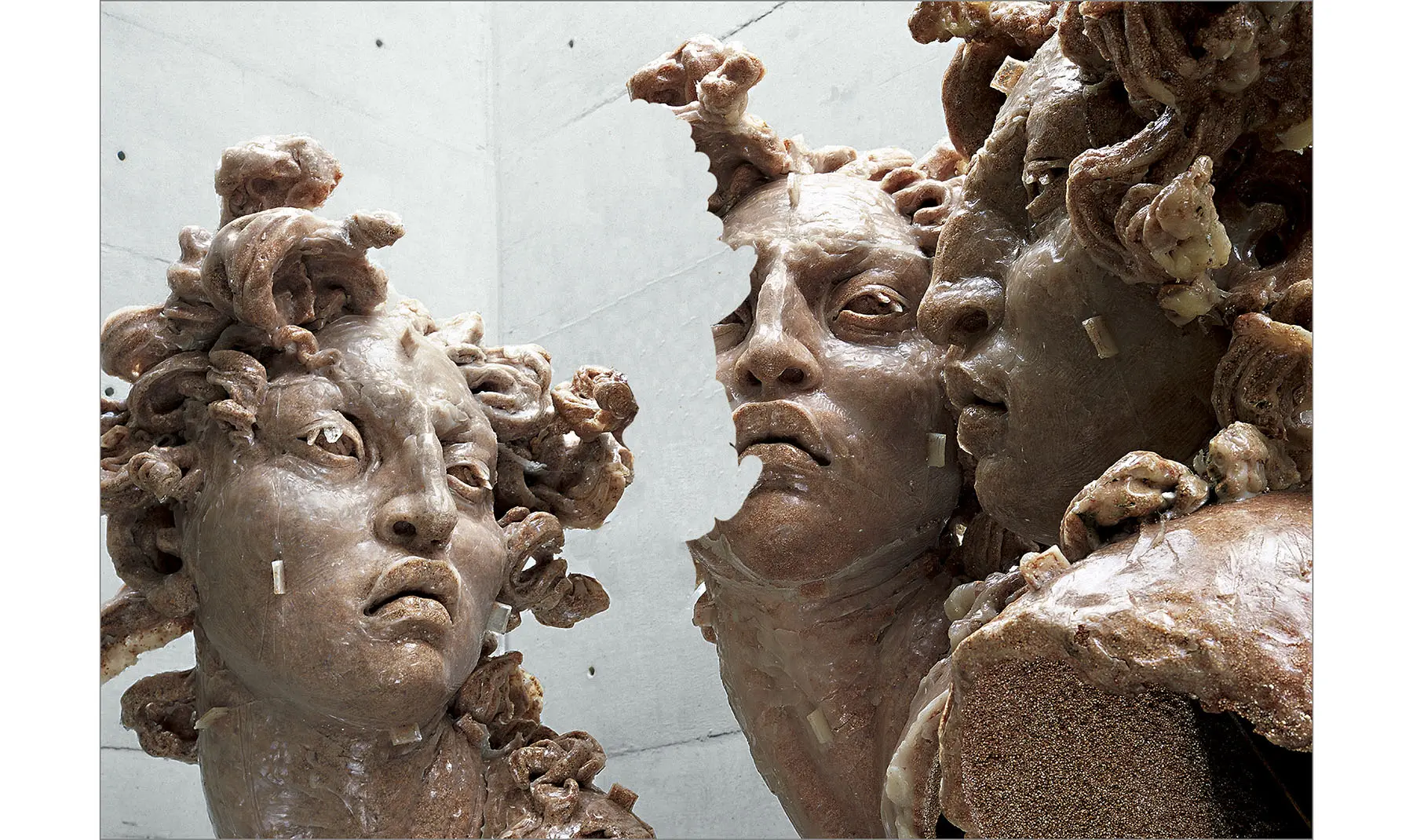
Toward the end of the twentieth century, the body became a screen for psychic or social signs, as well as of an ideal of beauty that is not Apollonian. If the body for Marín is the sacred tabernacle of the soul, it is also the face that concretely presents the soul. Faces are like transparent veils that allow us to see what is within; notice the altered, gnarled faces of his women. The paradox of the desire traveling through the body is made real when we, as subjects, want something beyond this subjectivity. Desire not only tends toward an encounter, but it also wants to lose itself and go astray and confirms what E. Lévinas calls “the exorbitant ultra-materiality” of the other’s flesh. Desire surely tends toward a face but also toward a beyond. The flesh almost always assumes an intermediate stage, between the person’s materiality and spirituality.
However, we can observe that the bodies in Marín’s sculptures—such as Torso de hombre, yo, Torso verde hombre—reveal a double reading of their appearance. Above all, we understand that the skin is presented to us as a complex multi-structured tissue that contributes to the conservation of the body and ensures stimulation and richness of sensibility. Of all the sense organs, the epidermis, what scholar Didier Anzieu calls the “skin-ego,” is the most vital; one can live being blind or deaf, but without the wholeness of our skin it is impossible to survive. Skin reveals to a great measure the state of inner health. To the eyes of others, it reflects the good or poor state of our health; it is a mirror of our soul. If one takes into account its psychophysiology, and not only its anatomy, skin provides clear examples of a paradoxical functioning, to the point that we can ask if psychic alterations more or less find their visible expression precisely through the skin. Though it is true that the skin keeps our internal environment safe from external disturbances, it is also true that the skin in its texture, its lumpiness, its coloration, and its scars preserve the marks of such disturbances.
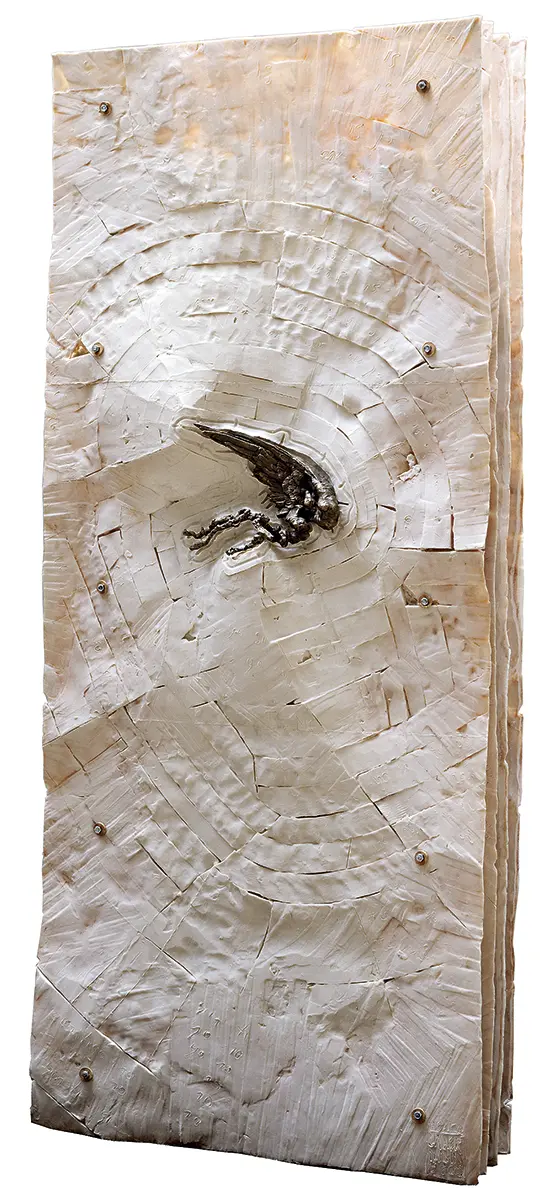
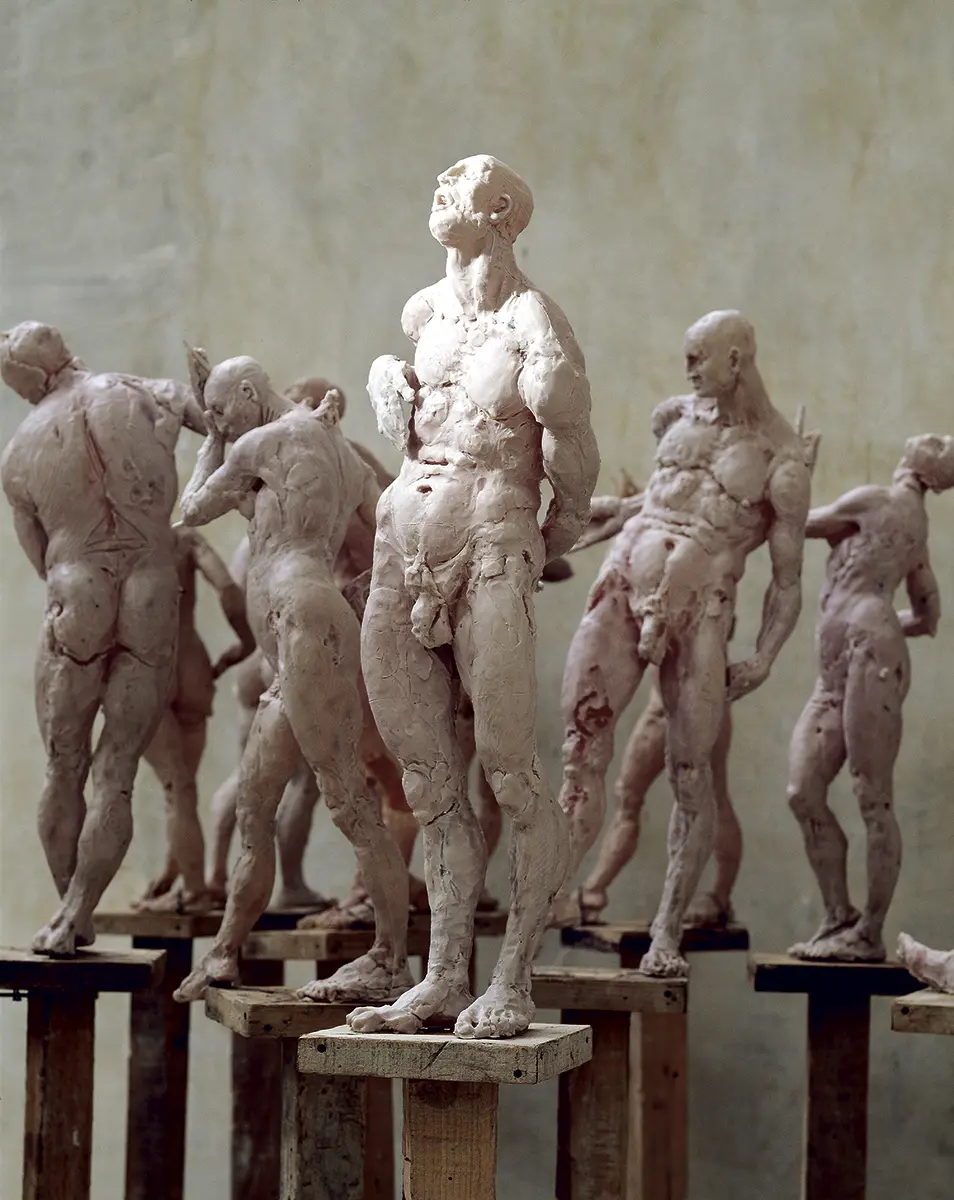
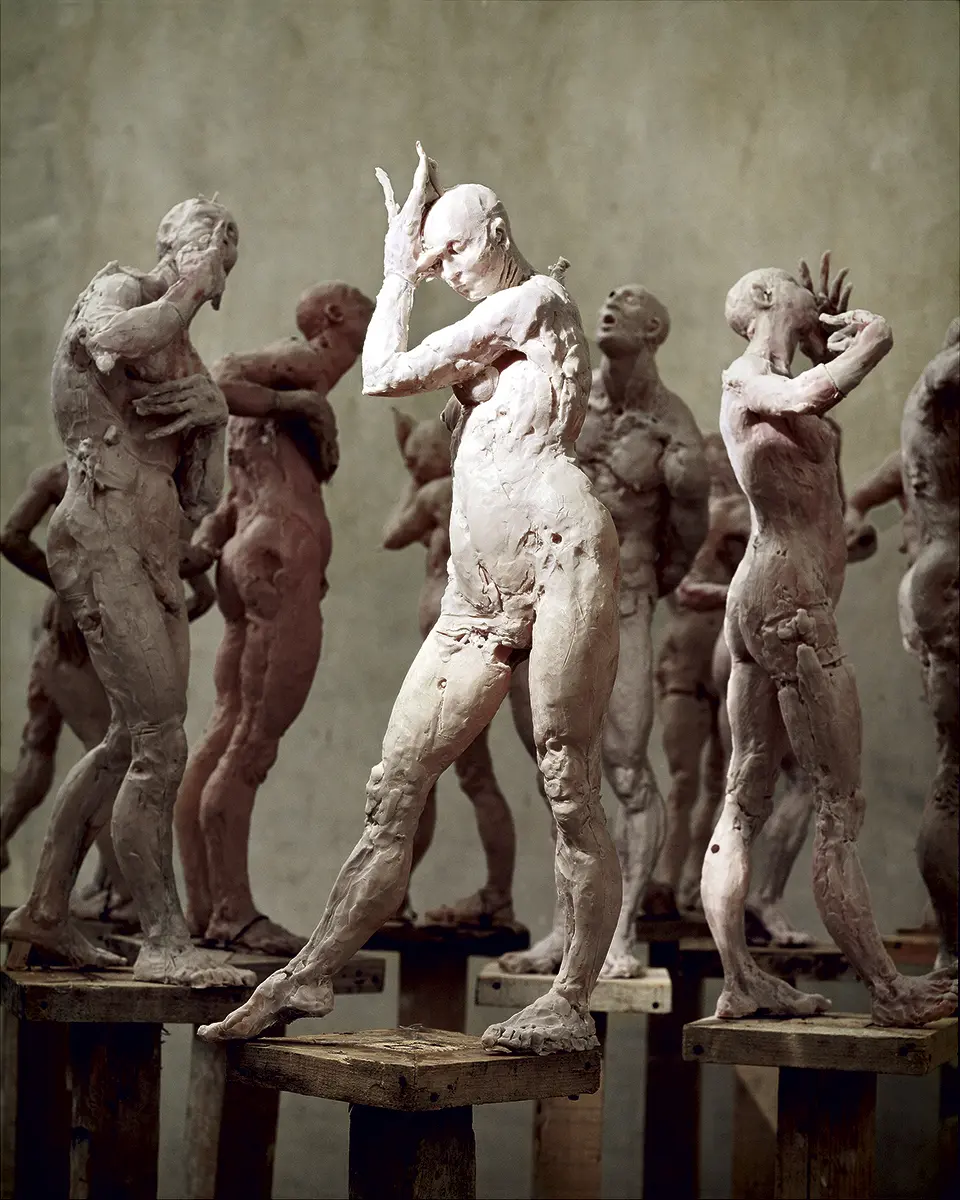
If we examine Marín’s sculptures Hombrecito VI (2000), Mujercita I (2000), and Mujercita III (2000), we can read in their surfaces a rhythm reminiscent of Bernini, a languor recalling Caravaggio, and a series of paradoxes referring to the inside—a permanent dissection of the dermic state, remnants of protuberances that give way to lacerations, signs of psychic pestilence, toxic gas ulcers, the chaos that we carry within, the pain or well-being, veritable assaults of the libido. But above all, we know that all these surfaces serve the brain, and what we see on them is the projection of what man really is. All of this could also contribute to the idea of old age as an enigma—as it is felt by the sculptor—as an unsolvable mystery that nevertheless is our destiny.
Nobody escapes old age, but still, we know nothing about it; it is an unknown, unexplored country. It is the true heart of the darkness of life. Old age is like a living death, like a thirst for oblivion, like the evil of life that pulls one toward itself and devours one. This suffering is what constitutes, in Leopardi’s words, the very essence of the living being. Such a great evil cannot be attributed to anything else but to an equally great cause and so definitely to God. Marín knows that art must always be embarked upon, to reach the extreme of what is possible. An art that confirms in us what we are and what we already know, an art that does not present us with what is different from us in a possible reality betrays its task, its meaning, and its own raison d’être.
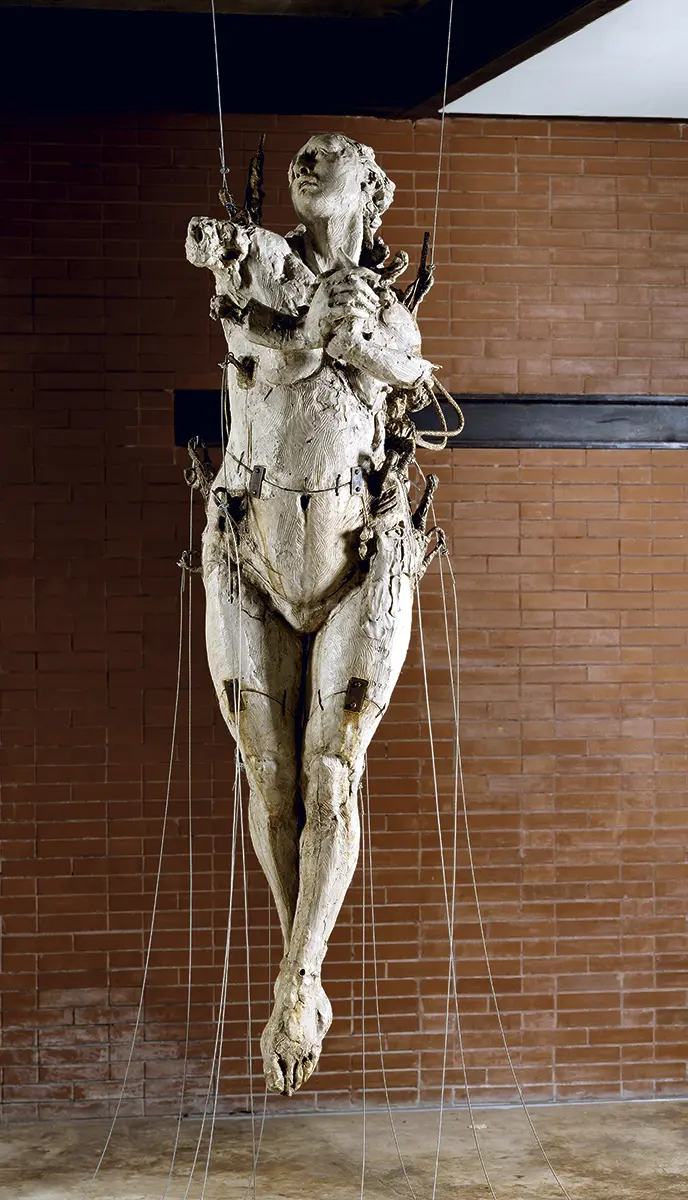
Marín makes a concrete statement of this in his sculpture Mujer suspendida (2000), an athletic, somewhat heavy, the body of a woman. Broken, mutilated, re-sewn with bronze wedges and nails, with a young and ecstatic face; it turns in space, suspended by iron strings buried in her waxen flesh made of resin, like an acrobat exhibiting herself before the eyes of ailing men, for an ailing life, in an ailing sky, for an ailing time. The mutilations of the skin and the body, more than indicating rites of passage, are dramatic efforts to preserve the limits of the body and the Self, to re-establish the feeling of being cohesive beings, and to re-establish the link between perverse masochism and the skin. These new beings of the metropolitan inferno, these “cutters” that at one time communicated their moods and chagrin through dress, language, and music, now declare that publicity has stolen their alphabets. So they challenge consumerist society with extreme attitudes of tension and self-exhibition, which they consider much more bearable than their inner vexation (see Cabeza blanca de mujer I, 2000).
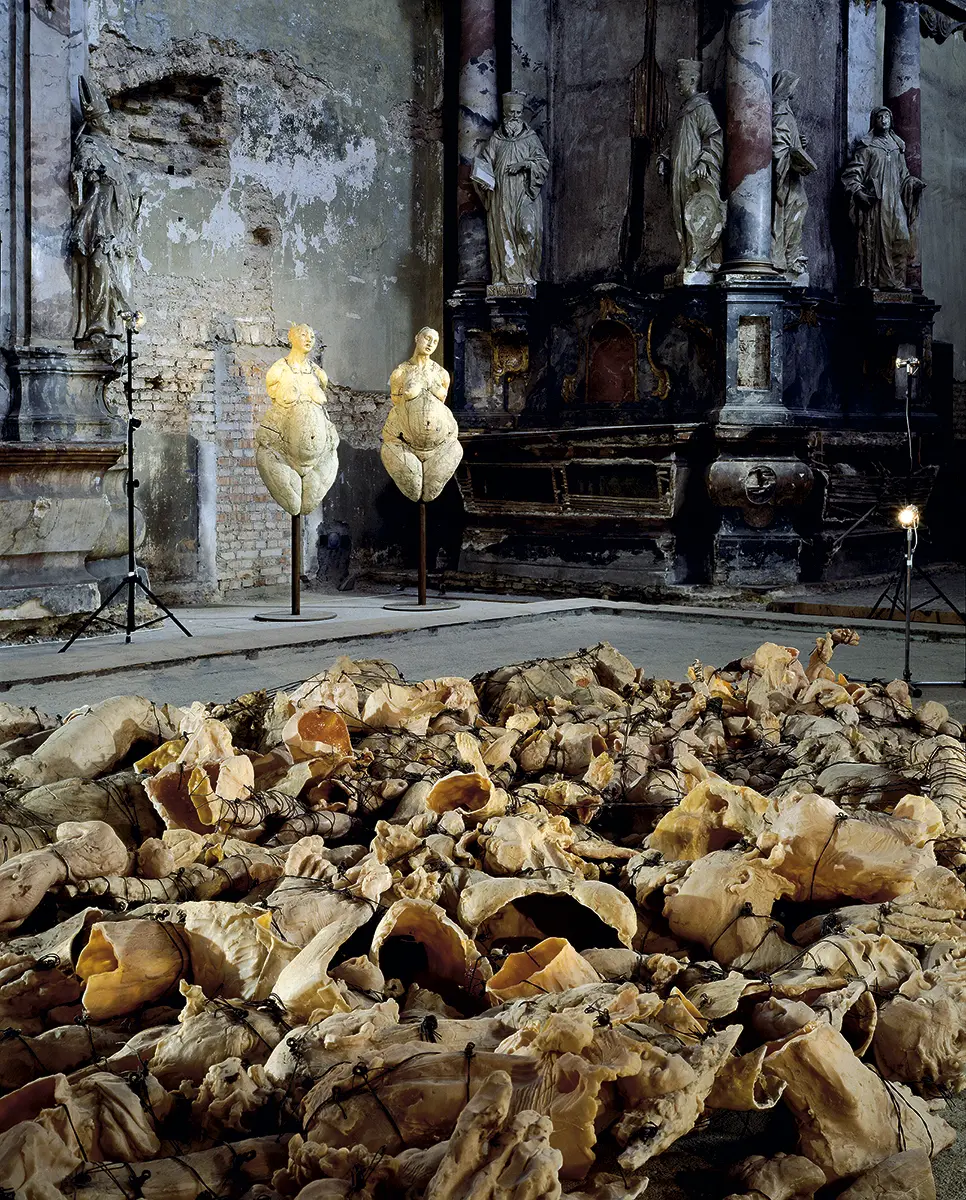
If anyone should mention a “desiccated fetishism,” it is philosopher Roland Barthes who reduced bodies to “fragments” to be able to talk about them. Javier Marín divides the body into a checkerboard—of eyes cast toward the invisible, folded and half-open lips, soft bellies carved by time and by the sculptor’s chisel, buttocks drained of their strength, overly prominent Michelangelesque noses, submissive sexes—to remind us that the search for the individual and his body is frantic. The body is mutated or decomposed, such as those poor, fallen, tormented, disheveled, badly mended breasts, like flesh that has been transformed into hard ashen cement (Puerta-cubos I and Puerta-cubos II, 2000). When Marín gives form to his reality instead of restraining it as an idea, when he brings together the real and the ideal, he stages a contradiction, besides the pathos that moves and motivates his moral conduct and practice. Within this tension, the possible and the impossible in their extremes are equally real. But the reality is not at a consistent level; it is an extreme, a boundary, a threshold, an idea of the within and the without, the here and there.
It is in Marín’s largest work, En blanco (2003), a veritable choral story, where the feelings of pain and desire are bulimic, always unsatisfied. In this extraordinary work, a tempest of legs, arms, and bodies descends from a passage like waste down the sewer. The body pieces are held together with wires, like those used for barbed-wire fences of concentration camps. Among the body pieces, a bust resembling a Greek god emerges. All of this reminds us that pain has never abandoned us and that God has perhaps died, as was said by many intellectuals and writers after Auschwitz, such as Weil, Levi, and Wiesel. Pain petrifies the soul more than it does the body, as in the myth of Niobe. The S.S. of the concentration camps reduced man to a thing, as if they were history’s agents of universal evil, fully embodying pain and pestilence. This work with its roots in the purest Mexican Baroque will never be the metaphor of a reliquary, of a mausoleum of shapeless and nameless remains, for it preserves the remembrance of memory and transforms perversion into love. It is suffering, understood as a purpose in itself, which makes the world fail, leaving us without language, like objects or abandoned remains ashore from which there is no return. But only through the knowledge of suffering, only by knowing it and studying it, will man one day perhaps come to neutralize, at least in part, the murderers of humanity.
To end this text, here is a poem by a Bosnian girl, words that could equally have been written by Afghan, Israeli, Palestinian, or Iraqi children. The wounds of war, in the body and in the soul, are all the same. The cry of pain asking for help is a universal pain:
“I also had a mother
but the grenade blew her to bits
I also had a brother
but the grenade tore off one of his legs.
Who knows if I’ll ever see my father again!
What good is the dream,
what good is the day,
if it does not come to pass?”
MARISA VESCOVO
Ph.D. in Art History, professor on Contemporary Art Phenomenology at the University of Geneve, Italy. Commissar at the Venice Biennial in 1984 and 1986. She currently works as an independent curator.