
Less than one year after Jesús Rafael Soto’s death, the Museum of Latin American Art in Long Beach opened a pedagogically oriented exhibition celebrating this artist’s prolific career, which spanned the second half of the twentieth century. Although it is not a full-scale retrospective, its modest size does a nice job of paying tribute to the breadth of materials and scale employed in his body of work. The show, titled Jesús Rafael Soto: The Universality Of The Immaterial, is organized in two sections; one is dedicated to didactic materials introducing the concepts and historical context of his work, and the other is reserved exclusively for the nineteen artworks included in the show.
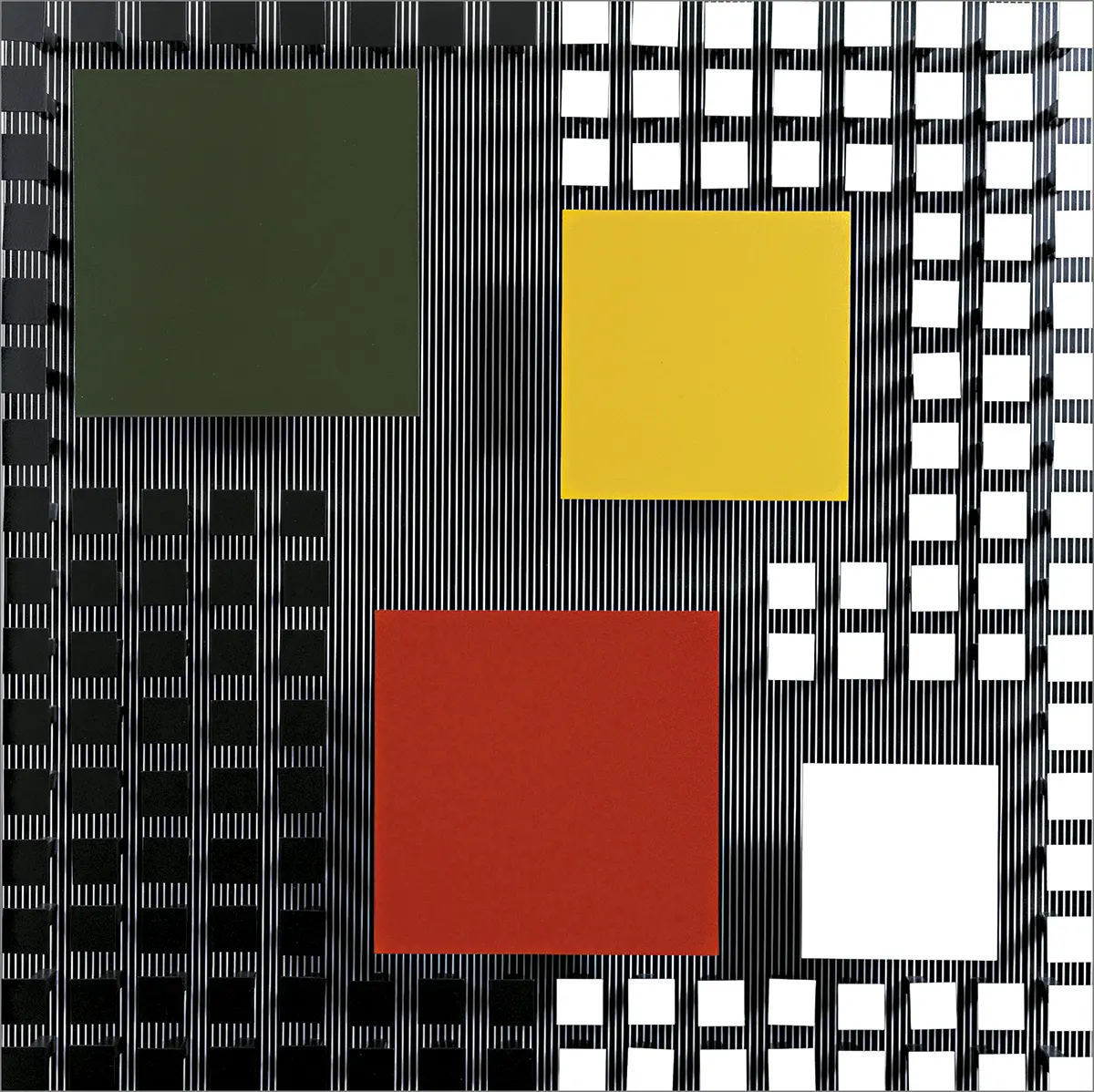
In a refreshing inversion of the customary exhibition format, the first gallery is dedicated to educational materials with the aim of familiarizing viewers with Soto’s working methods and objectives before they are visually confronted with his “original” works in the next section. A handful of interactive panels geared toward younger audiences even appear in the first gallery, rather than the typical relegation to a small room at the end of the show. The gallery opens with a suite of “multiples,” works made in 1979 to emulate some of his early Plexiglas pieces from the 1950s. Anyone familiar with Soto’s oeuvre will immediately recognize the superimposition of repeated dots, stripes, and spirals. (Although anyone new to his work would not know that these compositions reflect his production in the 1950s, not the 1970s.) The gallery features several didactic panels that highlight topics such as “Artistic Development,” “Influences,” “Chronology of Kinetic Art,” and “Soto and Architecture” as well as biographical information and photographs of his large-scale installations. Unfortunately, there is a privileging of a European teleological view of the history of art which tries to situate Soto within that narrative. Although it is clear that he was responding to a European milieu, there is hardly any mention of his Venezuelan context nor of any other Latin American artists making optical and kinetic art. In fact, the panel dedicated to the museum he founded in his hometown, Ciudad Bolivar, Venezuela, first names several of the European and North American artists included in his collection, relegating Carlos Cruz-Diez, the only Latin American mentioned, to the end of the list.
The second gallery is organized chronologically. Beginning with an untitled work of 1959 and, progressing around the room, finishing with a work made in 2003, the installation provides a decent survey of the trajectory of Soto’s career. Although he remained dedicated to a geometric language for over five decades, he alternated between working with purely geometric forms and industrial materials to more expressive gestures and organic media. This range is evident in the works selected. Although some of the works are redundant, the museum’s ability to include early pieces that now reside in private collections is a rare treat for the viewer. With the exception of the two walls flanking the entrance to this gallery, which are printed with quotes by or about Soto, the room has no explanatory texts and instead encourages the viewer to take time and look at the works, rather than read about them. Viewers can move through the room enjoying the visual stimulation that his works provide with the added contextual knowledge acquired in the earlier educational gallery. It is a shame that the museum was not able to include any of the original early Plexiglas works from the 1950s since they were a launching point for so much of the experimenting he did later in his career.
A static photograph of one of Soto’s works can never convey its dynamic dimension since so many of them rely on a mobile viewer. Confronting this challenge, the exhibition catalog’s cover incorporates a plastic panel which provides a nice approximation of one of Soto’s Plexiglas pieces. The book, published in English with Spanish translations, includes several short essays, two interviews with the artist, and dozens of photographs of him with friends, with artwork, and in his studio. There are also color plates of all of the works included in the exhibition, “originals” and “multiples.”
ALECA LE BLANC