
For several weeks, Juan Tessi’s recent paintings filled the main exhibition space of the Florencia Braga Menéndez Gallery with an unsettling feeling, a mixture of beauty and pain. Under the title All Models 18 and Over (perhaps the most used disclaimer in the world of legal porn), Tessi presents a few large-format paintings and numerous small works that recreate a repertoire of wounded, anguished, and lost youths in his characteristic hyperrealist figurative style, based on photographs that are rear-projected and then painted. Exhibited in the manner of a frieze, Tessi’s images affect a hypothetical sequence: the ages and physical types of his subjects, the compositions, and the interrelated contents of these scenes imply that the artist is narrating a single story, broken into fragments. The supposed plot always seems to deviate, adding greater tension to the series; some images are revisited—frightened faces, violent situations, traces of blows, blood stains—but it is impossible to read a linear narrative.
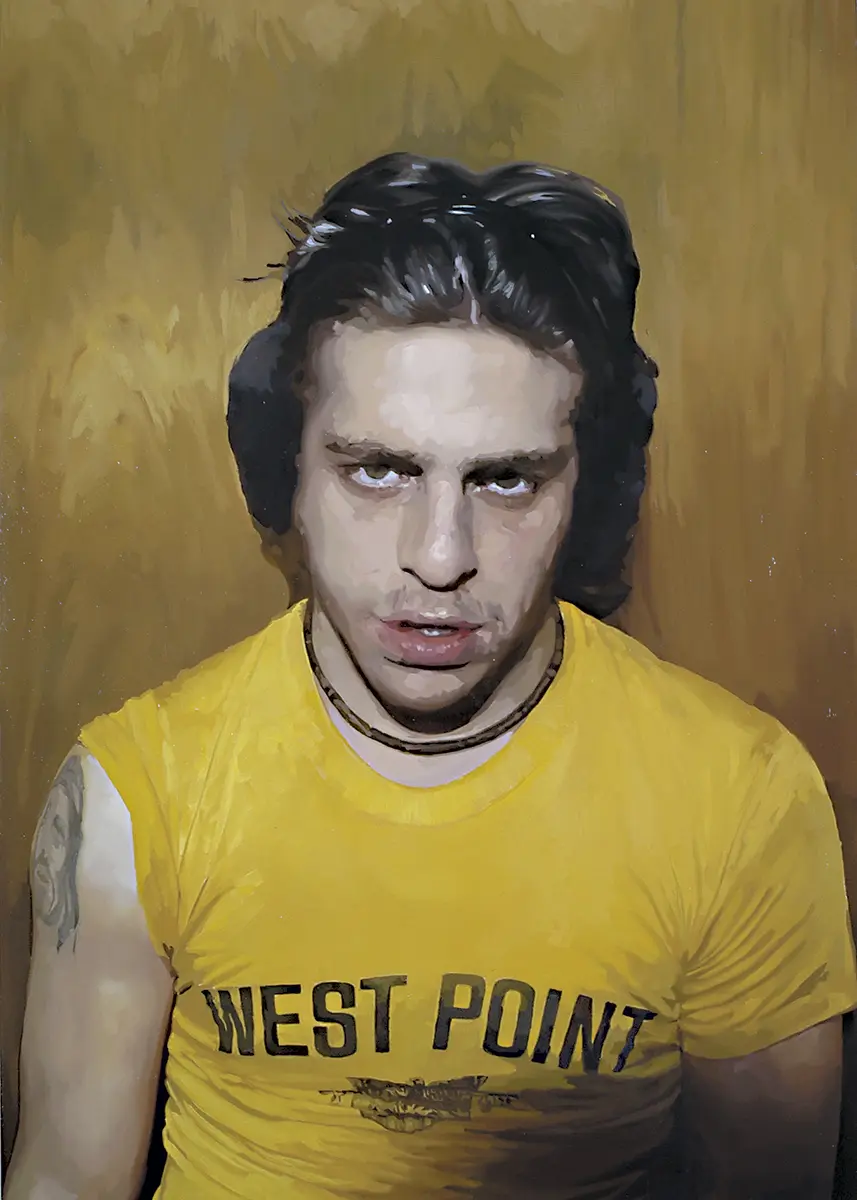
From a technical point of view, Tessi has taken a step forward in the production of these paintings, interweaving photographs taken by himself with mass-media images from the worlds of fashion, advertising, or the internet. This time around, the artist complicates the steps prior to the moment of painting, devoting a good part of his energy to constructing stages, directing his models/actors, and searching for scenes he wants to reproduce. These are relatively simple scenes involving between one and three people, captured at close and medium distance. These believable scenes refer to ambiguous yet unequivocal situations. We do not know what happened before and after the event, but an atmosphere of violence envelops it.
Tessi traces a social and generational map where every minimal gesture threatens to become highly sexual. His adolescent characters gaze with provocation and vulnerability, both conditions exacerbated by a languor that is a contemporary fashion stereotype of anorexic, unkempt bodies. Tessi’s images draw attention, from the apparently vacuous adolescent girl taking her shirt off, to an act of subjugation in which two characters seem to force another to do something against his will. Wounded or frightened, Tessi’s youths are nevertheless always beautiful, and there resides a large part of the series’ disturbing power.
The border between pleasure and crime, profusely explored by the audiovisual language of pornography that many of these images recall have become one of the most developed topics in all expressions in contemporary art. From the cinema of Larry Clark or Gus Van Sant to the literature of J. G. Ballard—who, in Cocaine Nights, analyzes the short distance that separates idleness from lawlessness, which would guarantee the survival of the micro-elites, saving them from a destiny of boredom—through the entire rock ’n roll imagination with its court of rebels and suicides, the topic retains its currency and accommodates the most dissimilar approaches. Unlike other artists fascinated by a culture that links pleasure and violence, Tessi abstains from making his opinion explicit and does not present a moral judgment. In his scenes, painted with his characteristic mastery, the notions of danger and suffering simply coexist with the sweetest and most luminous appearances. It falls on the viewer to judge and make statements about a subject that is as dear to us as it is taboo.
EVA GRINSTEIN