
In the 1-minute video circa 1978 (2001) a small girl performance a magic act —she makes a ball disappear under some plastic cups— that ends with applause and cheers. The —fictional— the public is located in the position of the viewer, right where the super-8 camera that filmed the girl would be. The girl wears a shirt with the inscription “Nayda,” which leads to realizing that this is a self-portrait? and that the magic act has become a performance.
Nayda Collazo-Llorens has taken a family memento and has codified it. The camera is the viewer’s eye; the tricked-up act makes us aware of the camera, and in this way what could be just some inconsequential filmic material acquires value as a “work of art,” as video performance. The key is our awareness of the medium.
This action traces —or erases— the border between what constitutes art —the medium, the physical material– and “Art” as a philosophical category. Here Collazo-Llorens’ work inherits the self-reflective tradition of modern art, be it its “de-humanization” or its “purity,” depending on the jargon one uses. In the end, art turns inwardly and takes from itself its reason and purpose for being.
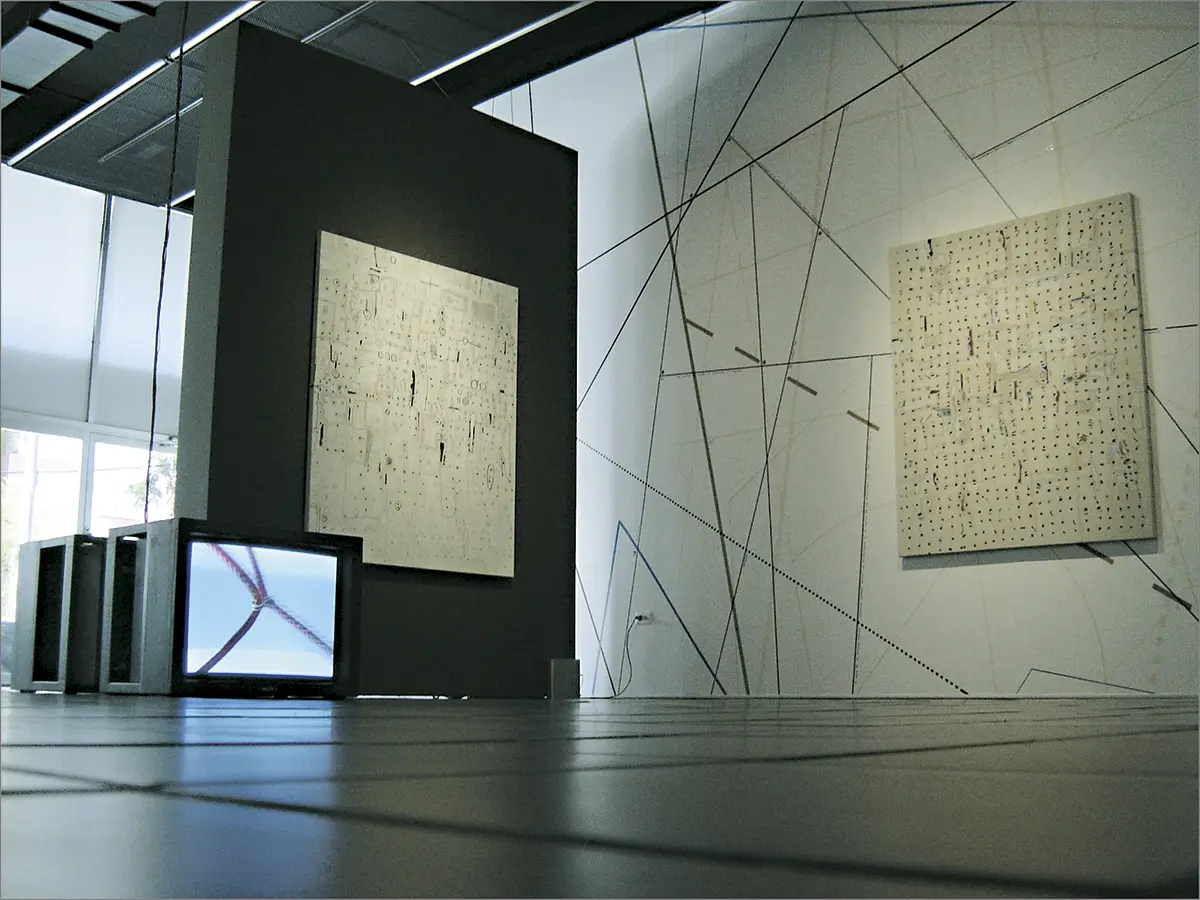
Thinking about the conditions in which art is produced —be it as an object, as experience, or as the situation— is a constant in Collazo-Llorens’ work. Her most recent series, Configuraciones, which includes paintings, interventions with vinyl bands, and videos, starts with the codification of the space where it is installed and uses the signs of that process in paintings and in transversal tracings in the gallery’s walls and ceilings.
A monitor displays Intermitente V2, a video work formed by texts that, in succession over time, become parts of dialogue. This is characteristic of Collazo-Llorens, suggesting the premise that dialogue exists in time, and as such in the wait for interlocution. The stripes that our gaze follows in a dynamic trajectory along with the gallery meet in the back wall. On the floor, two monitors stand back to back and display the same video, Roaming (2005) a journey around and inside an abandoned metal structure that forms a grid of lines against the sky. It carefully records details, the junctures between the different pieces, the possible configurations produced by each camera movement. The coordinates that traverse the gallery and interfere with the building’s orderly discourse seem to emerge precisely from here.
“Marks, numbers, moving images, and texts create a complex information system. They have been configured into a kind of net where individual parts connect in nonlinear ways and through visual, relational, and conceptual associations,” says the catalog. It is, then, a system that is placed on top of another —the architectural system already present in the site— in order to denote it in its very limits. This can be understood as a critique of the spatial determinism of certain kinds of site-specific art.
Bertrand Russell used to say that mathematics is not a science, but a code. And the sciences, so dependent on mathematics for their descriptions of the laws of nature, run the risk of remaining imprisoned by the code. The commentary implicit in Collazo-Llorens’ work moves in a similar direction. In times when the work of art is consumed more as the icon of an informative capsule than as a self-sufficient aesthetic product, an artist can provoke real interactions with the viewer, this is to say, interactions that transcend the mere reading of that informative capsule, recurring to the old Symbolist School trick: disguising the object under a veil, symbolizing it.
In the references of the remaining works in Configuraciones we find words with a strong metaphorical charge in that sense: fold, backstitch, labyrinth. They all refer to the articulation and the folding —of paper or of a corner— of a manifest reality in an occult one.
The 1978 girl “hides” the ball under the cups not to have us guess where it is, but to show us that she can make it disappear without us realizing how. It is the return to an axiom that acknowledged an aesthetic experience in the seductive power of suggestion, in the infinite pleasure of guessing the “object” under the veil. That spirit was summarized in a saying that acquires renewed currency in Nayda Collazo-Llorens’ recent work: “Art consists of hiding art from ourselves.” And it is up to those in this margin to discover it.
ELVIS FUENTES