

“Either they don’t hear me or they don’t see me” was the defiant phrase uttered by a large, burly man at the door of a school in Cartagena de Indias many years ago, when Oswaldo Maciá was still a child and didn’t suspect he would become the formidable artist he is today, at the age of forty-four. The man added, “I am the Greek man with the griegas,” although he wasn’t from Greece but from Cartagena, and what he offered in a large tray weren’t precisely griegas but crispy, aromatic obleas. Maciá was nonetheless so fascinated that he still remembered him as he titled one of his most recent acoustic pieces, Es que no me ven o es que no me oyen. It debuted at the Eighth Havana Biennial and consists of a symphony of British bat songs, as inaudible for us as the song of any other bat.
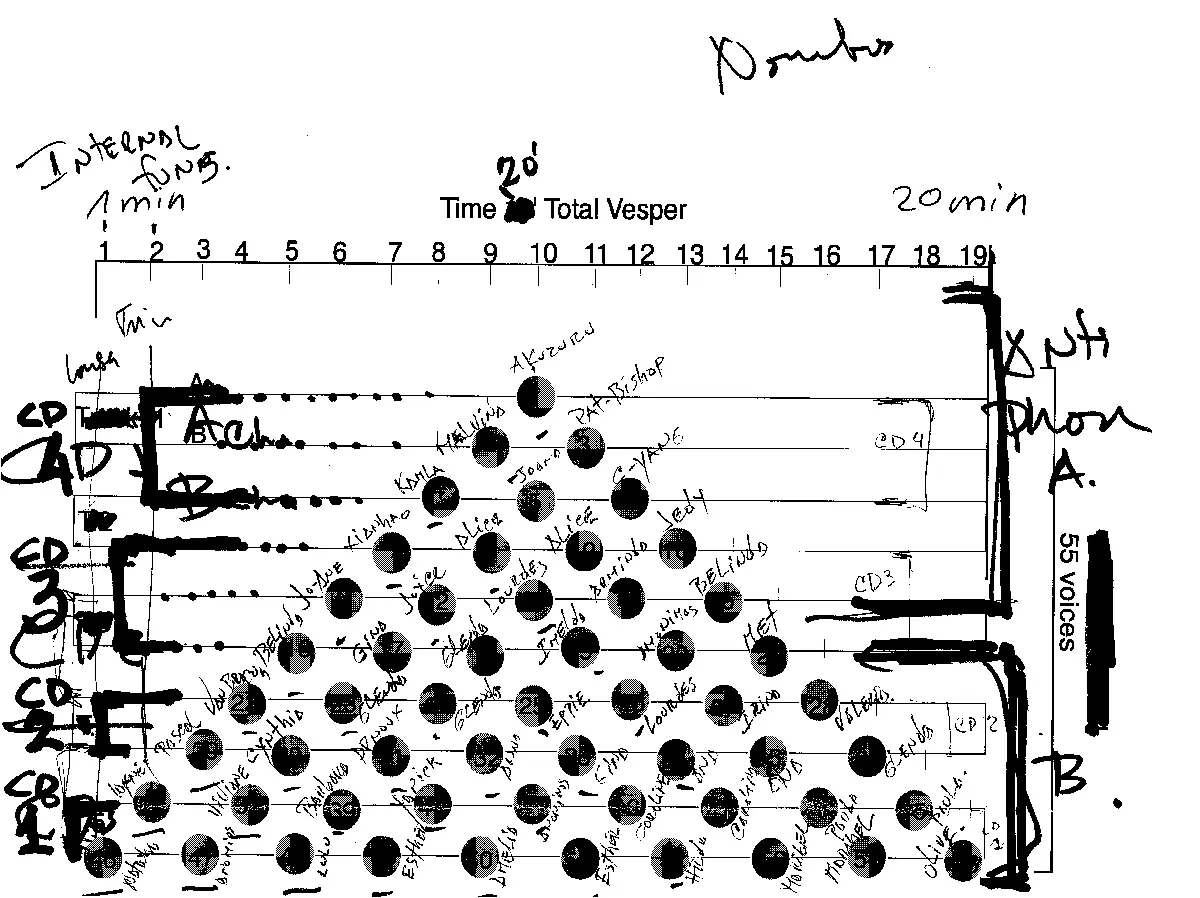
The remembrance of this childhood scene, moreover, refers us to two central issues, memory and voice, that appear intimately interwoven in Maciá’s work, to the point that for him memory is above all else memory of the voice. He remembers that anonymous peddler especially because of the voice he used to intone his call. That is, the pitch, color, and potency of his voice are as important for Maciá, if not more so than the content of the peddler’s call. In fact, another of Maciá’s most recent acoustic works, Vesper, is a symphony for fifty-five female voices, selected from 120 Caribbean women whom he asked to recall the happiest memory of their lives, the memory that supports them even through the most difficult or bitter times. Each one of these women, from a variety of social classes, ethnicities, and nationalities, told Maciá in her own language a passionate, touching, and fascinating story, but what he found most appealing was the way in which they told these stories, the unique quality of the voice in which the stories were told. Indistinguishable from that quality is the language brought to life by each one of those voices, which Maciá appreciates more for its sound than for its meaning. For him, each language is above all a melody. Or, better yet, a whole class of melodies, related to each other in their consonances and dissonances.
Maciá’s interest in memory displays the same acoustic bias because it emerges from his concern about the oblivion that befalls the oral traditions of native cultures. He finds in such oblivion the intervention of a forceful impulse that is at once obligatory and traumatic. Something must be forgotten because remembering it actualizes a punishment, the painful experience of an insult, a wound, or a loss. We come to understand then how difficult it was for the majority of the Caribbean women he interviewed to answer the question of their best memory, which they could not dissociate from a bad one. The exception was a young Aruba woman, the daughter of an Arab man and a Dutch woman, beautiful and wealthy, who answered that she could not tell of her best memory because she had no bad memories.
In Maciá’s work, memory also connects with two interrelated matters. The first is the matter of the archive, which is for him one possible remedy against oblivion and the silencing of other voices and tongues by the contemporary world’s media saturation, which amplifies and multiplies the voices of just a handful of political, artistic, and cultural stars. Those voices nobody hears anymore nevertheless survive in sound archives, which Maciá has searched in order to compose works like Cleanaway, shown in 1995 at the Lisson Gallery in London, which consisted of a shining trash can filled with 50,000 plastic sticks ending in a little cotton swab, of the kind used to clean one’s ears. From the bottom of the container, a couple of loudspeakers emitted a selection of oral testimonies by immigrants who arrived from the provinces to London in the 1950s, which were preserved in the city’s sound archive. The cotton swabs invited viewers to figuratively clean their ears and listen to those ignored and forgotten voices we are usually not able or willing to hear.

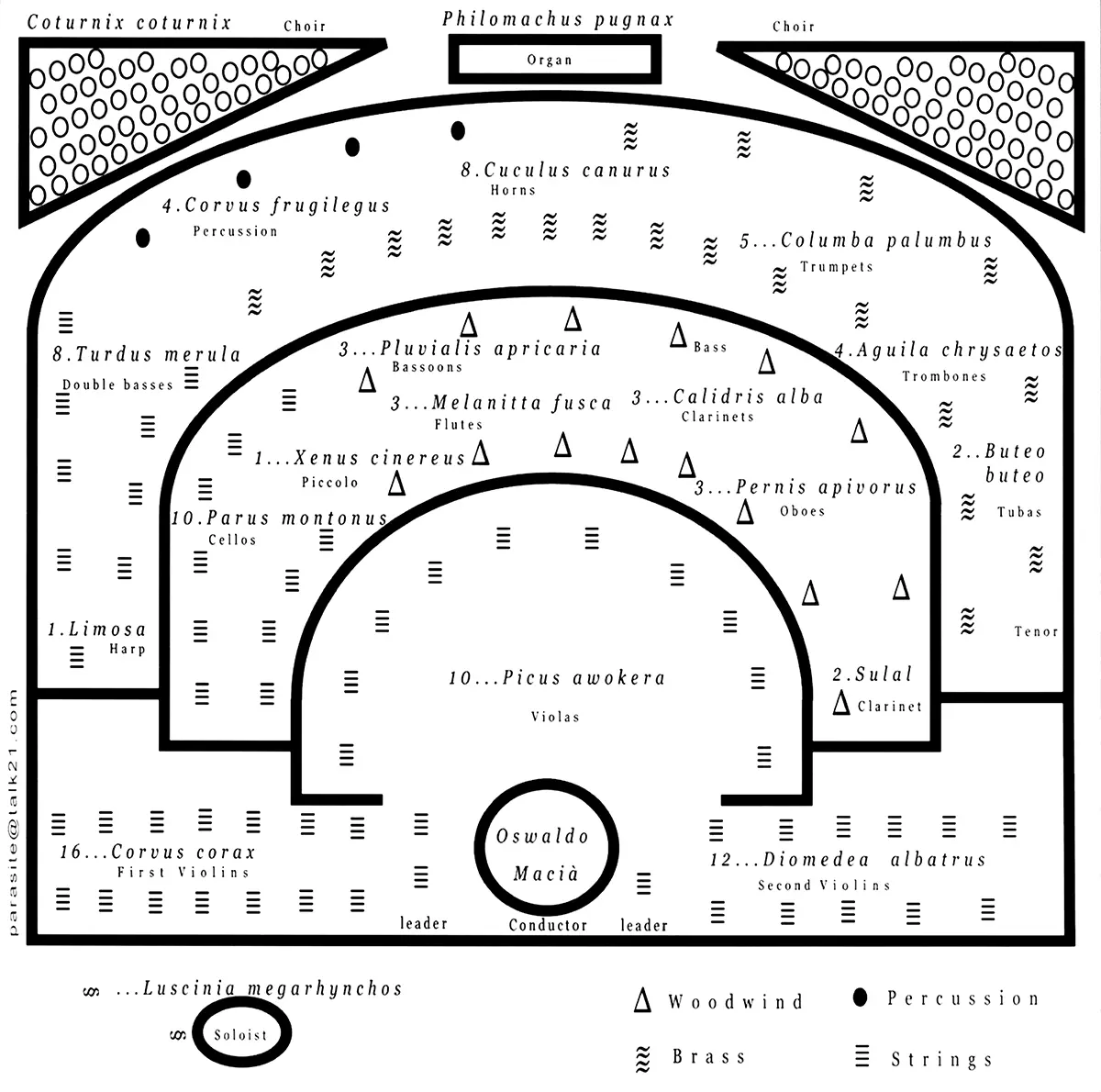
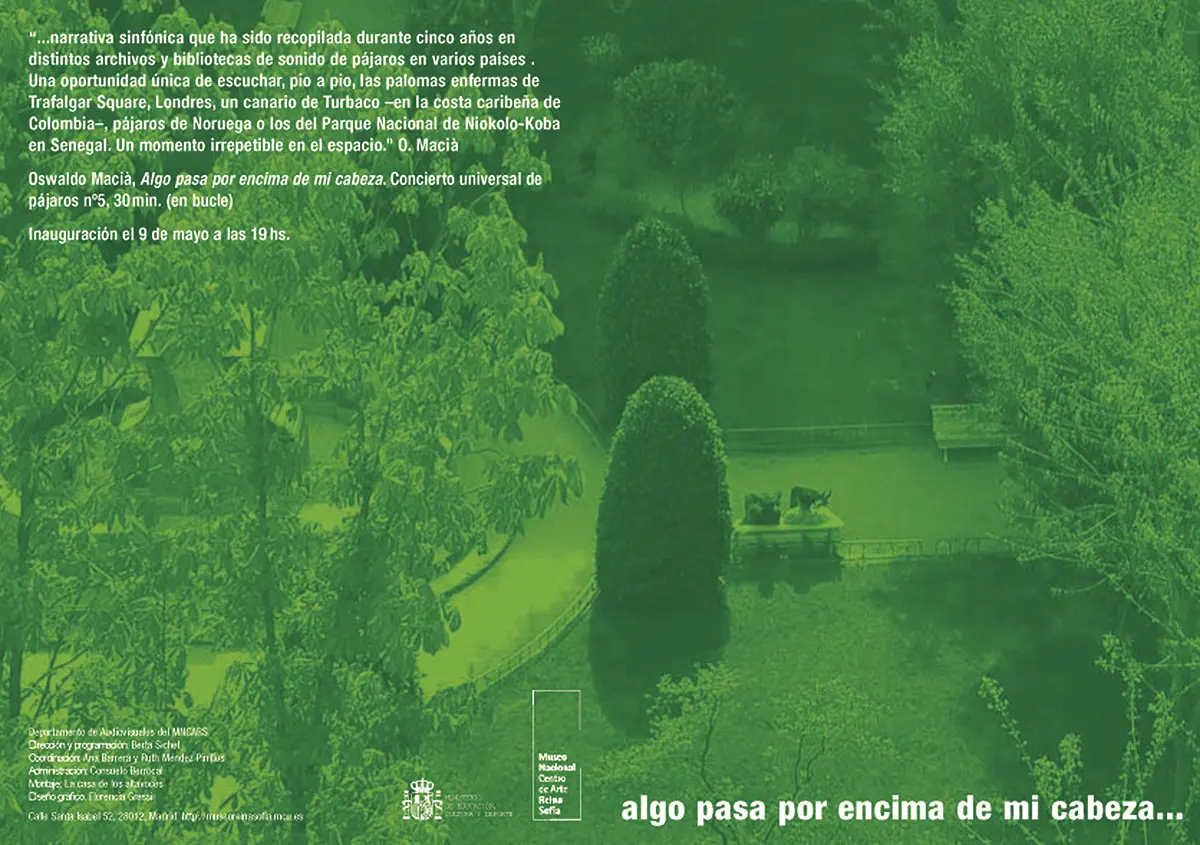
The second matter has to do with voices we do not hear, not because of political or psychological censorship or media cacophony, but due to our anthropocentrism, so keen on dismissing Nature’s prodigious polyphony. Maciá’s attention to this issue resulted in the work Es que no me miras . . . , which allowed viewers to hear the bats’ inaudible songs, and works such as The Sound of Smell, an 11-hour, 36-minute piece recorded at a Hamburg laboratory that reproduces the sounds produced by the smell of pine trees. Something Going On Above My Head is a remarkable narrative symphony composed on the basis of more than 2,000 birdsongs from all over the world, distributed in space according to the place reserved for instruments in a symphonic orchestra.
We should add that among Maciá’s most insistent interests is also synesthesia, the ability of a visual stimulus to provoke an auditory or olfactory response or vice versa. This interest drove Maciá to create a piece like Memory Skip, shown in 1995 at the London Museum of Installation, which consisted of a dumpster filled with a ton of pine essence; its smell was so powerful and penetrating that it altered the normal functioning of the visitor’s remaining senses. More recently, Provoke/Evoke is the olfactory version of an acoustic piece executed briefly before, Tomorrow Cloudy. The origin of both pieces is the same, the list of 52 animal species that, according to the eighteenth-century British philosopher John Wilkins, were aboard Noah’s Ark as the Deluge approached. Tomorrow Cloudy was a symphony composed using the howls, barks, growls, purrs, and songs of those species while Provoke/Evoke is a fragrance created with the animals’ secretions.
What relationship do you see between your work and John Cage’s?
If it were necessary to relate my work to someone else’s, I’d rather speak of Olivier Messiaen and his books of notes taken from birdsongs, because they relate in an obvious way to the pieces I’ve created using the same songs. Only he used those notes to compose pieces to be executed with classical instruments. I, thanks to my recordings, use the sound directly, without instrumental mediation.
Central to Cage’s thought is a critique of the opposition between music and sound.
I agree with those specialists who highlight the concept of “happening” deployed by Cage as it proposes the freeing of sound from the composer’s control and from its subjection to the kind of musical thinking dominant in the West for twelve centuries or more. Yet, I have never been interested in getting in-depth into Cage. I read his philosophy like any other that refers to free expression. I am as interested in his theories as I am interested in Freud’s idea of free association or in any other theory that speaks of the liberation of the human voice.
Why do you assign such importance to the voice?
I believe in the voice, in each person’s voice, in the voice of the historically voiceless, who nonetheless possess, like all of us, that very powerful instrument that is the human voice. We must think of our voice as not just a tool for daily life; it is the finest instrument at our disposal, the most multifaceted and resourceful, capable of instant jumps from positive to negative with a single tone shift, capable of seduction in all its aspects. We, humans, are masters in using it.
In Vesper you use female voices exclusively. Why?
Vesper is a project about memory whose starting point is a question presented to more than 100 persons about their best memory. I chose women because many sociological and anthropological studies have proven that they answer surveys more honestly. Men don’t reveal their true feelings in interviews. They are aware of the microphone and use “I” a lot. Women, on the other hand, use “we” and “among ourselves” much more; they speak more in terms of the whole family. Men say “me... me... me... I... I...” —Captain Big Dick!—do you know what I’m saying? The last thing I needed at my age was to make a symphony to the macho-man’s ego. I’m up to my balls in that. Women on the other hand can admit things like: “that’s how he left me,” “I lost him,” “I assimilated it, I suffered, I survived, I carried on, I started anew...” And those stories seemed simpler to me, clear, honest, and real.
Why the title Vesper?
Vesper comes from the word “vespertine,” which in turn comes from Venus; Venus is both the first star to appear in the evening and the famous goddess of beauty. Those church chants are called vespers because they are chanted when Venus appears in the sky. Also, my work is an antiphon, which is a musical form from the Gregorian period, when choirs were exclusively women who sang what was going to happen on stage.
In The Metamorphoses, Ovid tells the story of the Vesperidae, “Mineo’s rebellious daughters,” who, as punishment from the gods, had their memories scrambled when their weavings got tangled up. What they were weaving was the memory of a way of life.
The entanglement of memory is that you can’t easily separate positive memories from negative ones. You always remember first your bad memories and then the good ones. Good memories almost always come accompanied by the painful remembrance of some shock we have suffered in our life, and the latter are the ones that cause our strongest memories, next to which our positive memories appear. Freud used the term “memory screen” for what we tend to remember in our difficult moments, in order to balance them out. People who are kidnapped, people who are having a hard time, people who are dying, who are drowning, they are supported above all by the memory of that one niece, somebody’s photograph, a dear aunt, the wife, the brother, the most loved person in their lives. That memory gives them exceptional strength and allows them to survive. That positive force keeps them afloat. I researched this at the Freud Museum, guided by the library people there who told me: read this, read this chapter, photocopy this page, check this out, this sounds good.

So, asking for somebody’s best memories is really not all that innocent.
Right, because what you are doing is giving people a chance to speak and to reach the point where they open up and tell you their personal lives with complete honesty. It's difficult to achieve, but when it comes you realize that somebody is telling you their best memories in a tone of voice that wants to communicate the pleasure of the memory all by itself. It wants to communicate it phonetically, so to speak. When you listen to one of these recordings you can hear the difference between the first fifteen or twenty minutes and what comes after when the person becomes more comfortable and starts to communicate with that kind of aura. People in the opera spend lots of time researching how to achieve that kind of aura that could envelop the audience. I search for it asking people about their best memories in order to compose a contemporary symphony. This aura is very special, it comes from common people, not from a professional singer because all professional singers in the last instance give you the same thing. If I am interested in working with voices, if I am interested in working with testimonies that reveal honesty, it is because I am interested in the aura of the voice belonging to the person who is telling the story and uses vocal cords and sounds to create a singular sound. Even the word “phonetics” falls short in this case to describe what sound is within the body of the word. I am not interested in music. I am not interested in chorals. I don’t give a shit about what Rachmaninov says. What interests me is the aura of common people as they tell their stories.
Evidently, you are deeply interested in free speech.
Again, I am not interested in Blair or Bush, whether they sleep with their secretaries or with their wives. I couldn’t care less. What is important to me is that common person who tells a story that is also an apotheosis. That is why I want to give people the chance to do Free Speech, a free discourse, a discourse of free association. These are people who usually are not given the right, who are not given the opportunity to express publicly what they think, and they are desperate to say what they think. If you give people in the street a microphone, they are happy to say what they think—they think it’s phenomenal. You find people with an incredible communicative facility, people very apt at sharing their happiest moments. For others, however, oral communication is difficult. They don’t know how to tell stories; their vocabulary is small. One hears lots of “hmmm..., ah, ah..., oh...” and such. And then there are those who cry!
I am really fed up with the four media that control the world and force us to hear how big and how important are four or five people, maybe ten, in the whole world. What about our lives? What about your life? Let’s start at the beginning: if a bomb doesn’t fall on your town, the cameras will not come. And if it weren’t for what’s happening right now in Colombia, we would never show up on British television. It is as simple as that. Even if there is, and there is, a great wealth of popular sayings.

It must have been a great experience for you to hear the stories of these women told in all the languages of the Caribbean.
In terms of its linguistic variety, the Caribbean is a metropolis. We have everything here. So many migrations, so many mass kidnappings that brought people here by force, so many threatened with fumigation here who moved just over there. For all kinds of reasons, peoples of all races and of many languages have ended up in the Caribbean, and that has produced situations like that of the Maroon, a Jamaican minority who are the result of the intermixing of native peoples and insurgent blacks who sought refuge in the mountains, out of reach of the British slavemasters. Try to talk to a Maroon in English and you’ll see what a problem that is. It’ll blow your mind! Who can understand that? For the Vesper project, I interviewed one woman who lived in a slum in the lower part of Kingston, near the port, and she was one of the few remaining people who grew up and lived in the higher part of the island, where Maroon traditions are still kept alive. They speak a unique kind of Papiamento. Dense, but very beautiful. You have to hear it!
In Spain, the country’s wealth of oral culture is being drowned in all the cafés by the noise of television, of loudspeakers, of little game machines.
The short-circuiting of the oral is an immense, most grave problem, plus the fact that you lose currency. Once you hit fifty, nobody takes you seriously because you are old and dispensable, unlike years ago, when we listened to the elders and they had the last word. Now, since Thatcher passed through here and the twenty-something yuppies showed up and everybody retires at forty, in Colombia they adopted the same norm, and the elderly are not even allowed to speak. I don’t really know why it is that we have to adopt all kinds of policies that are completely cold, policies that have nothing to do with us. It’s just an imposition of the new colonialism. How is it possible for cazabe and ñame to have disappeared from the Caribbean? In Cuba you have to go to Hotel Nacional, one of the most expensive hotels, to get tostones de plátano served as if they were something really exotic. That’s rich! What I get from flour are snot and eye crust. And the worst thing is that nobody is going to come and take care of our culture for us.
Do you think oral archives can stave off the crisis of oral culture?
For me, oral archives, memory’s information banks, are the only physical means to archive memory. Memory is something that once you lose it, you are fucked. You are fucked and you took it with you. But in recording, you’ve got a way to preserve your oral version, which for me is the best because I distrust translations and interpretations. When you hear people speak, it is a completely different thing than reading it. You hear them and you can even imagine certain features of their character that you can’t imagine when you read. Voice has its place in history and in social life, which can’t be replaced by different means, no matter how pseudo-intellectual we get in our writing.
And it is not just a matter of recording and archiving, it is also a matter of using and activating those archives. I remember that in 1995 I did Cleanaway for Lisson Gallery and I used recorded stories around questions such as “How do you like your eggs?” “With green onions and tomatoes, they are my favorite on Sundays.” I don’t know if this is just an obsession of mine, but for me, oral history is filled with more images than any video. When the lady tells me how she likes her eggs, I can see them. My movie is already made!
Film adaptations of novels usually disappoint readers of the books because the film created by the director is not the same one the readers created in their heads as they read. They think, “No, not like that. They changed my movie!”
When I was investigating synesthesia, Gabriel García Márquez invited me to his house in Cartagena, and I said to him: I am interested in the olfactory part. When you write about the smell of the guava and it is translated in Norway, no matter how much you describe the fruit with all its little seeds, Norwegian readers will not understand it exactly. How could they? Because you will never have an olfactory vision of something I am describing. You can describe it any way you want, you don’t get even close to the smell of guava. To Norwegians, the smell of guava sounded like the name of a fish, like a herring, which is a salty fish. So they keep reading and are convinced guava smells like fish. How the hell can you control in literature the notion of smell? How does the memory of smell work? Gabo just looked at me and then he said a couple of things about the smell, but since he is so him, so “me and my stories,” he only wanted to hear his own stories and I said, “Wait a minute! I’m going to tell you my story now.” But he didn’t want me to get his head all tangled up with my stories, because like any artist he is only interested in his.
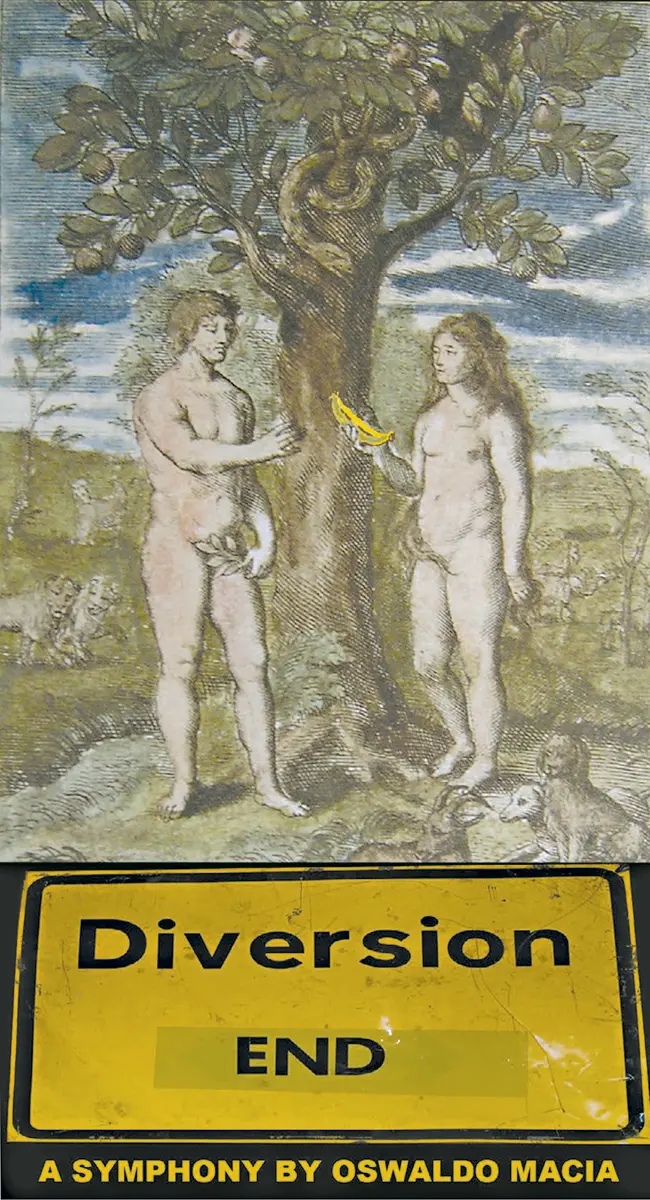
You were at the Liverpool Biennial in 2004 with an acoustic work you are created in collaboration with Michael Nyman. It had four parts, each broadcasted from four different sites in the city. Why did you choose crying sounds from the BBC audio archives for this work?
I chose the sound of crying because I believe it is a language that, due to cultural impositions, we haven’t learned how to listen to. Today, when, thanks to media saturation, images no longer communicate, we have to learn to communicate to each other our pain, for example, through languages and senses that in the past we set aside in order to give primacy to the image.
In the end, what are you? A musician? A sound technician?
What interests me is sound, not music, because music is written and sound is not. Music can be read and sound can’t. There might be many differences, but for me, that is the most decisive one. That’s why I’m interested in music from the thirteenth century and before when music was not written or read. It was entirely oral. It was sung and repeated and it was learned by ear. Those are the moments I have as my point of reference as I compose if I can be said to compose. In truth, I don’t like words that pigeonhole people. I like the word “artist” because it fits everybody.
Kafka spoke of the Hunger Artist. How many hunger artists have you and I known!
As many as you want! And include me on that list, with people from all over the world. When it was time for me to marry, I married poverty.
Oswaldo Maciá lives and works in London.
CARLOS JIMÉNEZ
Writer and art critic. Author of Extraños en el paraíso: Miradas al arte de los 80 and Los rostros de medusa: Estudios sobre la retórica fotográfica.