
Ricardo Lanzarini (Montevideo, 1963) seems to always be playing with limits. His ink drawings are surprising miniatures comprised of a multitude of tiny characters representing roles, mixed up in different situations in which each narrative event seems to emerge as a consequence of the previous one and disappears to generate the event that comes next.
Looked at in detail, they feature allusion to hospital dramas, to the bureaucracy, the church, forming a river of strange characters involved in situations that mesh together with the public and the private.
It is seemingly at the limit of narrative information, and the parade of medical patients, demagogues, brutal situations, alongside a quotidian environment devoid of surprises, crosses path with the mentally ill, hypocrite priests, building a grid where each character ends up included in a multitude of insignificant people.
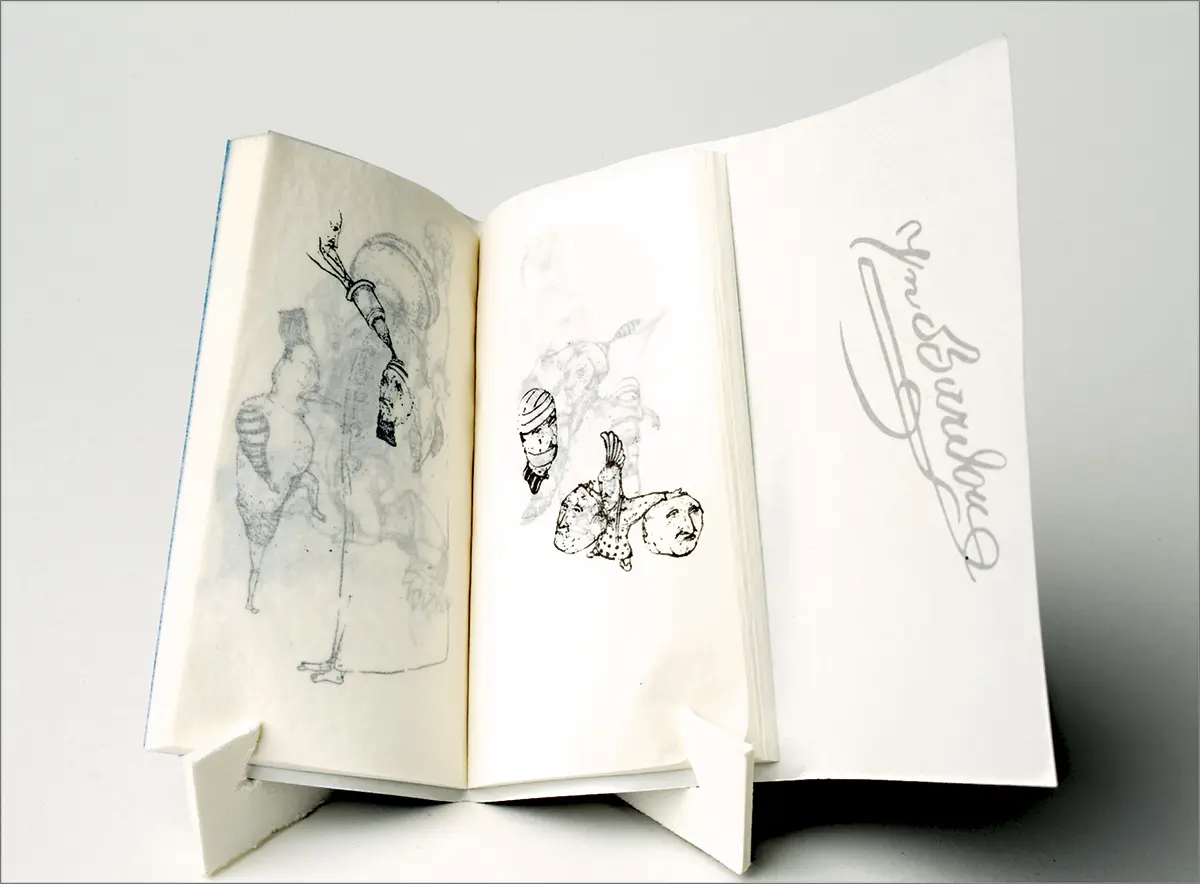
There are no certainties, everyone is integrated into a chaotic and extravagant world, nobody stands out. He plays subtly with the concept of time, and we never know exactly what moment we are in. Sometimes the odd hats, the attire of the minute characters, are reminiscent of medieval times, which does not deprive this strange fauna of its incisive gaze on the contemporary world. Lanzarini’s peculiar composition, foregrounding his interest in drawing, in painstaking manual work, allows him to build spaces that imply a multiplicity of readings. Seen from a certain distance, his drawings appear like abstract structures; up close, the level of detail is overwhelming. This way of approaching the art of drawing has the quality of generating a blurry border between abstraction, the whole, and figuration, the detail, bringing to the fore the whirlwind of narrative and visual information to which we are exposed.
Lanzarini writes: "A forest of heads and gazes populates and recreates my work. The multiplicity of gazes is a multiplicity of abstractions. Not discourse, not place, it predetermined space, in my work there are only forests that emerge like boils on skin, like allergies, popping up all over."1
What seduces us is what Lanzarini is able to do with materials such as rolling paper, support for tiny characters that force the viewer to stop and attempt to share the relationships proposed by the artist. Small pages that become a collection of art books where men and women that seem to come from one of Kafka’s works are crafted with such conviction that, despite their size, they are able to grab and hold the viewer.
Lanzarini’s interest in drawing on unconventional supports seeks a rapprochement between everyday objects and the art of drawing, and his small formats, both the support’s and that of its inhabitants, occupy the space from the edge of the page as if they were permanently confronted with the abyss. Because it is not just a matter of telling stories, but of showing daily frustrations without losing his sense of humor or his critical attitude.
On occasion Lanzarini brings his tiny characters out of the page, clipping them and putting them inside transparent display cases, where, by the actions of viewers as they lean on the case, they begin to move towards the walls, as if they wanted to escape their microspecies and migrate to the real world.
The drawings hung and installed in this show pose a particularly ambiguous situation where not only the viewer was surprised, but the author himself, as he entered a world that emerges in the process of his work, a world of characters that perhaps also cause in him the startling response they tend to produce in their public.
NOTA
1. Text was written by Ricardo Lanzarini on one of the walls in the show.
IVONNE PINI