
The twenty-third Dominican Republic National Biennial, presented in the ample galleries of Santo Domingo’s Museo de Arte Moderno, provoked controversy and debate.
Biennials are faced with serious challenges. These days, there is talk of the crisis and obsolescence of a nineteenth-century originated model, that in spite of time, reiterates certain structures and principles whose efficiency is questioned by many. Paradoxically, during these years, despite the apocalyptic tone with which critics and curators announce its collapse.
In this regard, the Dominican Republic is a privileged spot within the region, and it offers not one but two biennials. First held in 1942, this is the oldest biennial of its kind in the Antilles and, alongside the Caribbean and Central American Biennial, has had a favorable impact on the development and the progressive international projection of the country’s visual arts.
Pulled together in record time by the Museo de Arte Moderno’s new management, the Biennial was based on juried selections culled from hundreds of works. A prize-awarding jury—composed of Leopoldo Maler, a Dominican Republic-based Argentinean artist, the Dominican photographer Domingo Batista, the Dominican architect Gustavo Morel, the prestigious international curator Kevin Power, and myself—guaranteed rigor in the final decisions.

An examination inside this edition of the Biennial reveals a context’s dichotomies. In its favor, the number of artists and presented works speaks of the widespread receptivity for the call for entries. The Biennial didn’t establish firm borders between age groups or artistic expressions; it gave space to well-established artists—some of the local legends in the fields of painting, installation, and mixed technique—as well as younger, emerging artists. It worked as a pluralistic platform for a vast and varied repertoire of contemporary art in the Dominican Republic, without distinctions of form or content, or genres or schools, and it incorporated everything from relatively predictable expressions of language instrumented allies of foundational Modernism that form a majority of the Dominican visual imagery to other, less numerous proposals that were riskier and more contemporary.
In this sense, if in fact, the dominance of two-dimensional supports was evident, with painting preeminent, and the exhaustion of certain expressive paths over employed by several zones of Dominican art was brought to the fore. These included works derived from the late and extended influence of surrealist axioms in the region, from dream-based codes, from mythological formulas, from the baroque as a reflection of the popular, the consequences left by the abstract expressionism of a materic root in a line of work focused on archaeology. Nevertheless, the works on view also highlighted reformulations in some media, such as the discreet gains made by photography, the continuous pressure toward installations, or the entrance of less established forms like object art, audiovisual art, and video. The latter was handled, in some cases, with formal resourcefulness and inventiveness that indicate a very promising future. Lamentable was the marked absence of other disciplines, such as performance, and the infelicitous representation of sculpture, graphic arts, and pottery.
One of the most salient works was by Jorge Pineda, who once again proved to be a versatile and consistent artist. Pineda draws the contradictory faces of Dominican reality. The installation Me voy al sur, which won First Prize in the installation category, continues a theme that was present in previous works such as Frágil, El sueño de Winnie the Pooh, and Santos inocentes. Pineda uses graphic forms to represent the vulnerability of childhood as a visceral register of dysfunctions in contemporary society.
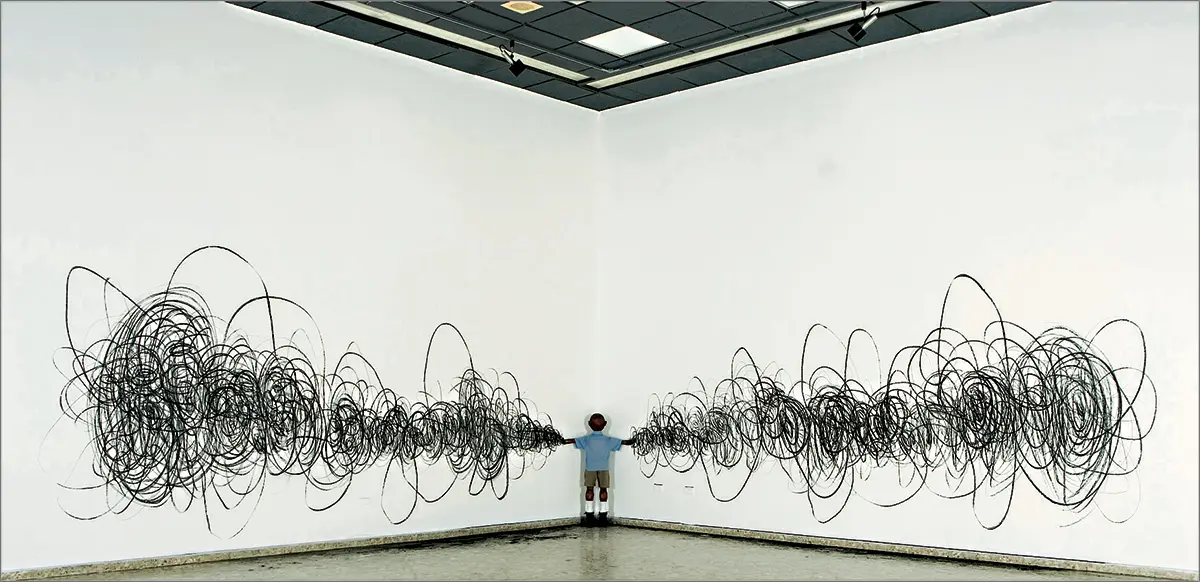
Me voy al sur featured the figure of a child standing facing the corner of an immaculately white room. The simile of a small wood figure made as a wooden sculpture wearing a school uniform and with mutilated forearms ending at the elbows in two small burnt stumps, extended across the wall. These stumps drew dense circular scribbles on the impenetrable and paradoxical hardness of the wall, evoking childlike rebelliousness and frustration. The work is another allusion to unprotected innocence.
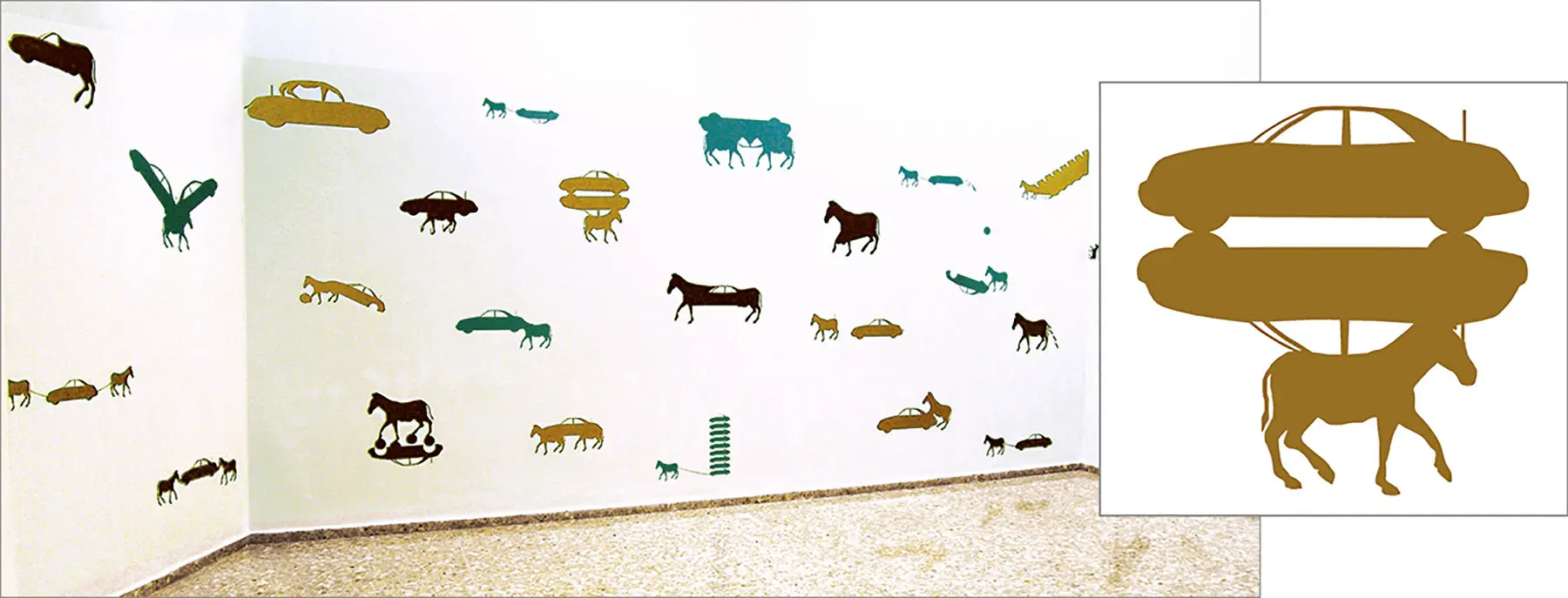
Among other works, there was significant interest in urban themes. Quisqueya Henríquez presented Intertextualidad, which received a mention in the installation category. This work comprised images of fused cars and horses cut up into stickers and displayed directly on the wall.
Quisqueya’s process illustrates questions that arise from the evolution of cities, understood as the transformation of their spaces provoked by large human migrations from the countryside and by the de-urbanization that results from the absence of state initiatives and regulatory plans to direct an ordered growth amidst a population overflow.
The curious, paradoxical inter-textual fusion of cars and animals connotes the impact of the clash between country and town and between tradition and modernity. The mirage of progress and the acceleration of the pace of life, represented by the overwhelming omnipresence of the automobile, an indicator of social and economic status, end up disrupted by the ruralization of life.
Limber Villorio presented Más poder (First Prize in sculpture). The work of this young artist, an architect by profession, deals with some of the urban issues of pollution, violence, sex, or poverty. Using old car parts, TV monitors, and videos, he assembles ingenious game machines that parody the archetypes of the “society of the spectacle” and submerge the viewer in deep Santo Domingo.
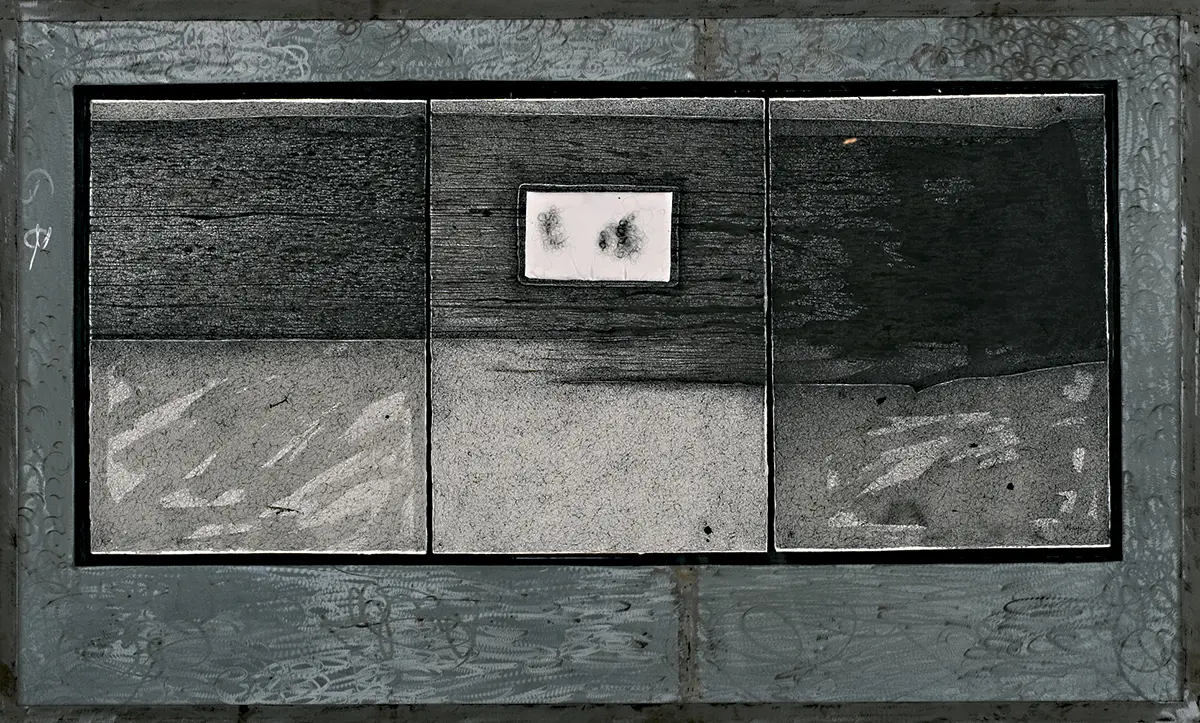
Villorio’s work was unwillingly recalled by the Mexican artist Betsabée Romero. The automobile tire with abstract figures of hundreds of projectiles encrusted on its surface and forming abstract images was a forceful object with complete three-dimensional autonomy, expressing the symptomatic violence contained in today’s Latin American cities.
Another young artist, Aquiles Azar Billini, made his mark with El hoyo 00-04, six large-format digital photographs, and took First Prize in photography. This series of images focused on an architectural project left unfinished by the previous Dominican government: a group of commercial and business buildings promoted by the country’s temporary economic boom. Azar’s photographic registers progressively unveil the abandoned plots on which these emblems of progress were to be erected—where only silent testimony of another unfinished enterprise of modernity remains.
Against all expectations, the Biennial’s Grand Prize went to the young artist Ignacio Alcántara. His three videos presented an ingenious sequence of images, effectively combining photography, drawing, comic books, and audiovisual art with expressive agility.
The hybrid resourcefulness and rhythm of Alcántara’s work revealed the identity crisis caused by contemporary nomadism and migration, which coalesce in self-referential investigations or reflections. Although these works come from a Dominican perspective, the emotions within them are not exclusively so.

An examination of the awarded works indicates that the jury favored those works centered on local realities and dilemmas, emphasizing the advance of contemporary languages and concepts. The remaining awards went to José Almonte in painting and Juan Mayi in the drawing. The jury chose to declare empty the competition in printmaking, graphic arts, and pottery. While some participating artists persevered in their formal investigations, others displayed content-oriented intentions and commitments to their context or something beyond their context, as was the case with Raúl Recio, Porfirio Díaz, “Chichi” García Cordero, or Eleomar Puente.
As a complement extension, the Biennial also programmed a series of collateral exhibitions and theory-related events. A special and well-deserved tribute was presented to the late Porfirio Herrera, who was the main promoter of the Caribbean and Central America Biennial, first held in 1992 as a meeting for the Caribbean region’s visual arts.
Biennials will remain pertinent for as long as there are no other events to take their place, ones that better respond to artistic practices that have won more adherents over recent decades. From this perspective, the Santo Domingo Biennial faces some serious challenges. It remains an effective measure of the health of the country’s visual arts. The granting of awards is such a controversy in the Dominican Republic and abroad that the event’s organizer should reconsider the practice. Having access to a promotional stage of such significance should be itself an acknowledgment of an artist’s achievement.
The Dominican Republic is one Antillean context that possesses a solid visual tradition, one that has produced valuable examples of historical commitment: the initial modernism of Gaussach, Colson, and Suro; the iconoclastic and anti-institutional avant-gardism of Silvano Lora; Martín López’s early enrichment of photography; or the critical renewal of the 1980s generation, represented by Tony Capellán, Marcos Lora, Raúl Recio, Belkis Ramírez, or Jorge Pineda.
In keeping with that history, one of the Biennial’s most positive aspects has been its willingness to renew itself, escaping the two-dimensional conventions imposed above all by painting, and transcending the hegemony of the market, showing itself to be sensitive to changes in the visual scene and articulating experiments that explore new paths. The Biennial must keep faith in formulations that are emerging, adapting to new circumstances and new languages; it can’t lose sight of the fact that this event has a direct influence on the design of modernity and is ideologically committed to the most innovative work.
JOSÉ MANUEL NOCEDA FERNÁNDEZ