
Alejandro Aguilera was recently invited to exhibit at Georgia College and State University by Richard Lou, a Chicano artist and the head of the art department. Lou has been developing a new curriculum and a visiting artist program that is a first for the institution. Guillermo Gómez Peña was the previous guest of the program.
Aguilera’s show, Forty-one Yards of Lines, is representative of the development undergone by a group of artists linked to the artistic renewal of the 1980s in Cuba. These artists were part of the massive exodus of intellectuals and artists in the 1990s, which resulted from the institutional collapse of cultural activity on the island. This development consists of a formal and conceptual opening toward a diversified expressive space, one that is more inclusive and encompassing. In Cuba, Aguilera became interested in the grand narratives of history, myth, and politics as the sources and materials for his work, and he created works that aspired to wide social implications. Later, in Mexico, his interests focused on the systematic study of literary sources—the work of Octavio Paz was his most important source in this period—and on formal quests that led him to incorporate abstraction into his work. This exhibition gathers sculptures, large-format watercolors that combine drawing in diverse media, and temporary mural installations that include three-dimensional materials and objects.
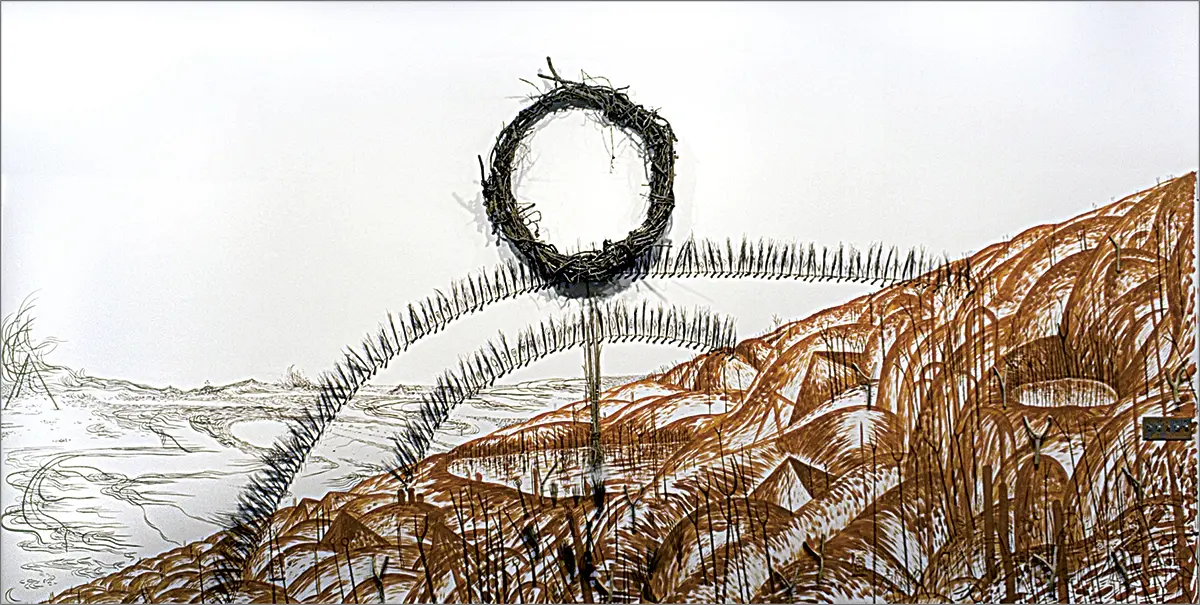
The wall installation Border Landscape (2006) is like a visionary landscape, a subjective landscape, or a dwelling of the spirit. As its title suggests, this work is inspired by the landscapes traversed by the illegal immigrants that cross international boundaries in search of a better life. It is made with nontraditional materials. Aguilera uses dirt as a pigment, diluting it in water and mixing it with gum; natural vegetal fibers are woven together to form a circle, like a mystical center, located high and central to the composition; pine-tree fibers are used to draw two bridges, like symbolic connectors of different worlds; and three forked branches are attached to the wall, like charms for the protection and good luck of the walker. Formally, the landscape unfolds on diagonals that traverse the composition up and down and from side to side. The pictorial gesture and the ochre, earth color dominate the larger triangle; a number of fine, black, undulating lines against white are the most salient expressive elements in the smaller triangle. The diagonal line becomes an elevation covered by mounds and lakes. In the lower level, in the distance, the landscape becomes shore and sea. Defoliated trees and anonymous, schematic human figures inhabit the landscape.
The artist took advantage of three boarded-up windows in the same gallery to recreate three typical veins of Romanesque and Gothic medieval architecture. Drawings in the windows create the illusion that the viewer is looking at an exterior composed of omnipresent, directionless, source-less light. The axes that appear to support the openings each form a cross. With this, the artist situates the viewer before a metaphysical, spiritual universe.
The six sculptures present in this show are part of a wider body of work titled Ornamentos (Ornaments, 2001), inspired by nature and specifically by trees. Aguilera works in an open studio surrounded by trees. In general, his sculptures/ornaments celebrate his daily experience in that environment as well as the basic cultural meaning or symbolic function that humans have assigned trees: as vessels of communication between earth and sky. Thus, these pieces have a stele-like character or a marked verticality.
The drawings are also part of the larger series Black Drawings, begun in 1997 and continuing to the present. The essential characteristics of the series are the self-referential quality of art and visual richness that includes figurative and abstract representation, from the colorless to the monochrome to the polychrome. The mixture of drawing and painting techniques sustains this visual richness. Black Drawing (Homage to Bill Traylor) incorporates a character taken from the drawing Man with Umbrella by Traylor, a self-taught American artist, and Black Drawing (African Shield) is inspired by a shield from Africa’s Kikuyu ethnic group. Lastly, Black Drawing (Paisaje Japonés. Homenaje a Pedro Vizcaíno [Japanese Landscape. Homage to Pedro Vizcaíno]) recreates a seventeenth-century Japanese panel painting that represents a valley traversed by a river and its tributaries. There are boats in this valley and structural elements show the Chinese building method known as column-beam-bracketing. The representation of water in the three drawings acts as a unifying motif. Aguilera incorporates techniques and cultural and artistic expressions from a diverse repertoire. His intention is to create a space of emancipating interceptions that negate all attempts at categorization.
ANA FERNÁNDEZ