
Alfredo Jaar’s first use of film continues his life-long sojourn into the night of global inequities and human atrocities, while it begins a new path to what one hopes is the light he seeks on our behalf. His turn to film accepts newly realized limits to art and artist, while it affirms a new, fragmented fullness of the human condition.
The thirty-three-minute film, titled Muxima, is edited from twenty-five hours of digital video shot in Angola into ten “cantos” of varying length and content. The socio-political inspiration for filming in Angola was the duration of Portuguese colonialism, followed by thirty years of postcolonial civil war. The country was used as a proxy battleground for international global forces focused on its oil wealth. The process killed one million people, displaced four million, created still-active killing fields with eighteen-million landmines, and established Western trickle-down economics that led to a 70% poverty rate and a 15% AIDS infection rate.
The backdrop is the poverty of the capitalist promise; the foreground is the consequent devastation. But Jaar has learned that such realities are so powerful that they become meaningless abstractions for Western viewers submerged in visual culture. More importantly, they cannot be contained or affectively transmitted. This has been a constant source of frustration in his attempts to respond through various strategies of representation in the art world system. His answer is to reframe his public, social conscience through a return to healing, initiated first within the self and now extrapolated to his global concerns.
This film’s title is taken from the Angolan folksong Muxima—which means “heart”—that was created to protest Portuguese colonialism in the 1940s. Jaar found various versions of the song in his own music collection while trying to heal his own heart, which was wounded from his work centered in Rwanda (1994–2000). By 2002, his strictly text-based series Lament of Images abandoned hope for images to fully embody the nature of the worlds he experienced or to sufficiently direct the social conscience of viewers. The failure of images also denied his own aesthetic drives.
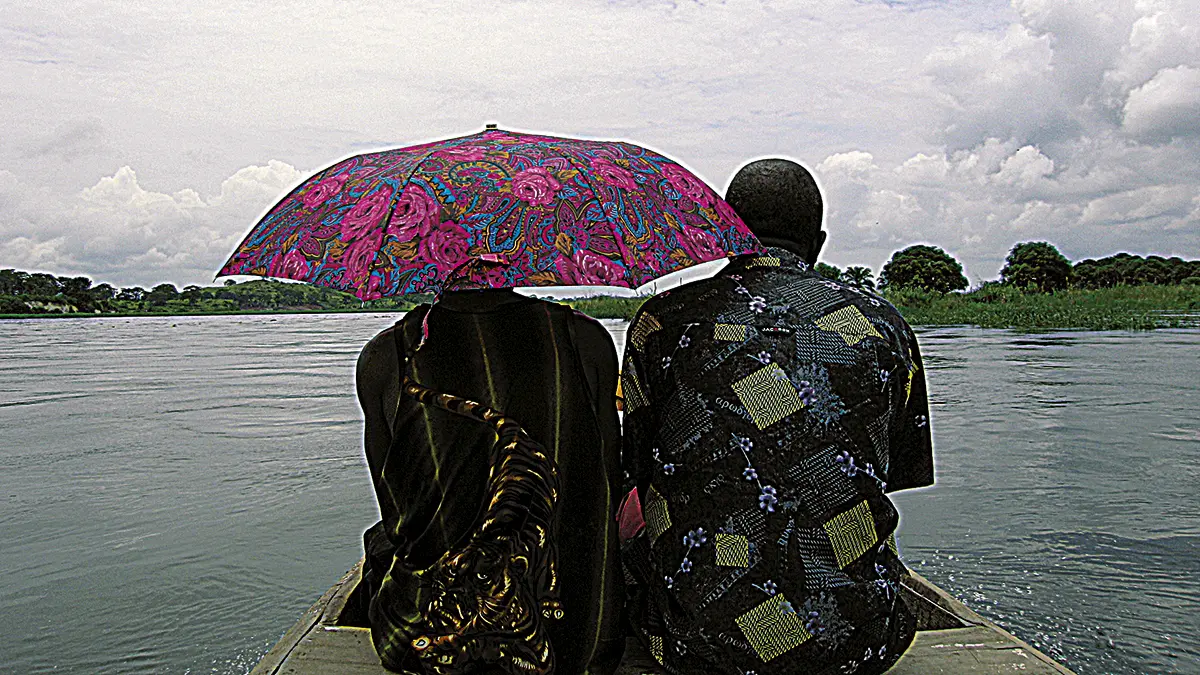
Muxima is a selective but rich tapestry of people, landscape, colors, and music that commingle rather than merge. Various versions of the song, with and without words, are part of the new text, which is heard rather than read. Jaar refers to short poems of lingering effect as his model and derives maximum effects from minimum means. The film was edited according to the rhythms of the music, but he extends the concept of rhythm to the fullness of light, color, and movement, although not to the exclusion of stillness. The faces of men riding a boat upriver appear noble as the camera simply locks on to them while music without words accompanies the scene.
Many still-camera shots of Angolans are intercut against movement to allow their faces to speak, in silence. I find these to be the most affective moments of the film, especially his choice to use silence as mothers, with photos of their children in hand, testify on camera on behalf of their “disappeared” family. The same can be said for the man removing landmines, whose effect is carried by the intensity of his gaze, the deliberation in his body’s movements, and the sweat across his brow.
Jaar’s heart has returned to a faith in the images of people as a text that speaks more clearly of personal costs and personal agency. But silence is also used to reframe his frustration. He freezes the frame at the end of each canto, with a fade to black to embody the realization that only fragments can accomplish what a single, united narrative cannot: reality can be suggested or encircled, but not represented. One of the cantos is constructed into rapid, brief shots of the ground, quick-cut to the running footsteps of an unidentified individual. This person arrives at an empty, outdoor stadium with a large, blank screen. Angola has no representation in the Western mind, no screen on which to replay its image. For Jaar, this is the continued problem for the artist but presented in new terms: to retain a socially committed position that neither abandons nor is seduced by the power of the human condition or the autonomy of the aesthetic.
RICHARD LESLIE