
San Juan’s Raíces Gallery presented Transcorpus, an exhibition of works by Puerto Rican artist Annex Burgos. Three life-sized sculptures were arranged inside a white-walled, decoration-free, and distraction-free space. This succinct, sober show summarizes Burgos’ proposal about the female body through an evocative metonymy. The lower part of the body is absent in the three sculptures, suggested by skirts made out of metal and iron rods. In Transcorpus, corporeality is not subjected to intense scrutiny; its forms are, in part, fragments of plaster mannequins and volumes achieved using metal plates or the contours of the rods that conform the skirts and a cage. For Burgos, the body is absence and emptiness.
To imagine a comparison between these sculptures and, for instance, the Delphos Charioteer, creates a sharp contrast. While the Greek artist attempted with great effort to suggest the bare feet of Polizalos of Syracuse, triumphant in the 470 Games, Burgos refuses to describe legs and feet, to shape the parts that suggest movement. The body beyond the body, as suggested by the show’s title, has disappeared, in part replaced by a linear container, an external contour, dressed in metal or iron. Nevertheless, this is not a restrictive, disguising attire, with the exception of the skirt in the work that gives title to the show, the others, Metacorpus and Ímpetu, show an interior where there is nothing to be seen. Symbol of containment, the metaphorical frame, the cage as a skirt, regulates what could be seen in the lower part of the body, associated with female sexuality and mobility.
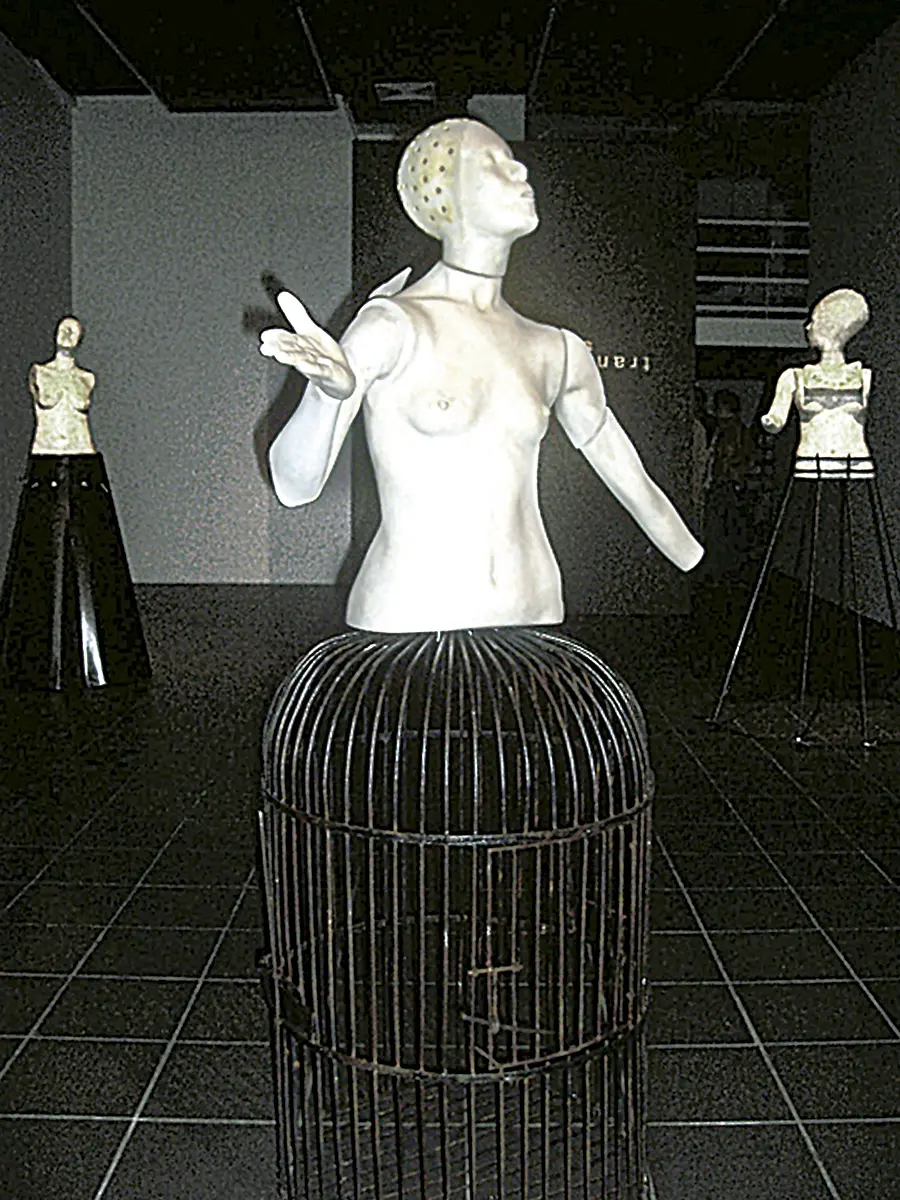
The formal division established by the plaster torsos and the metal or iron skirts could imply a bodily hierarchy where the lower part, associated with sexuality, to basic needs and functions, and to movement, is dismissed since it is not defined, while the upper part, governed by rationality and language, is privileged since it is given shape. But if Burgos’ sculptures intended to highlight such a hierarchy, they would reiterate a vision that, rooted in n Greek thought, has ever since Descartes been central to Western thought: a binary classificatory model based on the opposition between psyche and body. However, Burgos’ proposal can be conceived as contrary to this homocentric vision, because it recovers for women positive values of the mind that were associated mainly with male attributes.
Contrariwise, head and torso are, in a different sense, a reminder of the traditional conception of the body in Western sculpture and of the patriarchal vision on which is founded. The plaster works, imitations of marble sculptures, connote Renaissance art and Eighteenth-century Neo-Classicism. Their hard, smooth surfaces control the female body’s potential lack of docility, transforming and containing its voluptuous and sensual flesh in white, contrived, decorous shapes. Burgos situates her conception of the female body in the modernist tradition, somewhere between the mannequins of the surrealists and of high-fashion designers, and Dada’s ready-mades. This convergence of the ready-made and mannequins makes the female body in these works an entity dense with meaning and significance. Nevertheless, there isn’t here an interest in full visibility, since not the entire body becomes an image. Parts of the body are not knowable. It would seem that full visibility would take us to an appreciation of the female sexual body, more than a meditation on the body in art and as art.
Transcorpus refers us to the contemporary ambivalence between what is permissible and what is forbidden in the representation of the female figure. The body dressed in a skirt/cage made of industrial materials suggests the protection of a woman’s most private parts, that which has always been a threat to the art of the female nude. The discomfort and the anxiety about the forbidden are resolved by the alchemy of art, which turns matter into emptiness. The censored aspect of the artistic body in its decorous exhibition for the other is limited to what can be a part of representation and is double protected from gaze and touch; visually, it can be seen, and physically it can be touched. As the artist has said, iron and metal form a protective shield for the lower part of the female body, that part left to the imagination. The outlines of the skirts delineated in iron and metal possess a hardness that can’t be compared to the drawn or painted lines that establish the contours of a nude, nor can it be compared to the imaginary lines of a marble sculpture’s contour.
Thinking of the body in the context of postmodernity’s crisis of values, beliefs, concepts, and definitions, Annex Burgos reconstitutes the female body in the way in which scientists and engineers do. Plaster, iron, and metal are metaphors of the organic hybridism of a body that long ago ceased to be just flesh and bones.
INGRID MARÍA JIMÉNEZ