

“ I remember Celia Birbragher coming to visit with ArtNexus under her arm when in another distance and this nexus, this knot that was then —and still is— Latin America’s best art magazine”.
An old etymology links knots to nexus, nexus with signs, signs with ties, ties with waits, waits with weaving, weaving with analysis. Legein is, in the language of the ancient Greeks, the act of trying something: tying things with words, that impossible knot. The two figures that appear most closely joined in that spool of words are Ulysses and Penelope. Ulysses, because his chest has been tied with rope to the masts in order to survive the mermaid’s mortal song. Penelope, on her part, waits for him in Ithaca, doing and undoing her weaving, in an action whose etymology, when Laplanche has had to postpone Freud, reminds us that: analoien, analysis.
I remember Celia Birbragher coming to visit with ArtNexus under her arm, when in another distance and this nexus, this knot that was then —and still is— Latin America’s best art magazine served me to image a favorable place that could be called, it also, Ithaca. I was then only —and still am— a student. In the pages of ArtNexus I found a home for my letters, for the first time outside my country. I can say then that ArtNexus has been a knot, a nexus, a sign, a tie, await, and a weaving: there where the art of our region makes its nest, there where the South becomes North, there were the analysis that offers the necessary density for the demanding exercise of the gaze is done and undone.
Paul Celan spoke once of the striations of the gaze. The great poet was referring to the opaque islands that dance in the vitreous see of our eyes and that are neither a part of what we see —always dense—— nor of what sees —transparent by definition—. These striations could be the allegorical islands of the difficulty of seeing, of the incessant gaze, of the utopia of reaching what we see. The visible is, in truth, desire. It dissipates as soon as we believe we possess it. Only the voice, like a breath, can bring us close to the non-place that is to reach the gaze. None other is the exercise of art criticism. None other is the wait, promissory and luminous, that takes place each time, and each month, in this nexus of art.
LUIS PÉREZ ORAMAS
Adjunct Curator of Drawing Department of MoMA-New York.
“ Arte en Colombia/ArtNexus has also been a forum for the first expression of critical and art-historical voices. Indeed, the list of regular contributors is a who’s who of the region’s criticism”.
We don’t need to repeat what is well known: Arte en Colombia/Art Nexus has been a stalwart in the promotion of Latin American art within the Latin sphere and outside of it. In a country where cultural initiatives tend to lose momentum very quickly, and where projects are always for the short term, the longevity of this magazine (and its vitality after three decades ) is admirable.
Besides being the first to show the work of many Latin American artists at length and in-depth, Arte en Colombia/Art Nexus has also been a forum for the first expression of critical and art-historical voices. Indeed, the list of regular contributors is a who’s who of the region’s criticism.1 Fulfilling at once the roles of the current-affairs magazine, debate forum, and archive, Arte en Colombia/Art Nexus has accompanied the careers of all of us who have come up in the artistic disciplines since the late 1970s. Through its pages, we have gained access to texts by key figures in Latin American artistic thinking. Such as Marta Traba, Aracy Amaral, Juan Acha, Damián Bayón, Shifra M. Goldman, Ivonne Pini, Luis Camnitzer, Gerardo Mosquera, María Elvira Iriarte, Luis Pérez Oramas, Miguel González, Germán Rubiano Caballero, Alvaro Medina, and Carlos Jiménez, to cite but a few.
The magazine’s synchrony with the art of its times has been the key to its relevance: indeed, from its earliest issues, which devoted feature articles and covers to the work of Carlos Rojas, Fernando Botero, Juan Cárdenas, or Luis Caballero (all younger than 45 at the time,) to the most recent ones, dedicated to a young artist with an established oeuvre, like José Antonio Hernández-Díez, Allora & Calzadilla, Beatriz Milhazes, Alexander Apóstol, Jorge Macchi, Oswaldo Maciá, or Santiago Sierra —all of them born in the 1960s or 1970s— the magazine has been clear that history is made by betting on the art of the present at a time when it has yet to achieve the unanimous approval of the critics. In that sense, ArtNexus acts as a catalyst for artists in mid-career at a moment when the wide diffusion of their work is not only pertinent but especially useful.
Many of us have thought that it’d be ideal for the magazine to deepen even more this close connection to contemporary creation, by means of an editorial line that gave it pride of place. The young art scene in Latin America is strong enough to provide content for such a publication. But it is also evident that in the current context there are no publications with a continental reach that focus on more specific scenes, which would free ArtNexus from its sometimes too-wide spectrum. In the third issue of the magazine (January/March 1977,) in response to comments and suggestions provoked by the previous two, the editorial stated that: “Several sectors of opinion ask us for an editorial policy (…) This demand would be valid if there were in the country other specialized publications that could divide among themselves the opinions and interests of groups and factions. But as such publications do not yet exist and to date, Arte en Colombia is the only one of its kind among us, it has adopted a policy to guide its actions since the moment it appeared. This policy seeks to open the debate about art to the largest possible number of people (…) Arte en Colombia promotes the debating of art as an essential cultural matter and is interested in the vast public it aspires to reach in an effort at informative, clarifying, and didactic dialog.”
Thirty years later, those other publications are still to appear in Colombia. And in Latin America, the terrain of ArtNexus, there isn’t either any publication with a continent-wide reach and global circulation. The wait continues. In consequence, ArtNexus will continue with its work in the promotion and diffusion of Latin American Art.
NOTE
1. To clarify, I am on that list.
JOSÉ IGNACIO ROCA
Chief Executive of Temporary Exhibitions at Biblioteca Luis Ángel Arango, Banco de la República, Bogotá, and co-curator of the 27th São Paulo Biennial, Brazil.
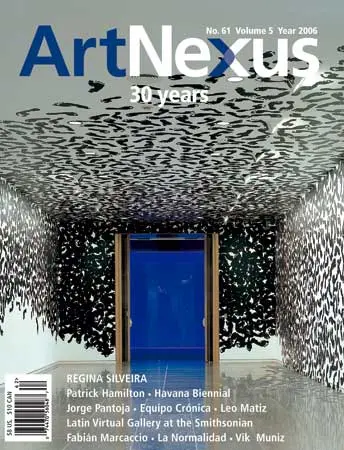
“ Throughout 30 years we have had the vision of uniting and linking the most outstanding visual arts from Latin America with the international context”.
Today, on reaching 30 years of uninterrupted labors of Arte en Colombia/ArtNexus, I recall when we began together with Carbonell (q.w.p.d), the first executive editor. For me as the director, it was another project of the many that I had carried out as a student of Fine Arts at the University of the Andes. At that time I was working as a sculptor and thought that in five or six years I would organize the magazine and return to sculpture. Time passed and the project grew; it became a challenge, then an obsession, and today perhaps a responsibility.
In the hands of my daughter, Francine Birbragher the office in Miami opened to respond to international circulation, and Francine continues to be a valued consultant and writer.
It was because of that, that from May 1991, besides Arte en Colombia, we published ArtNexus in Spanish and in English. This name obeyed the interest and spirit that we have had throughout 30 years, the vision of uniting and linking the most outstanding visual arts from Latin America with the international context, a spirit that still motivates us. It was my formation as an artist that allowed me to see and feel art passionately and even when the work has been intense, I don’t feel the interminable hours of work. To travel, visit and participate in museums, galleries, fairs, and biennials have been a privilege that has allowed me to learn and share.
The credit for the prestige and quality of Arte en Colombia/ArtNexus goes to all of those who have accompanied us throughout these years, writers, announcers, consultants, and the working team. Credit goes especially to Ivonne Pini who, after Galaor Carbonell, assumed the position of executive editor and she has been carrying it out excellently for 18 years.
We currently have more than 100 collaborators of many latitudes - fitting people whose opinion prevails above any other interest.
The economic support of institutions, galleries, museums, and dealers has allowed this project to grow, maintaining the independence of the editorial space above the commercial. Arte en Colombia/ArtNexus has taken over as one of the most important magazines of the international circuit participating in art fairs, supporting and advising projects, museums, and fairs.
ArtNexus.com
The ArtNexus.com website was launched in October 2001 after working for a year with a team of specialists. It was my daughter Susanne Birbragher who led the ArtNexus.com project and who had the vision to develop projects with fairs and museums to expand the projection of ArtNexus to an international level.
At that time I wrote: “We have seen Internet businesses succumb, but we are as convinced as we were 25 years ago when we predicted that a magazine in Latin American art did not have the possibility to survive, that the Internet will allow us a new and wider form of communication”. Today we have more than 41,000 subscribers who receive our News Bulletin via email, also offering this service to recognized art institutions. We currently have 150,000 visits monthly and the 106 editions of the magazine published to date are indexed on the site.
Documentation Center of the ArtNexus Foundation
For the last few months and under the consultancy and supervision of Mario Cifuentes we have been organizing the Documentation Center of the ArtNexus Foundation. For the occasion of our celebration of 30 years, we hope that more than 9000 art documents such as books, catalogs, magazines, CDs accumulated since my time as a student will be put at the service of the artistic community.
To my husband León and my daughters Francine, Denise, and Susanne from whom my work has taken their time, I wish to thank them for their support and understanding since they have understood my love for art and the labor that we have carried out.
CELIA SREDNI DE BIRBRAGHER
Editor and Director of ArtNexus/Arte en Colombia