
Last January 19, the Mexico City gallery OMR opened for the public the show La Gran Noche Mexicana (The Great Mexican Night), with paintings by Daniel Lezama (Mexico, 1968.) It was indeed one of the signal events in a variegated beginning of the year, filled with controversy and fresh polemics. The show comprised 11 paintings, seven of them in formats larger than 200 cm, and 15 drawings that are essentially sketches for the works on canvas.
Entering OMR on opening day was to discover the show’s emblematic work in the gallery’s main wall, La Gran Noche Mexicana. In this 240 x 300 cm. oil-on-linen work we see a group of naked women whose physiques are far from those that the Western beauty canons mark as desirable. Almost all of them are overweight, their bare breasts sagging, six of them have painted on their bodies the letters that spell MEXICO.
However, the narrative of this work needs to begin with a review of the recognizable characters it includes. First is Daniel Lezama himself, of whom we see a partial figure and the arms supporting an easel. Next, two men, a worker, and a bureaucrat, carrying a child on their shoulders. To the left, in front of the easel held by Lezama, Paul Gauguin, and Vincent Van Gogh seat at a table. From left to right, we see rap artist Eminem, the young Mexican curator and art critic Eric Castillo holding a baseball bat, singer Juan Gabriel (who sings Hasta que te conocí (Until I Met You), the title that appears on the side of the hot-dog cart); later and in the background is Alejandro Benasini, and to the far right, the Virgin of Guadalupe…
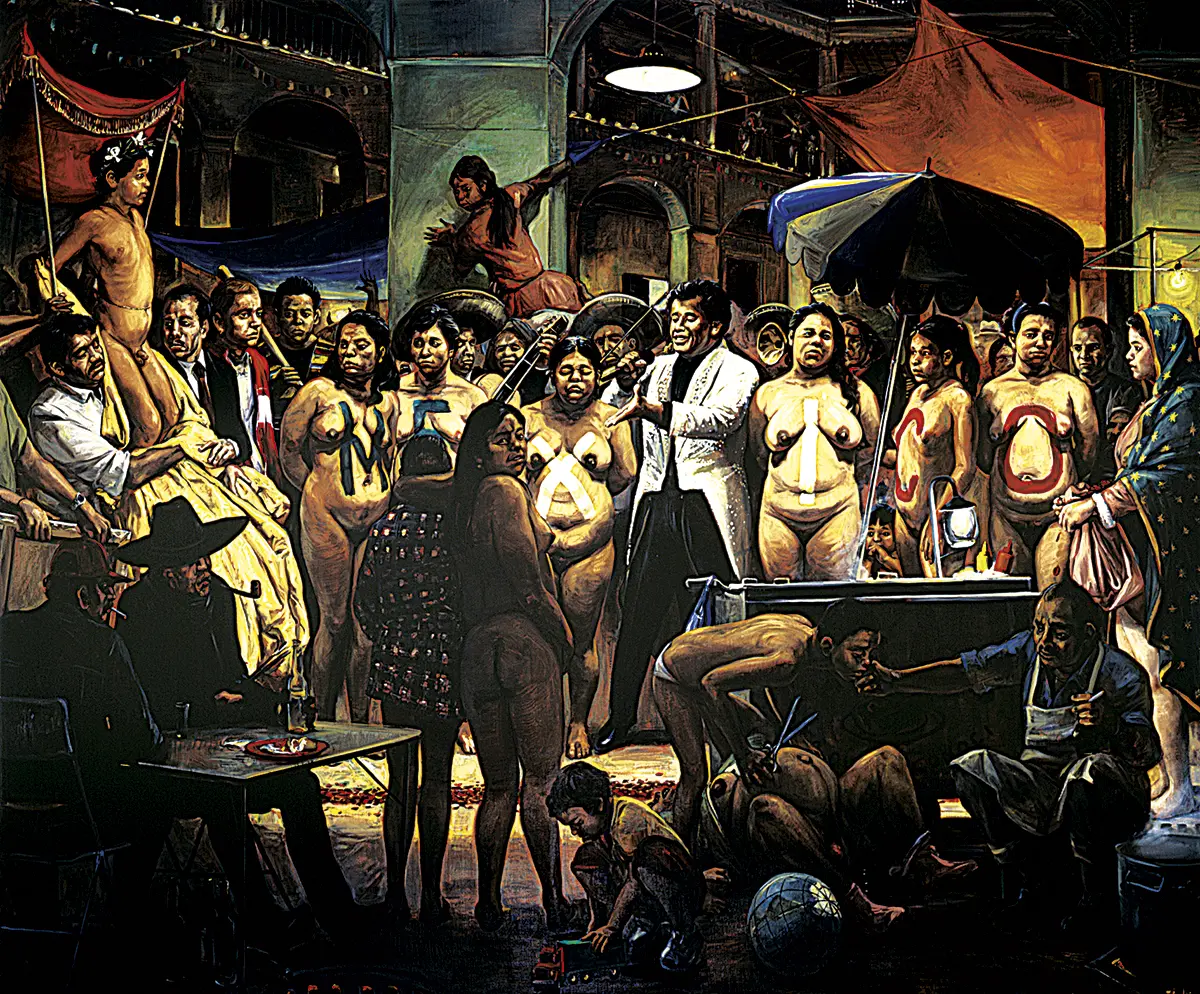
This work deals with the issue of the Mexican people need to identify with something, which is the reason why the song Juan Gabriel sings is precise Hasta que te conocí (Until I Met You), since, as Lezama says, “…the Mexican people possess great wisdom, even among illiterates. It is a people who live on a daily basis the self-sought otherness, the possibility of being another based on its rejection of itself, its negation of itself; but the search never ends, because that search is already in itself an artistic attitude, which is why I represent it as the pathway that one needs to follow to reach the origin, this is to say the mother represented by the Virgin Mary and whom we reach following a path of rose petals.”
More than being immobile symbols whose signifying charge remains still, or simply given to each member in its arrays of characters, these beings are charged with symbolism that is in movement and interact with each other, changing and mutating not only within a given work but even lending each other meanings within Lezama’s production as a whole.
Lezama understands that speaking of identity at this point can have as many angles as cultural origins can be imagined; this is why he assures us that that which identifies us, referring to the works in his show, is the search for “an I that is another; the I that is the promise, the I that is what remains to be discovered…” In his eyes, festivities in Mexico and in our culture are filled with fantasy, of bodies in labor while the celebration follows its course, of drunken men, of naked women who have painted their bodies, of a court of individuals who some times take part in this marvelous chaos and other times simply ignore it and let it follow its free course.
To talk about Daniel Lezama is to refer to one of the most radical painters in the Mexican scene of the last years. With this individual show, Daniel Lezama has once again discomfited all the good consciences and, without seeking in his work anything beyond the satisfaction of his intimate expressive needs, confronts the viewer’s eye with pictorial founders such as Raphael, Caravaggio, and Tintoretto, appearing in his work as the masters who give origin to the structure, lighting, drama, and even his readily identifiable palette.
This admiration is reflected in Lezama’s canvases, but there is another, more evident one, which is to include among his characters two of his admired creators: Van Gogh and Gauguin. They are now part of the cast in works like La Gran Noche Mexicana and of course, the explicitly titled Vincent and Paul en América.
However, these sometimes direct, sometimes veiled references would seem to elude us when we find that the sublimated dreams presented in Lezama’s works are situations carried to their most extreme reality, if by extreme we understand the faithful reconstruction of the body aesthetics of the majority of Mexicans, including a vast catalog of gestures, attitudes, and poses.
In his latest period, Daniel Lezama has tended towards compositions of large groups of characters. This evident compositional freedom, which was not present before in works where at most three figures per canvas were included, gives the show’s reading a particular strength. These are, at any rate, works that support careful review, coming from the hand of one of the most provocative of today’s painters.
SANTIAGO ESPINOSA DE LOS MONTEROS