
An exhibition of the work of El Equipo Crónica is currently traveling through South America. Though not exhaustive, the present exhibition comprises about sixty pieces and offers a rare opportunity for a retrospective overview of the group. That this exhibition can achieve the status of a retrospective is especially remarkable given that the show is limited to works owned by the Instituto Valenciano de Arte Moderno (IVAM), or Modern Art Institute of Valencia, and consists of some paintings but mainly of silk-screened prints.1
The work of El Equipo Crónica is one of the very few examples of art production outside England and the U.S. in which an original language connected with the Pop Art movement was developed. It is also an interesting example of teamwork in art production.
El Equipo Crónica, literally “Chronicle Team,” started with three members—Rafael Solbes (1940–1981), Juan Antonio Toledo, and Manuel Valdés (b. 1942)—from 1965 to 1966 and then comprised only Solbes and Valdés from 1964 to 1981. This group may be considered a phenomenon in Western art of the second half of the twentieth century. For one thing, teamwork, as represented by El Equipo, was rare in the period in which they were working, especially among artists espousing realist aesthetics. A contemporary of El Equipo Crónica was El Equipo Realidad that functioned in Valencia from 1966 to 1978. Some later examples are the duo of Komar and Melamid, originating in the USSR and continuing in the U.S. between 1973 and 2003, and the Cuban duo of Eduardo Ponjuán and René Francisco Rodríguez, who worked from 1986 to the mid-nineties.
Seen more locally, it is also quite amazing that El Equipo produced this body of work while in Spain. The political edge of the group’s first pieces came from being mostly made under and against the Franco regime and its values and beliefs.
The IVAM, the owner of the collection and sponsor of the show, is an institution that began operation in 1989. It was the ideological project of Tomás Llorens, an art critic who was very close to El Equipo Crónica throughout the life of the group. This fortuitous coincidence explains the fact that a public institution was able to build a collection of this magnitude.
El Equipo Crónica started as a fragment of a bigger group, or rather event, a national movement known as Estampa Popular, or Popular Print. Estampa Popular was formed by various Spanish artists who were interested in the use of printmaking as a political expression. The majority of them were artists sponsored by the Communist Party and had local chapters in each province. In 1964, Estampa Popular organized an exhibition in Valencia, which included the participation of the three artists who shortly afterward would form El Equipo Crónica. Considering its purpose and intention, Estampa Popular included mostly predictable images: figurative ones with distortions accentuating a political message, firmly anchored in the tradition of expressionist woodcuts of the early-twentieth-century and popular prints. Subsequent to this exhibition, and in spite of the fact that printmaking and particularly silkscreening remained a frequent vehicle for their images, El Equipo Crónica focused on painting.
While El Equipo Crónica adhered to realism during the span of its existence, its approach was more expansive than narrow. In their definition, reality consists of more than merely the original objects commonly accepted as representing visual reality. They also focused attention on the means used to reproduce images of these objects, in particular on commercial printing. With this step, while remaining ideologically close to Communist dogma, the group positioned itself away from the Party’s emphasis on the aesthetics of Soviet social realism. In the group’s view, the mediated reality is an intrinsic part of our present way of seeing; this renders as outmoded the nineteenth-century view that reality is only what is immediately and directly sensed.
This expanded definition of reality brings the artists from El Equipo close to the artists of North American Pop Art, while at the same time keeping them at a distance from the Pop Art movement. The El Equipo artists perceived that a distance exists between the individual and the environment. Tomás Llorens, who for all practical purposes may be considered the group’s theoretician, once described their organization as a mode of “defense against subjectivist tradition."2 The artists themselves wrote in 1966, “We apply collective ways of working for supra-individual goals."3
In this exhibition of El Equipo’s work, it is the group’s distance from Pop Art that is shown most clearly, more than their connection with the movement. Pop artists, in their search for a language based on commercial icons, also tried to establish personal calligraphy that would identify them as individual artists, not to express the subjective or the emotional but rather to parallel the process by which commercial brand names achieve distinctiveness. Their goal was to impose a personal set of images without leaving individual traces, the achievement of a form that could make subjectivity itself seem objective.
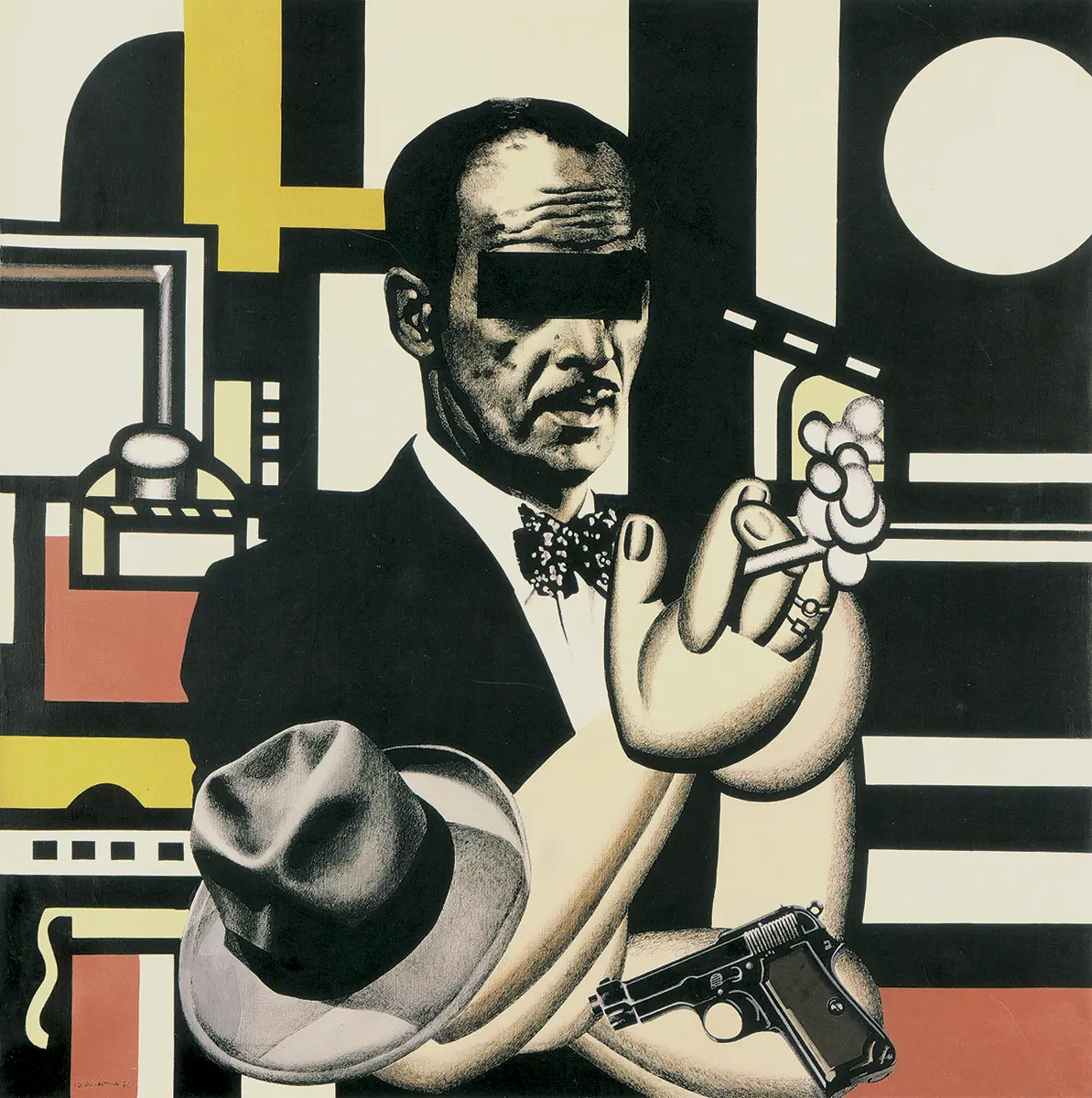
In the work of El Equipo Crónica, the search for an individualized brand or trademark is absent. The sterile look of the work is fully intended and there is no discernible attempt to define or suggest an individualized style. Ironically, the fact that their works are recognizable as an identifiable body separate from that of other artists could, in their case, be considered as a sign of failure.
Producers of art may be crudely classified into two groups, one that consists of artists who create games and their rules and one that consists of artists who play games originated by others. Duchamp created games that he tended to play only once. Matisse was a virtuoso player of a game defined by the historical tradition of painting, even if he introduced some adjustments to the rules. Midway between these two poles, we can place El Equipo Crónica. But their middle position between these two is outside these extremes. If the Duchamp-Matisse continuum is a line, El Equipo Crónica inhabits a point above the line, creating a triangular scheme. El Equipo Crónica plays with the rules that already exist but also introduces one new rule: critical distance.
With this critical distance, El Equipo is able in one single production to analyze both political and artistic conditions. One can say that El Equipo adopts an anthropological vision, similar to that of Icelandic painter Erró and of the art teams mentioned earlier. But while Erró and the others are eclectic, and Erró in particular travels anarchically through different art styles, El Equipo is firmly rooted in graphic design. It is this footing in design that provides coolness and stylistic unity to the work of El Equipo. Even in those cases where the group uses the type of crosshatching typical of freehand drawing, there is a nearly machine-like mediation in the process, yielding a poster effect.
It is interesting to note that when the artists themselves discuss this mediation, they refer to what they are doing as a “Brechtian distancing.” The excellent catalog to this exhibition— which, with its long explanations for each piece, offers something of a catalog raisonné of the works in IVAM’s collection—cites at length Llorens’s texts on the importance that Bertold Brecht had for the artists: “The influence of the Brechtian doctrine of distancing on the work of the El Equipo . . . implied a conception of the function of art as activation (mobilization) of the spectator’s experience, and a trust in the semiotic efficacy of the ready-mades system of visual communication . . . . We had seen in Brecht a precursor and parallel action when he gave priority, in theatre presentations, to rules and conventions in opposition to naturalism and expressionist psychologist forms."4
In terms of composition, the first works of El Equipo clearly show the influence of Warhol in a serial repetition of the image and its rendering as a poster. In light of Llorens’s comments from ideas he formulated in 1966, however, we can view the group’s debt to Warhol as more a matter of recycling than of derivation. For El Equipo, Warhol’s tools were visual devices that allowed them to achieve an initial approximation of Brechtian distancing.
The group’s Warhol-like repetition of images ceased in 1966. One-piece not in the exhibition or the collection of IVAM, Concentración (la cantidad se convierte en calidad [Concentration (quantity becomes quality)] from 1966 illustrates the importance for El Equipo Crónica of ideology over form and also signals the change to come in their work. Composed of a square formed by nine panels, it is no longer an exercise in repetition but, as in comic strips, it successively adds more information, increasing the size of a group of people until there is a crowd in the last panel, presumably engaged in an act of protest.
The same year, the repertoire of El Equipo opened to include anamorphic and topological distortion of images. As with the repetition of panels, these distortions had a precedent: a year earlier, the Argentinean artist Jorge de la Vega used this type of distortion quite effectively. But 1966 is also one when El Equipo seems to define its future path. It is the moment when the group fully assumes historical quotes and consistently constructs work on the basis of the work of other artists through the history of art. When El Equipo recycled Warhol, they were not quoting him. The visual device was interesting for its efficacy; it mattered not who originated it. In 1966, however, the author of imported devices becomes important in the work of El Equipo. In the silkscreen print Barroco Espanol (Spanish Baroque) from 1966, characters from Velázquez, El Greco, and Goya appear at a table filled with food and against a Lichtenstein sky. The use of anachronisms becomes a satirical instrument for El Equipo, with classical characters symbolically taking the place of the Spanish oligarchy.5 Iconic images from Western art history are used to point out how culturally validated imagery contains and projects social values. Historical images become both conventional and are used as a container for symbolic values.
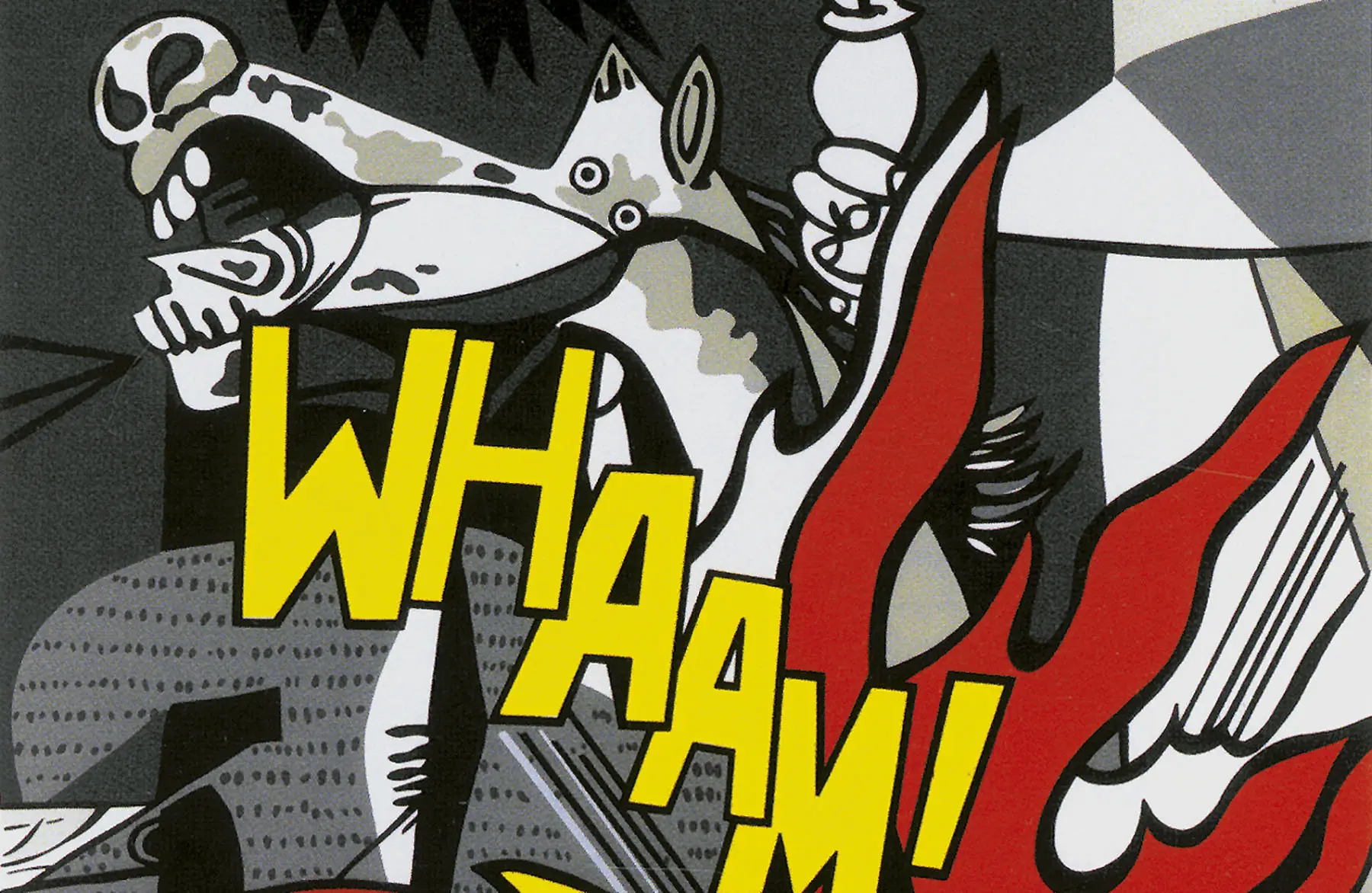
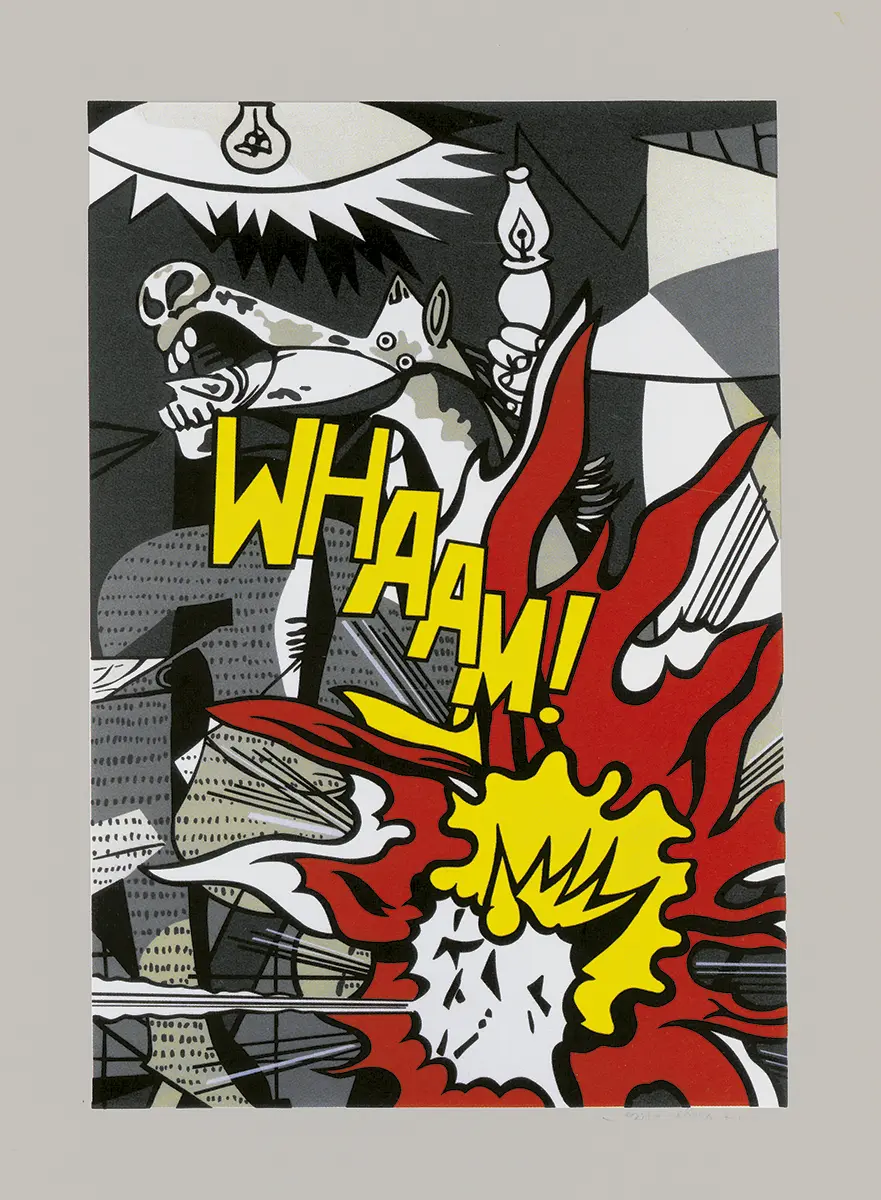
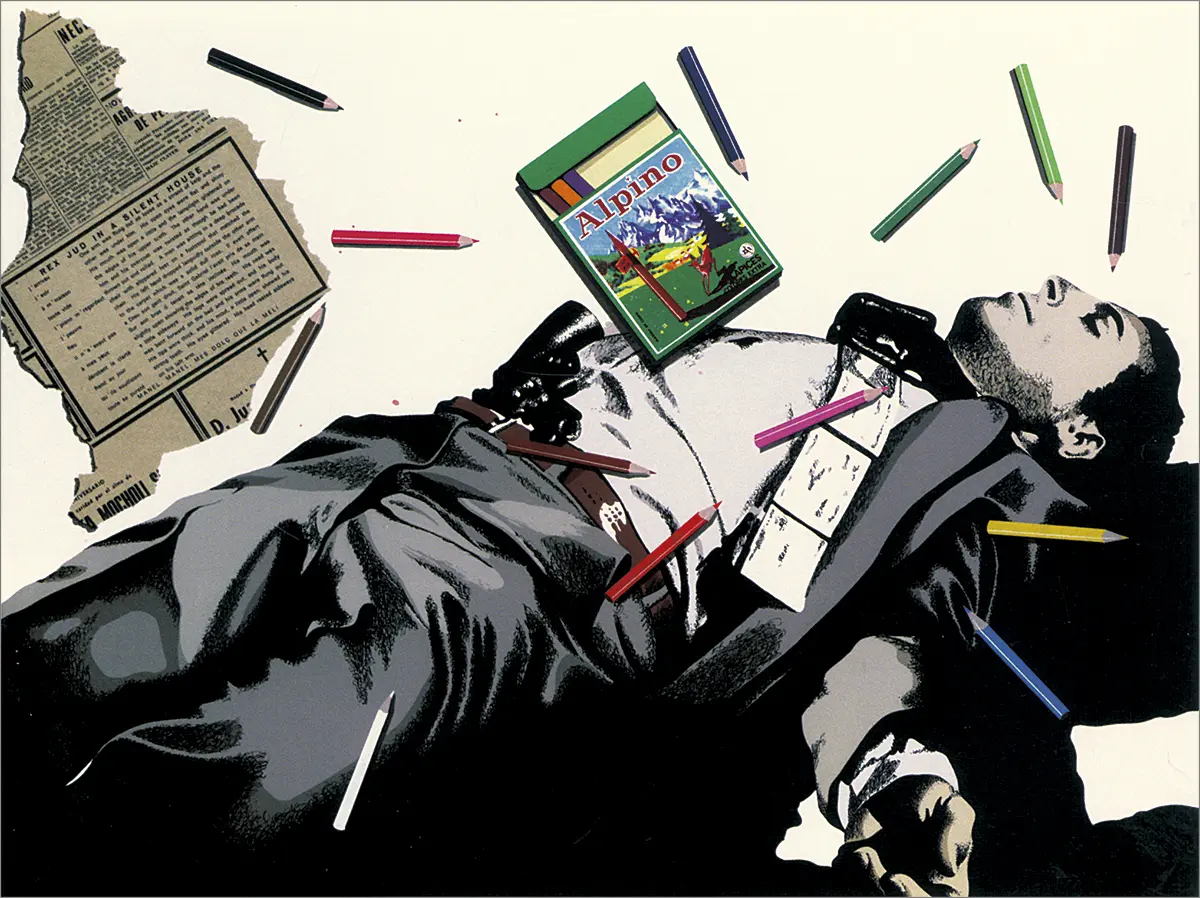
The inclusion of art history in the work of El Equipo Crónica becomes a double-edged sword with respect to their political development. In the beginning, they emphasized political accusation, but increasingly they shift into playfulness, digesting the political statements reflected in the work of other artists. Their best-known work, using Picasso’s Guernica, illustrates their more political phase. In their Guernica (1971), a Lichtenstein comic-strip explosion is depicted as the culprit of the drama in Picasso’s painting. In subsequent work, while references to violence remain present, the political message becomes more indirect and increasingly diluted. In the Serie Negra (Black Series), initiated in 1972, photographs of gangsters taken from police chronicles and from movies are incorporated into modernist paintings. Constructed with black, grays, and white, with color used in bloody or sometimes humorous ways to rivet our attention, they constitute the most somber and threatening works in the exhibition. In some images, as in the painting Los impactos (The Impacts) from 1972 and a later silkscreen print Lápices (Pencils) from1975, the attack on the victims is performed with colored pencils. The atmosphere here is not contemporary but rather nostalgic for the “Roaring Twenties” and the post-World War II period. In this sense, the images do not evoke terror as a phenomenon of daily life, as previous works did.
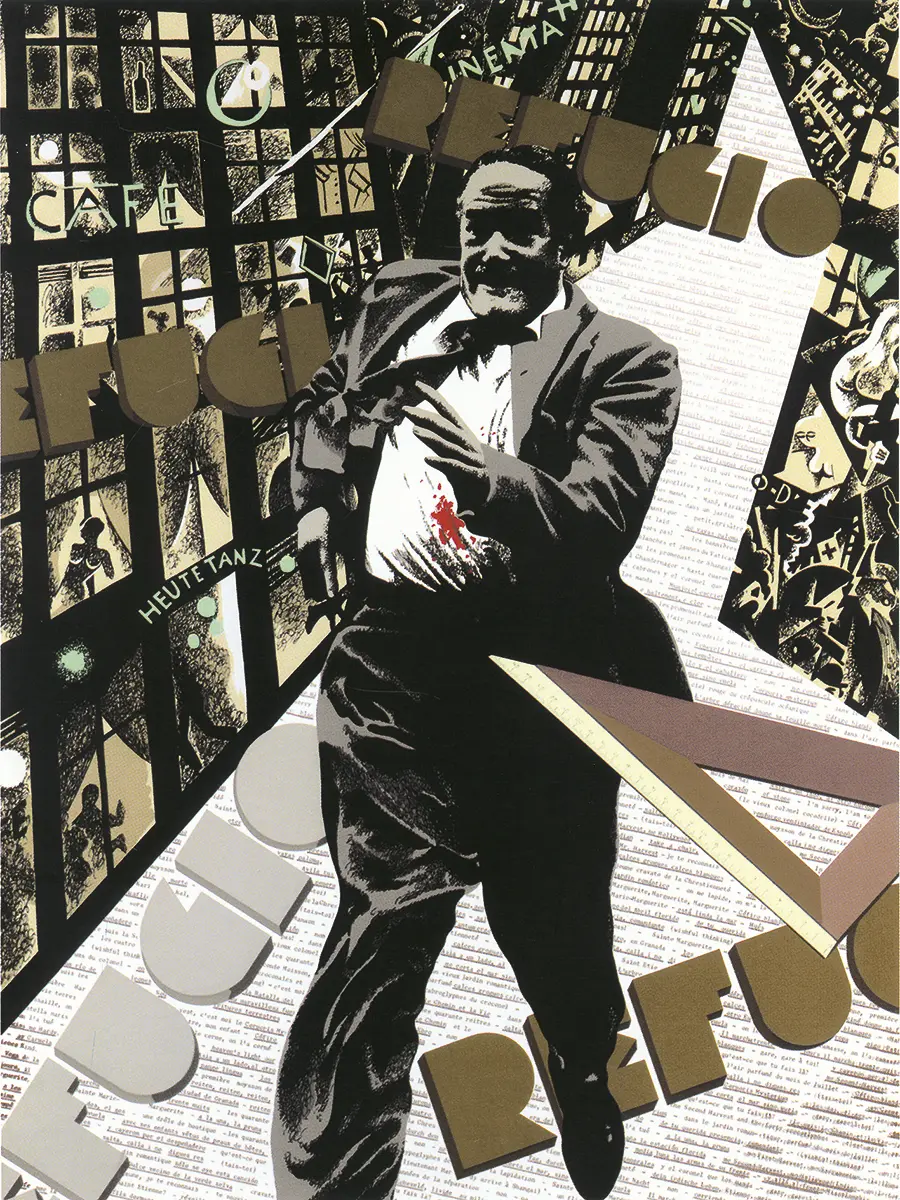
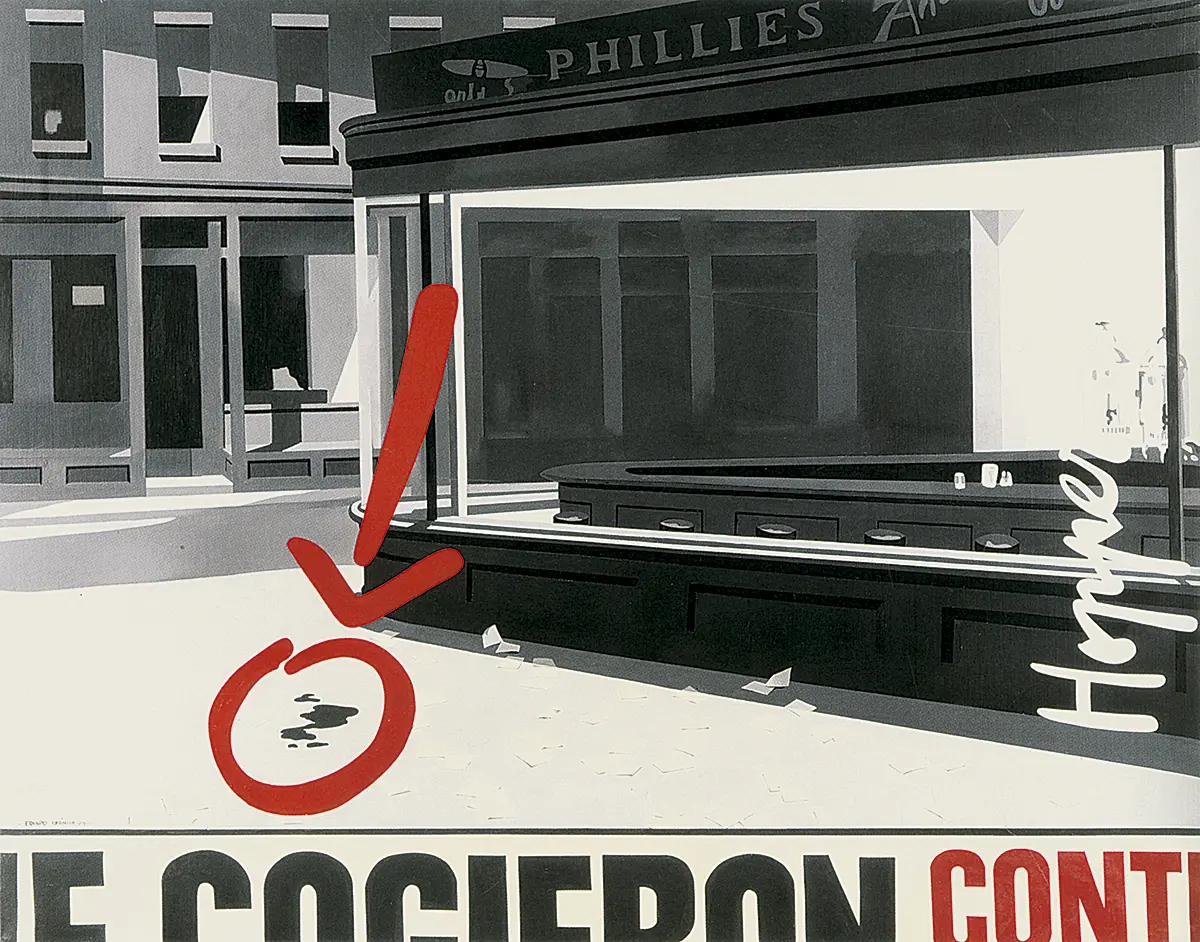
Though contemporary political reality fades, violence remains in their work, either explicitly or as a latent presence. Weapons of aggression continue to be drawn from the artistic toolbox with ironic effect. In Vallegas Melody (1972), a red paint tube and two squirts of paint float three-dimensionally over a musical presentation on a Broadway stage. In Refugio (Refuge) from 1975, the wounded victim tries to escape from a George Grosz background. Probably the most memorable piece in this part of the show consists of detail of Edward Hopper’s Nighthawks, translated into a black and white image. The added blank white fliers and a black bloodstain seem to suggest a political event. The only color in the piece appears in a circle rendered over the painting, with an arrow pointing to it, as though to establish the precise point at which violence had occurred.
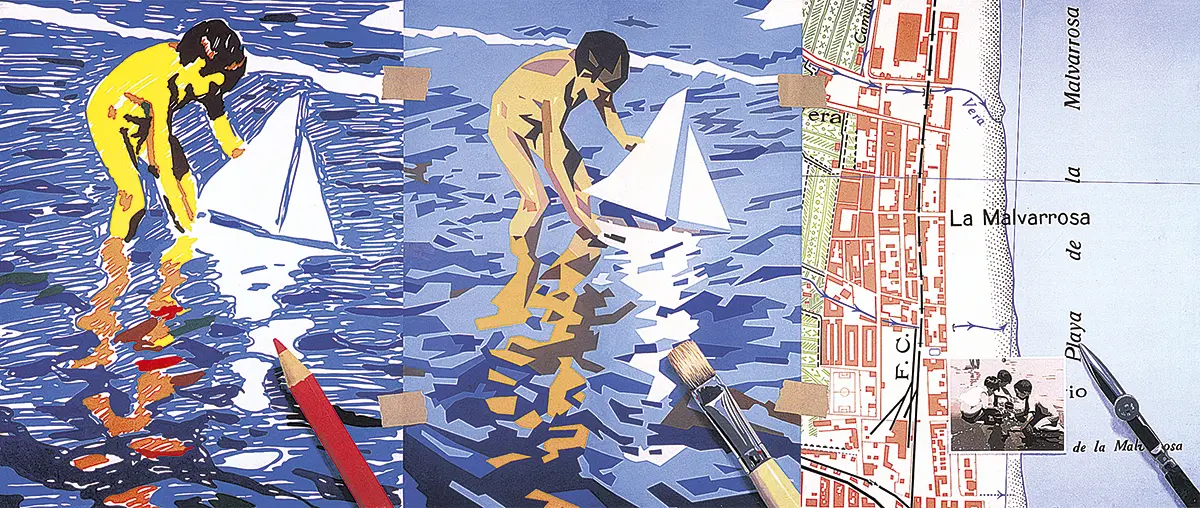
Increasingly in El Equipo’s work, historical quotes gain even more importance, hiding everything else. Joaquín Sorolla’s 1909 painting of a child playing with a sailboat, El balandrito (The Little Yacht), is transformed into a triptych about the mediation of reality performed by painting. In El Equipo’s 1974 Sorolla como pretexto (Homenaje a Sorolla) (Sorolla as a Pretext [Homage to Sorolla]), the first version of the image is made as if drawn with a color pencil; the second is made as if painted in oils but presented as a geometric composition; the third takes the form of a map of an area of the beach at La Malvarrosa and includes a photograph of children playing at the edge of the water.
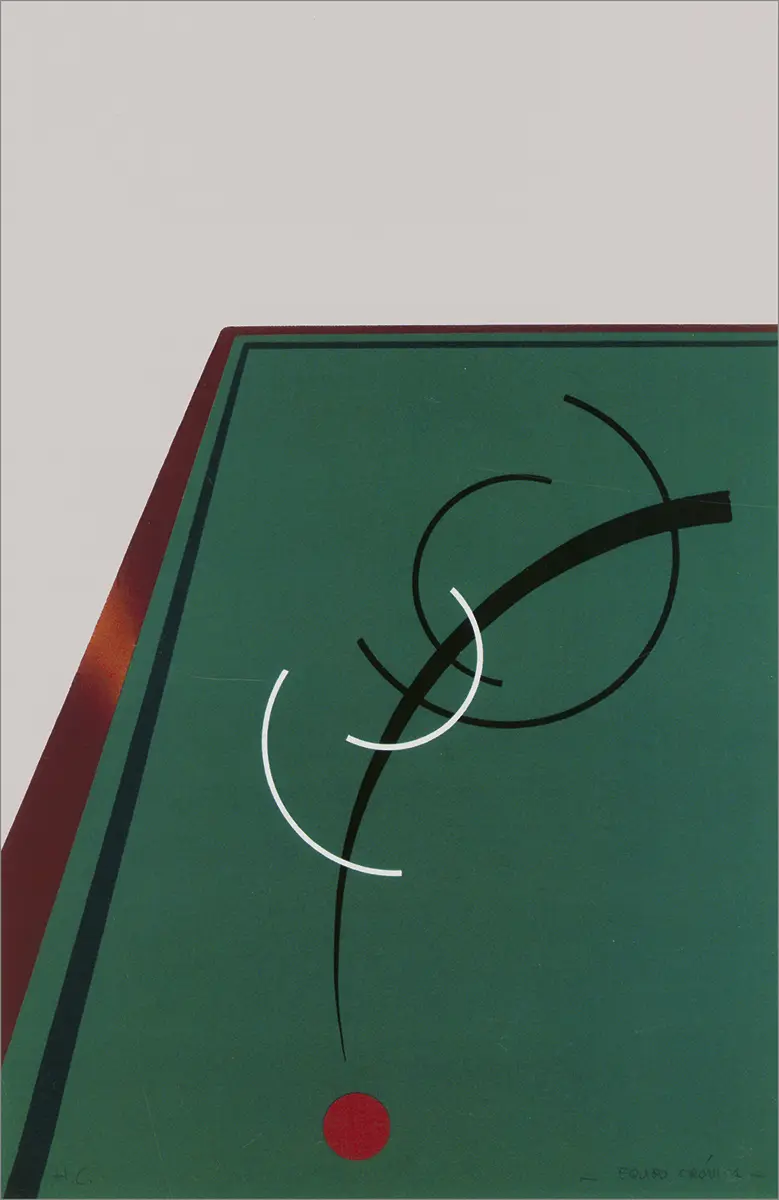
At the same time, the group’s works become more elegant, culminating with the 1977–78 series El billar (The Billiard Game). Paintings by El Lissitzky and Kandinsky are integrated into the pool table into a geometric room. 44 El (1977) and Jugada Kandinsky (Taco de billar) (Kandinsky Play [Billiard Cue]) from 1978 avoid falling into frivolous decoration and are impressively beautiful.
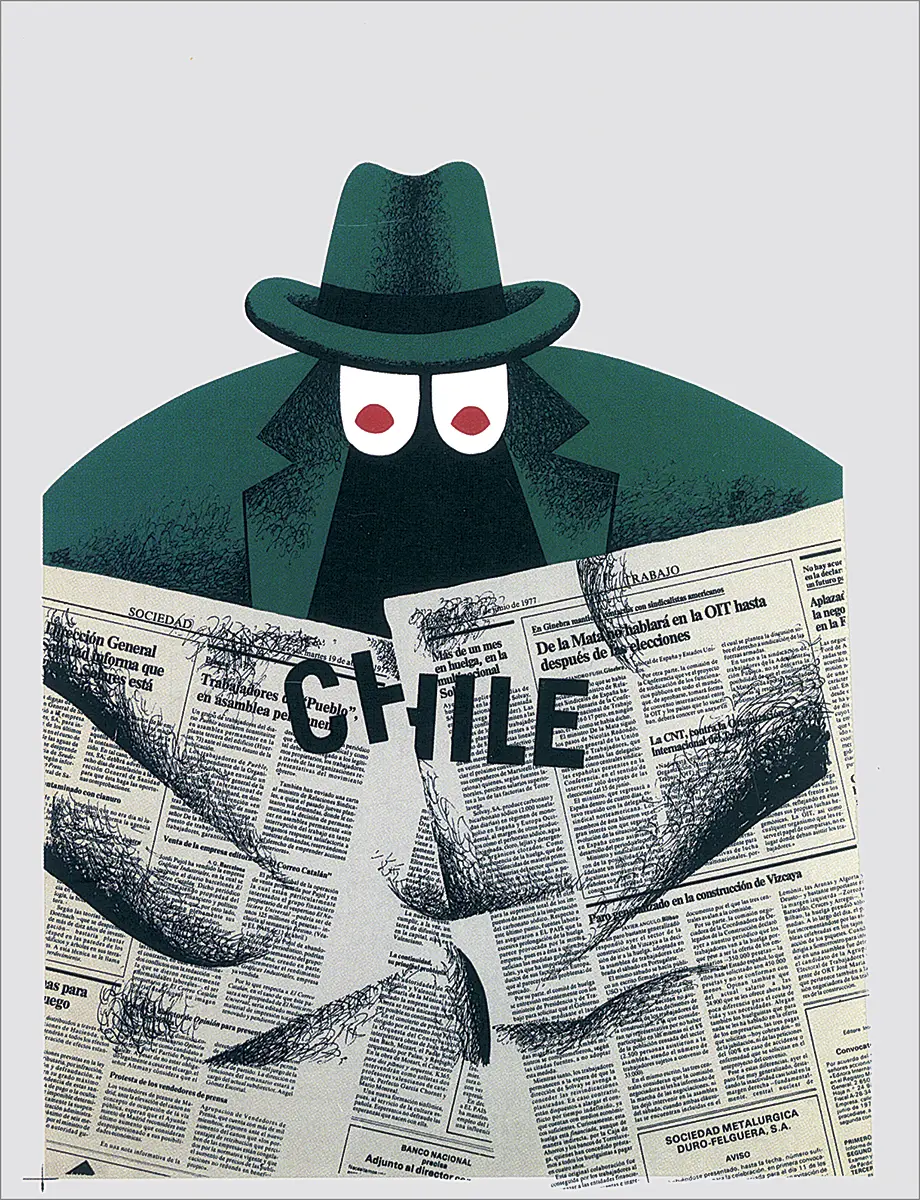
After the El billar series, El Equipo seems to lose its compass. The group created a political work to protest Pinochet’s 1978 decree that abolished political parties in Chile, but after that, and until Sobel’s death ended the group’s activity, El Equipo ceases to evolve and concentrates on combinations and variations of earlier solutions. Masters of modernism reappear in impeccably designed paintings and prints, but the bite of the group’s earlier work in this mode is missing. What had started as a remarkable rebellion here ends as a gallery of good art.
But the delight in seeing so much work of El Equipo Crónica in one exhibition is not diminished. If nothing else, we are reminded of how difficult it is to keep fertile and alive a spirit of subversion in art, how nearly impossible it is to escape the tentacles of a culture that reinforces the power structures that govern us. The work of El Equipo’s first years serves us well, however, as an example for generations of artists yet to come. They show how, even within accepted and conventional schemes of art, rebellion is viable.
(Edited by Selby Hickey)
NOTES
1. “El Equipo Crónica en la colección del IVAM,” March 2–May 2, 2005, Museo Nacional de Artes Visuales, Montevideo; May 24–July 22, 2005, Museo del Barro, Asunción; September 7–October 16, Centro Cultural Recoleta, Buenos Aires; October 26–November 24, 2005, Centro Cultural España, Rosario; December 15–January 2006, Santiago de Chile.
2. Facundo Tomás, “El Equipo Crónica cuarenta años después,” in Facundo Tomás, Sofía Barrón, e Isabel Justo, El Equipo Crónica en la colección del IVAM. Valencia: IVAM, 2005. P.32.
3. Ibid.
4. Ibid., p.123. Tomás Llorens, “La distanciaciación de la distanciación” 1973.
5. Ibid., p. 141. Facundo Tomás, note 11.
LUIS CAMNITZER
Uruguayan artist, emeritus professor at the SUNY College, Old Westbury.