
When I first received the postcard advertising Fernanda Brunet’s new exhibition at Ramis Barquet, I was utterly perplexed, for it featured a photograph of what appeared to be edible pastel flowers crowded together on one plane. As an admirer of Brunet’s paintings, I became concerned that the artist had abandoned her medium to embrace photography instead.
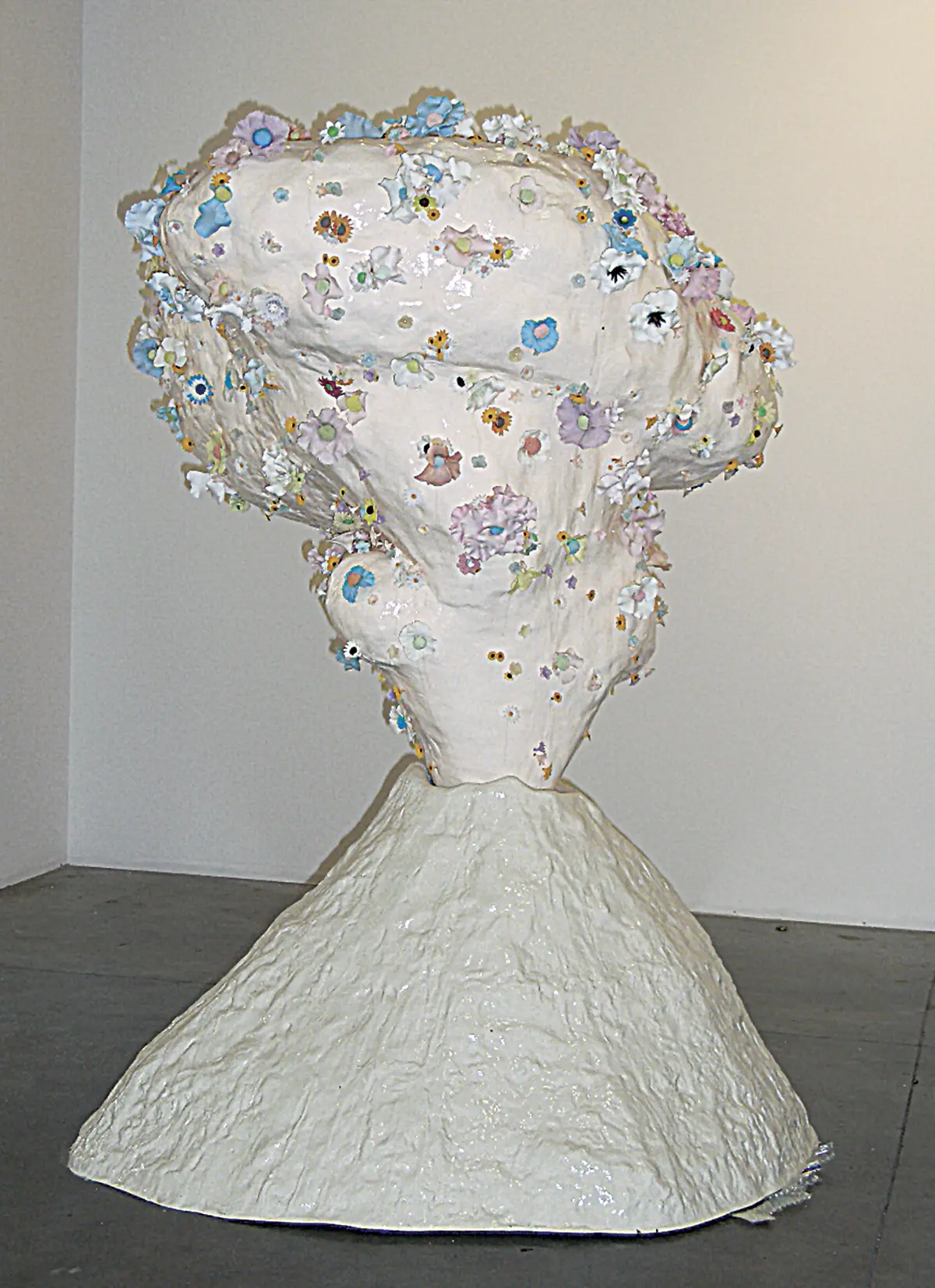
My fears proved unfounded – sort of. The artist has not given up painting, but she has begun exploring the sculptural realm. What the postcard depicted resembles a close-up of one of her new sculptures, a free-standing, life-sized representation of an erupting volcano in pink fiberglass with small pastel flowers made out of bread dough adorning the gushing lava. The work is deliberately campy, seeming to mock tropes of femininity. It recalls wedding cakes and quinceañera (the Latin American equivalent of sweet-sixteen) dresses in all their tacky excess. Because of their scale and medium, they also have an emphatic presence.
Brunet has long been known for her paintings exploring female sexuality. The volcanic eruptions, explosions, or flowers in full bloom that make up her visual repertoire are hardly subtle in their orgasmic exuberance. But they are also highly decorative works, which, like Georgia O’Keefe’s flowers, maybe admired exclusively for their formal characteristics, sublimating their sexual undertones.
The volcanic sculptures do not allow for a purely formal encounter. Rendered in skin tones and occupying real space, they insist on a bodily identification with their viewers. They resemble organs that secrete, such as a vagina, phallus, anus, or breast – in short, they allude to the taboo parts of the human body. Exhibited alongside the volcanoes, wall reliefs entitled Drops, consisting of the same pink fiberglass with flowers attached but on a much smaller scale, also look like body parts, whether internal or external organs. It is the volcanoes, however, that command the most attention. The clean sharp lines and matte colors of the flowers contrast with the volcanoes’ shiny, irregular surfaces, which resemble nothing so much as chewing gum. The rough-hewn look of the sculptures also recalls children’s science projects. These consciously vulgar pieces deny traditional associations of talent or artistic ability attributed to works of “high art” and instead engage in a deskilling of the art object, insisting on their own materiality. Unlike the sublime connotations of the volcano in art in the paintings of the nineteenth-century traveler artists to Latin America or the great Mexican landscapists José María Velasco and Dr. Atl, which often explore themes of spirituality and awe in the face of nature, Brunet’s volcanoes desublimate the subject by grounding it in the matter, positioning it directly on the floor, making the volcano into an outlet for bodily referents, and rendering it in kitsch pastels. These sculptures make visible repressed desires in an unequivocal way.
For Brunet’s longstanding fans, her three-dimensional work may come as a surprise, and perhaps not a welcome one. To those of us who admire the vibrant colors, dynamic compositions, and constant freshness of her paintings, the volcanoes look strangely static and one-dimensional. Fortunately, the exhibition also included new paintings, mostly crammed together in the gallery’s back room. These were for the most part representations of flowers, volcanic eruptions, and sometimes both, rendered in flat metallic and neon colors. Their haphazard presentation, arranged from floor to ceiling with disregard for size or any other form of hierarchy, added to their dynamism and also provided a refreshing contrast to the emptier front gallery displaying only sculptures and reliefs. Notable among these was the fabulous LAAL-LA (2006), a tour de force of erupting lava in silvers and pinks, with an array of flowers floating in the orange lava spilling into the foreground space. The simply titled Flores (Flowers, 2006) is another memorable image, consisting of a vibrant red background with splashes of purple and orange very flatly rendered, like a cartoon. The foreground space is occupied by big white flowers, with highlights in greens and violets, drifting in the lava, and the focal point is another white flower hovering in the upper left, petals spilling every which way, that serves to unite the two halves of the composition.
Fernanda Brunet’s works engage in a multilayered dialogue with the history of the visual arts, from pushing the parameters of the landscape genre to exploring ever-widening possibilities of incorporating popular imagery and kitsch subjects into “high” art. Her volcano sculptures present an interesting foray into a new medium, and only time will tell if her sculptures will eventually generate the same vigor and visual excitement as her paintings.
TATIANA FLORES