
Desire and guilt, sin and forgiveness—these are some of the polarities that inform José Alejandro Restrepo’s exhibition, Video, Passion, and Death. The show comprises a series of works arranged almost like Stations of the Cross. Surveying the show brought a mixture of feelings, including devotion, curiosity, disappointment, and impotence. Despite being self-contained, differentiated units, the works are joined by the tension created between the terrible and the fascinating, the desire to see, and the fear of what was seen. It is a series of videos, video installations, and photographs that function as variations on a theme: the body as a discursive space, a vulnerable and violated space, a space possessed in ecstasy.
Historical and sociological research has been a constant in José Alejandro Restrepo’s work. For a number of years, he has been studying the tensions and equivalences that can be established between religious practices and the conditions of life under political violence. As seen in his work for the latest National Artists Salon, José Alejandro Restrepo appeals to cultural memory to make analysis through the decontextualization of Colombia’s religious and political iconography.
The entrance to the gallery, under the vigilant and menacing eye of God, establishes the tone for the visit. Darkness, sound, and image join forces in the creation of a devotional space. The visitor is transformed into a supplicant and finds there a strange object of adoration.
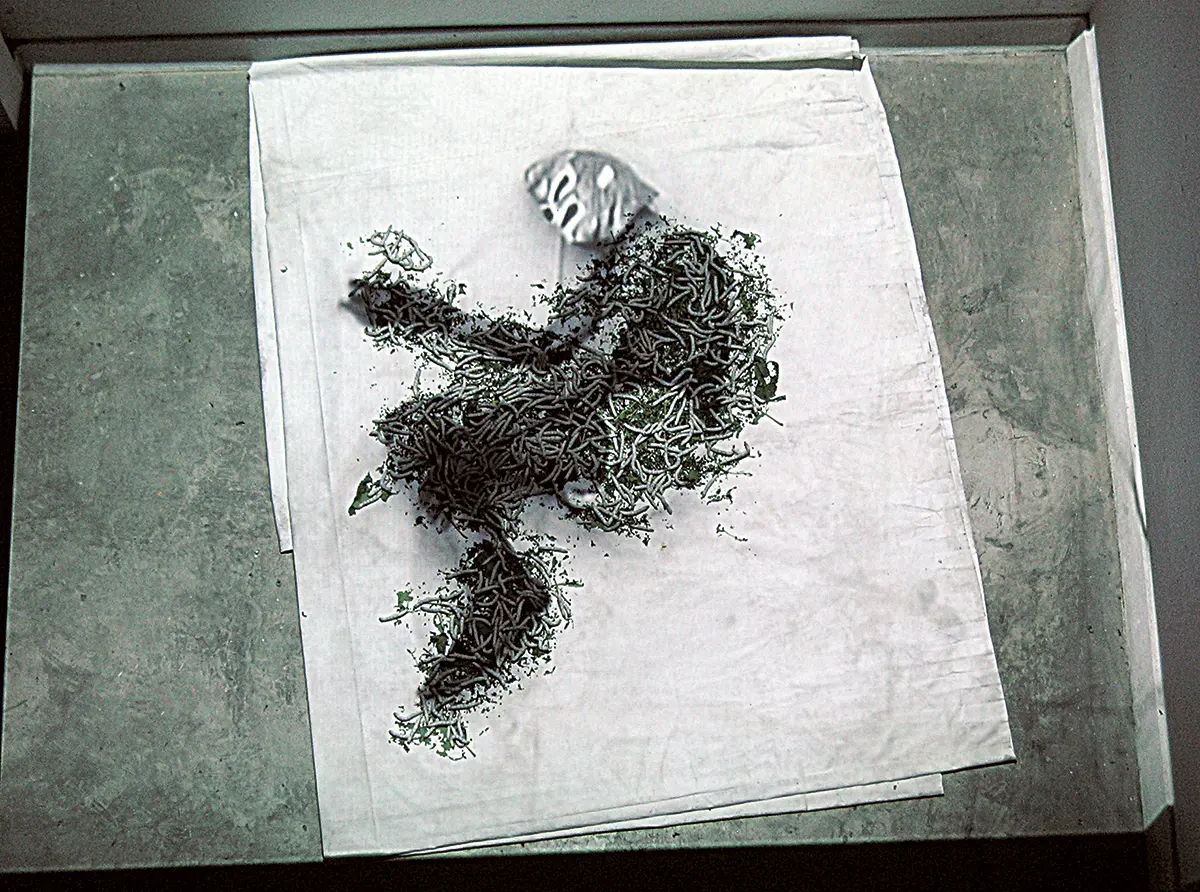
First, there is the video projection of a masked wrestler, crouched in a fetal position on a bed of silkworms that wiggle and squirm, like the wrestler, does, forming an image that shuttles between agony and sleep. Then one encounters what the artist has called an “appropriation” of a divine face that supposedly appeared in the gallery by the light of some large candles. This divine “apparition” contrasts with the Dibujo de Dios (A Drawing of God) made by a man in Quito and purchased by the artist in 2003.
In his videos, Restrepo elaborates on the topic of devotion in a country like Colombia. He uses media images from newscasts and popular shows with a messianic attitude and mixes these with documentary-like videos of religious practices. The video Sanadores (Healers, 2004), for example, strangely combines images of priests, healers, military people, and celebrities with an ominous, menacing sound. This bizarre combination is a strategy, a mechanism that pushes the viewer away from an accustomed perception of the armed conflict.
In Colombia, one’s contact with victims of violence generally comes through the mass media. Even for the direct victims of the conflict, the violent fact becomes a spectacle, and within this logic, the violence is trivialized. José Alejandro Restrepo points at and captures what appears normal, giving the development of the scene a different rhythm to introduce the element of strangeness. Something is not right in the image of a formation of soldiers singing carols. Something is out of place in the messianic attitude of Jorge Barón and his traditional offering of “a little water for his people.”
This, however, is not a show about the armed conflict in Colombia. It is a more profound pronouncement about human nature and its vital impulses. Restrepo appeals to intuitive feelings in relation to eroticism and death. In Exorcismo (Exorcism, 2006), a video installation that includes a documentary of an exorcism ceremony and a statue of St. John Eudes that strategically shades the face of the possessed, Restrepo poses an equivalency between religious and sexual ecstasy. Here, as in the rest of the show, the denial of the body becomes a highly sensual practice. Ánima (Ghost, 2006), for instance, shows St. Barbara, with her breast cut-off, burning in a fire; this image of a woman in ecstasy alternates with the pained expression of an old woman that resembles one's often seen in the news.
In Video, Passion, and Death, the place of the sacred is the place of transgression, of violence against the body, of the surfacing of the animal. Here, the austerity proclaimed by the church irrevocably results in the Baroque character of its practices.
MARÍA CLARA BERNAL