
Before there were multiculturalism, hybridity, and the global artist, there was José Gurvich—a Modernist who synthesized the major themes and styles of his era while absorbing a range of cultures. These all merge organically and give his oeuvre a unique place in art history. That legacy has been largely unknown outside Gurvich’s native Uruguay until this exhibition, the first New York retrospective of the artist’s paintings, multi-media works, and clay sculpture.
Born Joseph Gurvich in Lithuania in 1927, the artist and his family immigrated to Uruguay when Gurvich was six years old. Although he later took the name José and embraced the Spanish language and literature, the artist grew up speaking Yiddish in Montevideo’s large Jewish community, Barrio Sur. Music was his early passion and ambition, but Gurvich’s talent was drawing. After a brief stint at the School of Fine Arts of Montevideo in the mid-1940s, he would join the inaugural group of acolytes at the Taller Torres-García, founded by Joaquín Torres-García. Fresh from Europe, Torres-García brought home the advances of the European avant-garde and inculcated his eager students with a new artistic philosophy, “universal constructivism.”
Advocating the unity of form, space, and everyday life, Torres-García’s teachings gave the mature Gurvich the tools he needed to bridge the disparate elements and influences merging in his personal world. Gurvich used abstraction and recurring geometric motifs to create “visual music.” Paintings like Construcción en blanco y negro (Black and White Construction) from1962 display his earnest attempt to mimic the swelling movements and tones of his first love.
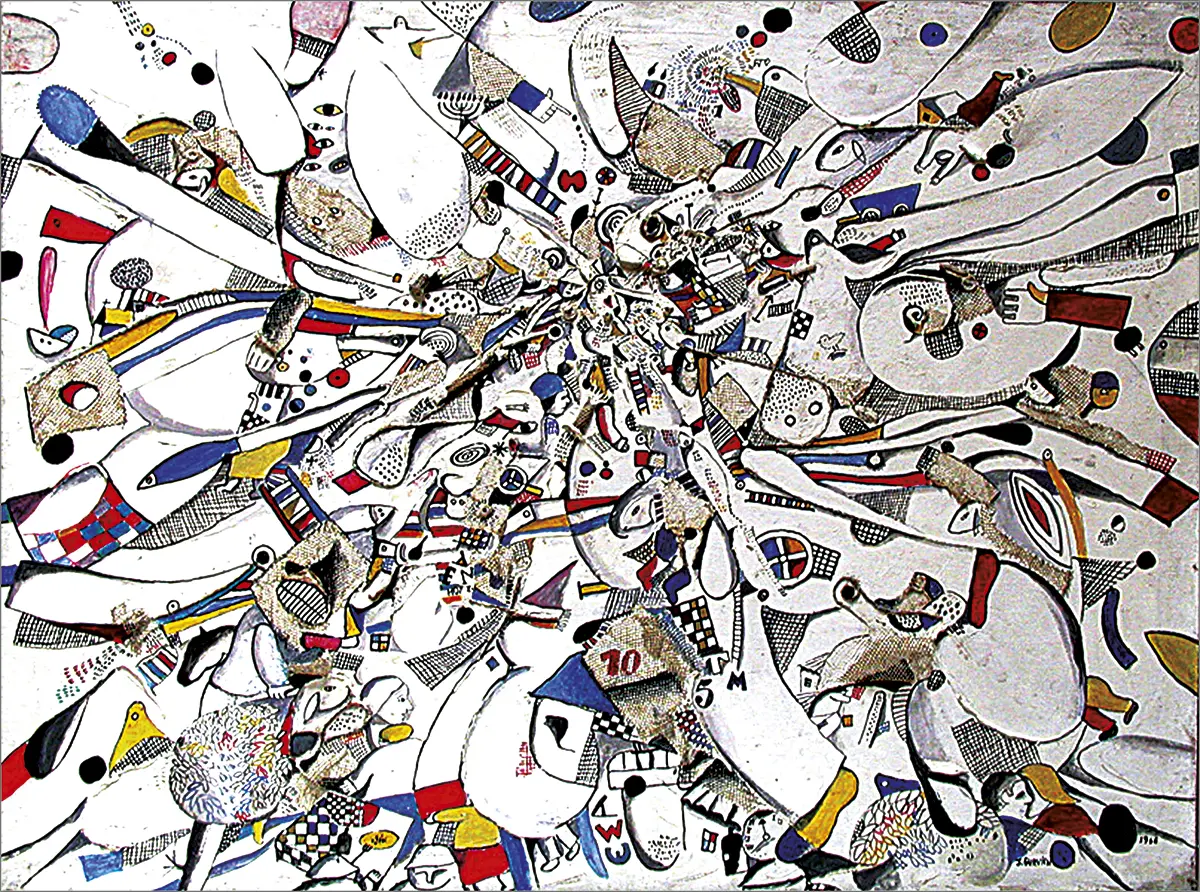
Likewise, Gurvich’s exposure to Bosch and Bruegel on a trip to Europe found a resonant home via constructivism in his art. Throughout his career, he would depict the everyday life and rhythms of working-class communities in Uruguay, Israel, and, later, New York. The stylistic approaches of Chagall, Miró, Klee, de Chirico, and Ernst all found their way into his worldview. This melding of artistic and social influences is represented as a colorful, joyful vortex of animals, figures, symbols, and shapes in Mundo fantástico con fondo blanco (A Fantastic World With a White Background) from 1966.
This painting also features multi-media elements such as tulle. Gurvich was a fan of collecting and incorporating odds and ends from daily life. His use of burlap as a distinctive surface element brings both texture and cultural specificity to his often fanciful depictions of every day, and this material would ultimately speak of displacement and nostalgic longing in his last works painted in New York’s East Village less than a decade later. The artist’s most striking and original contribution appears to be this sensitivity to the tactile as a gateway for both human experience and aesthetic ideals. His clay dioramas, mobile-like hangings, and figurative sculpture combine archaic forms, elemental materials, and manufactured bits of culture in powerful, even mystical, works.
Gurvich’s sister Miriam co-founded a kibbutz in Israel, where his parents later retired. Throughout his adult life, the artist would travel regularly to Israel to live and make art in the collective, at times working as a shepherd. In 1970, while Gurvich was in Israel with his wife and son, political unrest in Uruguay prompted him to move his family to New York, where an exhibition of Torres-García was being mounted at the Guggenheim Museum. Several fellow Taller artists had settled in the city, and Gurvich did as well. New York would be his home for the last four years of his life; he died of a stroke in his studio in 1974, at the age of forty-seven. This New York period produced brooding and melancholic, though still fantastic, views of everyday life displaced to a frenetic, urban environment.
In New York in 1971, Gurvich executed what could be considered the culmination of his life experience, the Proyectos para monumentos (I-IV). Made of tempera on paper, these visionary plans reference forms from his clay sculptures but also carry some of the utopian themes from his early Taller years and even the collective idealism of the kibbutz. With New York cityscapes in the background, Gurvich’s work suggests that human existence is a layering of experience and setting condensed into essential, reproducible, and even portable forms. A short, peripatetic, and highly productive life was the artist’s best example.
JOHN EWING