
When thinking about Los Angeles, one thinks of David Hockney’s blue swimming pools, but beyond the beach houses, Hollywood, the celebrities, and Rodeo Drive, Los Angeles and Mexico City have certain similarities, be it due to the large number of Mexicans living in the former city, to the vertigo of life, the insecurity, the high population density, and for being important centers of artistic production that have captured the international attention in recent years.
Proof of that are the art shows devoted to both cities, such as Los Angeles-Paris (2006) at the Centre Georges Pompidou, in Paris, or Mex-Artes-Berlin (2002,) and the interest that Mexico City and its artistic contributions have gained in the United States can be corroborated in Mexico City: an exhibition about the Exchange rate of bodies and values, at PS1 Gallery in New York, Mexican Report (2004,) originated in San Antonio, Texas, and traveling to Houston and Washington, and another interesting show such as Made in Mexico at the Boston Institute of Contemporary Art, which gathered not only renowned practitioners of Mexican art but also foreign artists like Yasumasa Morimura and Mona Hatoum, who took part with works that have Mexico as their theme.
Based on the similarities between Los Angeles and Mexico City as creative foci and under the premise o showing the creative vitality of two cities that hold an important place in the context of contemporary art, Colección Jumex presents Los Ángeles / México. Complejidades y heterogeneidad. The curator was Alma Ruiz, who argues that the confluence in a single space of the various artistic proposals, processes, and concepts fosters an animated dialog between two cultures.
The show begins a new period for Colección Jumex, which under the direction of Abaseh Mirvali, an American of Iranian background, has solid future plans such as the opening of a gallery alternate to the one already established in Ecatepec, in the state of Mexico. Alma Ruiz, invited now for a revision of the collection’s holdings, is associate curator at the Los Angeles Museum of Contemporary art (MOCA); she has originated important shows such as Basquiat in New York in 2005 and has worked with important Mexican artists, as in the show The Beetle Trilogy and other works, by Damián Ortega, and Gabriel Orozco, both at MOCA. The latter had great importance in Mexico and was presented at the Museo Rufino Tamayo and the Museo de Arte Contemporáneo in Monterrey.
Alma Ruiz curatorial proposal gathers more than fifty artists working and living in Los Angeles and Mexico City, even if they are not native to either city, as is the case of Thomas Glassford, Melanie Smith, Francis Alÿs, and Santiago Sierra, residents of the Mexican capital, or Cuban artist Jorge Pardo or Yunhee Min, from Korea, who live in Los Angeles and whose works are considered native to the cities where they are conceived.
The exhibition covers various media and formats such as photography, painting, drawing, sculpture, installation, video, and sound art. In the case of the Angelino artists, they started to gain recognition in the 1980s, and in the Mexican case in the 1990s. The chronology of the works spans the years from 1986 to 2005, and the show is a general panoramic of recent artistic production in both cities. Most of these artists were born in the 1960s, save the cases of highly recognized Angelino artists like John Baldessari (1931,) Ed Ruscha (1937,) or Paul McCarthy (1945.) In the case of the Mexican artists, young artists with a significant trajectory are included, such as Steffan Brüggemann (1975), Minerva Cuevas (1975), Yoshua Okón (1970) o Carlos Amorales (1970.)
The vast exhibition is divided spatially and thematically into six large nuclei: the urban context; photography and the use of language; the fascination with adolescent topics such as sex, alcohol, rock music, comics, tattoos, and identity; the strategies and norms imposed by the artist as the generating agent of his or her work; the reinterpretation of painting and sculpture; and the use of construction systems and design. Such divisions are marked by the arrangement of halls in the large gallery, which is entirely transformed for each exhibition according to the museographic and conceptual needs established by the curators. Thematically, the division is not very drastic, because, as indicated by the exhibition’s title, heterogeneity is the connecting thread.
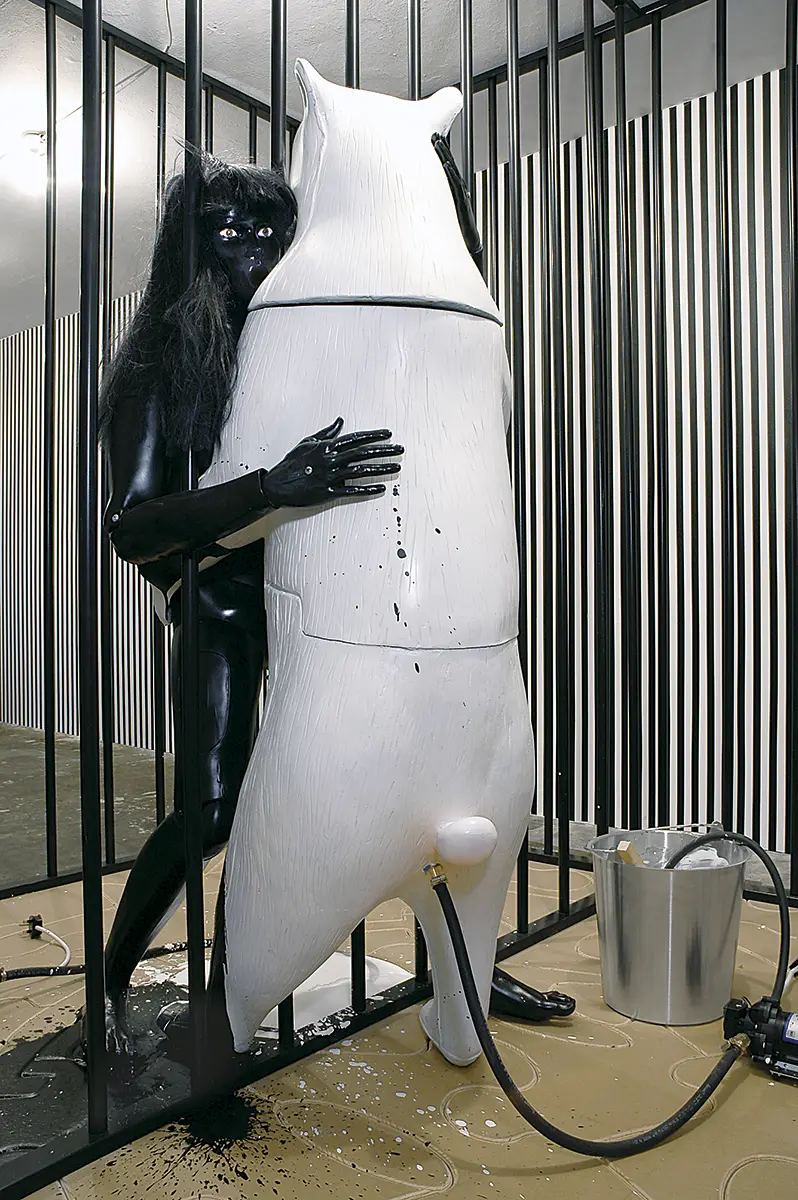
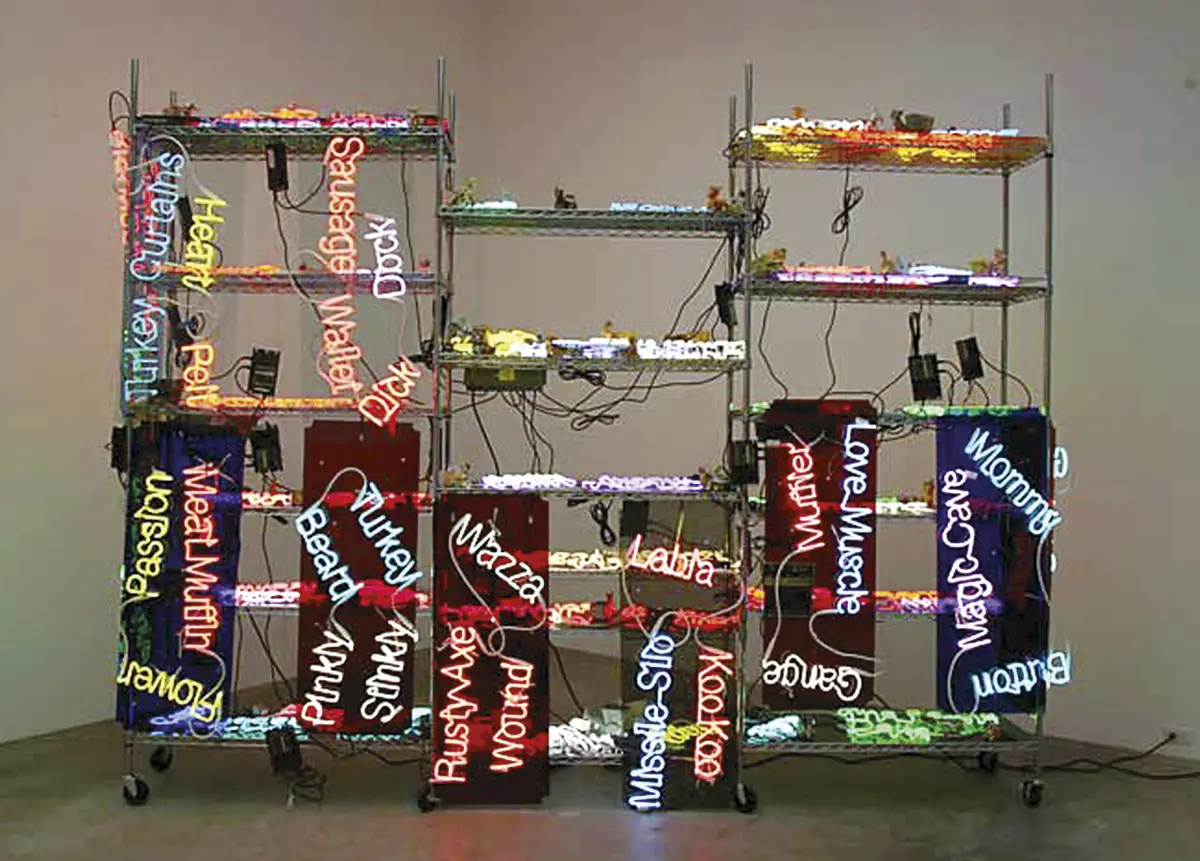
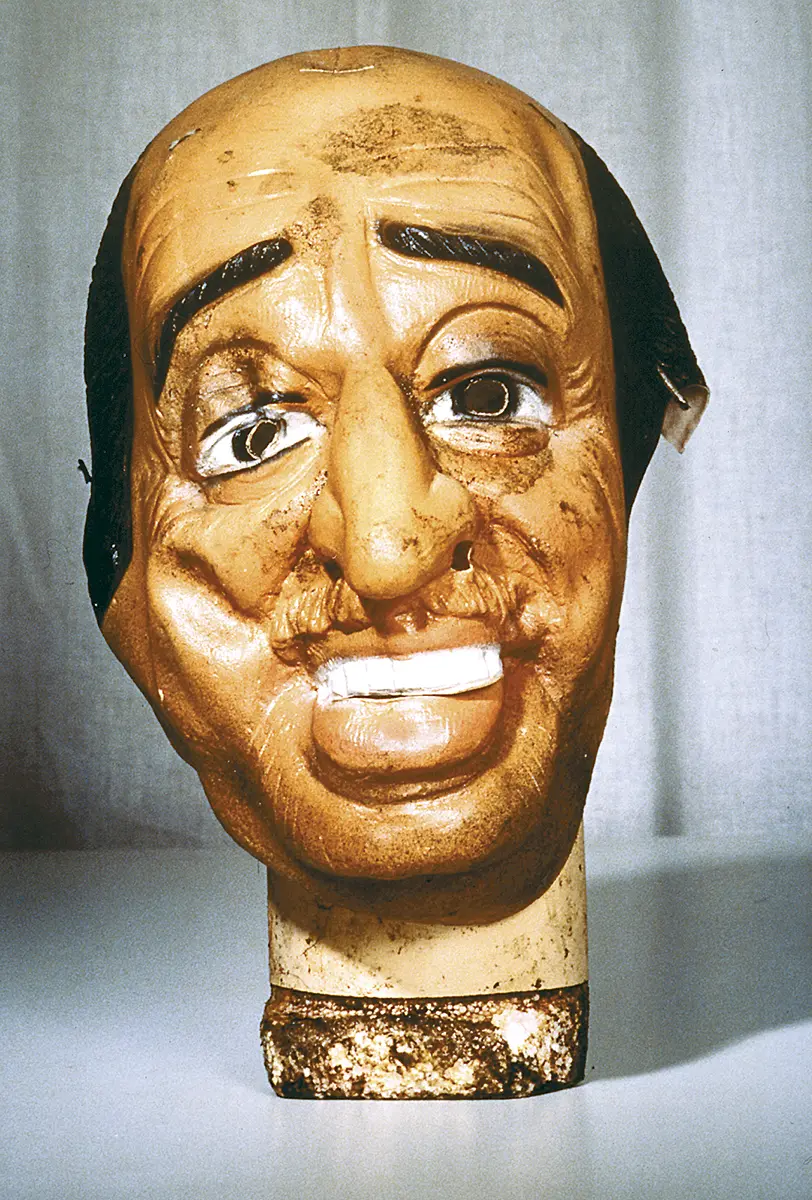
Among the Angelino artists included in the Jumex collection photography is a highlight, especially by Paul McCarthy, as two works from his series Masks are presented. Also relevant are installations by Jorge Prado, Richard Jackson, and Jason Rhoades, which include light and mechanical elements to great visual attractiveness.
The Mexican artists in this exhibition reveal themselves as more objectual and more diverse in their use of supports and their artistic proposals, which go beyond genres like painting, photography, or installation. What dominates is the pluralism of artistic proposals, many of which impress with their simplicity and ingenuity in terms of creativity and concept.
Specific cases to be mentioned are the photographic register of Santiago Sierra’s action Ocho personas remuneradas para permanecer al interior de cajas de cartón, and nine photographs by Gabriel Orozco, the only artists in the show with 19 works, unlike all the others, who only present one or two. This speaks of the international stature and recognition achieved by this Veracruz artist. Among those photographs are some that very well known, such as La extensión del reflejo, Pelota ponchada, and El sillón de mi perro.

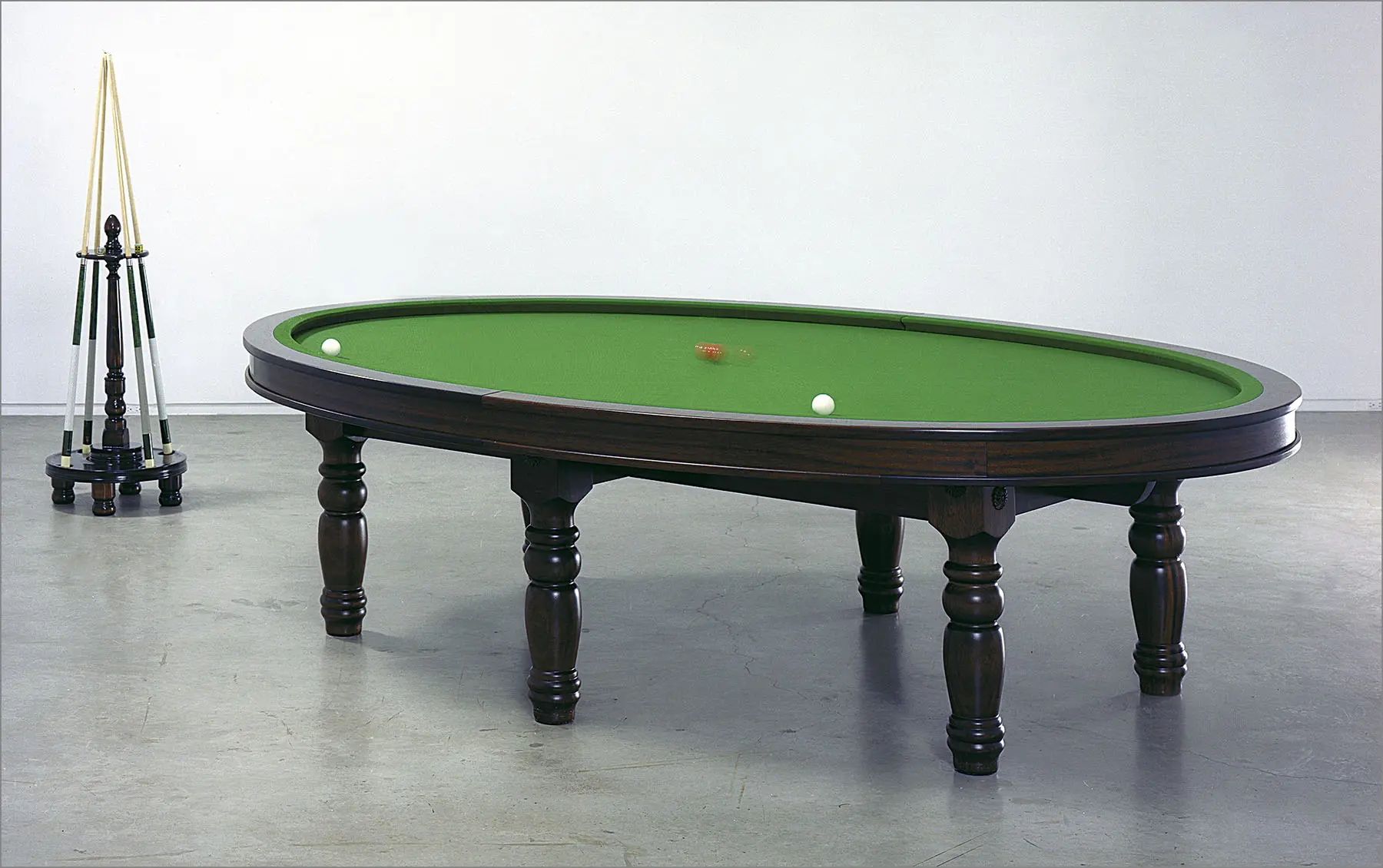
Other works by Gabriel Orozco selected for the show were his interventions on paper with geometric motifs and especially included is Oval Billiard Table, also well known and presented in other exhibitions.
Within this plurality of works, videos are exhibited, and also one sound artwork, located on the upper floor and titled El eco está en todas partes, by Mexican artist Manuel Rocha Iturbe, a work that evokes moments, spaces, and is a felicitous inclusion among so much visual work. It comes as a breather in a white environment that is very well organized in museographic terms.
The show closes with Stage for an imaginary friend, a large-format installation by Carlos Amorales, already exhibited at Yvon Lambert Gallery in New York and Paris.
This is how the creative landscape of the last twenty years in Los Angeles and Mexico City is seen, even if only partially due to the limitation of exhibiting works from a single collection. One notices the absence of important Angelino artists like Joseph Martinez, or of widely recognized Mexican artists whose works are yet to be acquired by the collection.
Despite all that, this show is an important sampler of what takes place in these two important cities, and will undoubtedly impact the art world, since Colección Jumex has become the cornerstone in the promotion and exhibition of contemporary art, being one of the most important collections in Latin America, with its holdings of more than 1400 works by well-known national and foreign contemporary artists, besides the important work the collection undertakes in promoting theoretical reflection through courses and workshops for the general and specialized publics.
Thus, the exhibition is a wide range of artistic proposals that allow us to form a vision of the developments in recent years and the future perspectives for contemporary art in our continent.
ISAURA RUIZ