
Printmaking was one of the disciplines practiced by Luis Guevara Moreno, alongside his activity as a painter and draftsman. From the early years of his education to his establishment as a recognized artist, this medium allowed Moreno to experiment and achieve unexpected results that go beyond the conventions of traditional graphic arts. His career as an artist and member of cultural groups and movements, such as La Barraca de Maripérez, the Taller Libre de Arte, Los Disidentes, the Madí group, and the New Figuration, made him one of the protagonists of Venezuela’s artistic renewal.
Some of that legacy and part of the country’s artistic memory was exhibited at the Museo de la Estampa y del Diseño Carlos Cruz-Díez, from November 2005 through April 2006. Luis Guevara Moreno a través de su obra gráfica, (Through the Graphic work of Luis Guevara Moreno) curated by Ann Bello and Renny Barrow, displayed the variety of the explorations carried forward by the artist in the practice of his craft. The selection of eighty-one small- and medium-format works offered a retrospective vision of Guevara Moreno’s stylistic shifts, from geometric abstraction to lyric figuration. Five decades of work, from 1950 to 1996, revealed the techniques deployed: etching, drypoint, xylography, lithography, serigraphy, burin, and what is known as transpositions.
A sober display arranged in chronological order allowed for sequential reading of the different periods in Guevara Moreno’s oeuvre. Sin título (Untitled), from 1950 is a serigraph displaying geometric shapes in contrasting hues—black and white against a green background—that make possible a dynamic interplay of form and color. Familia campesina (Peasant Family, 1954–55) is a lithograph with oil added, where the schematization of the characters reflects the definitive move toward a figurative language. Desnudo en flor ( Blooming Nude, 1963) and Desnudo 65 (Nude 65,1965) present an expressionistic treatment in their draftsmanship; the gestural tracings describe energetic and fleeting movements and develop a textured surface related to Informal explorations of the material and the visual. Guevara Moreno’s repertoire of images in this period encompasses different themes: landscapes, nudes, portraits, figural groups, etc. His work points toward a dual critical intention: the collective as a means to denounce social, cultural, and political issues, and the introspective individual that refers to contemporary angst and is inscribed within dream-like or imaginary worlds.
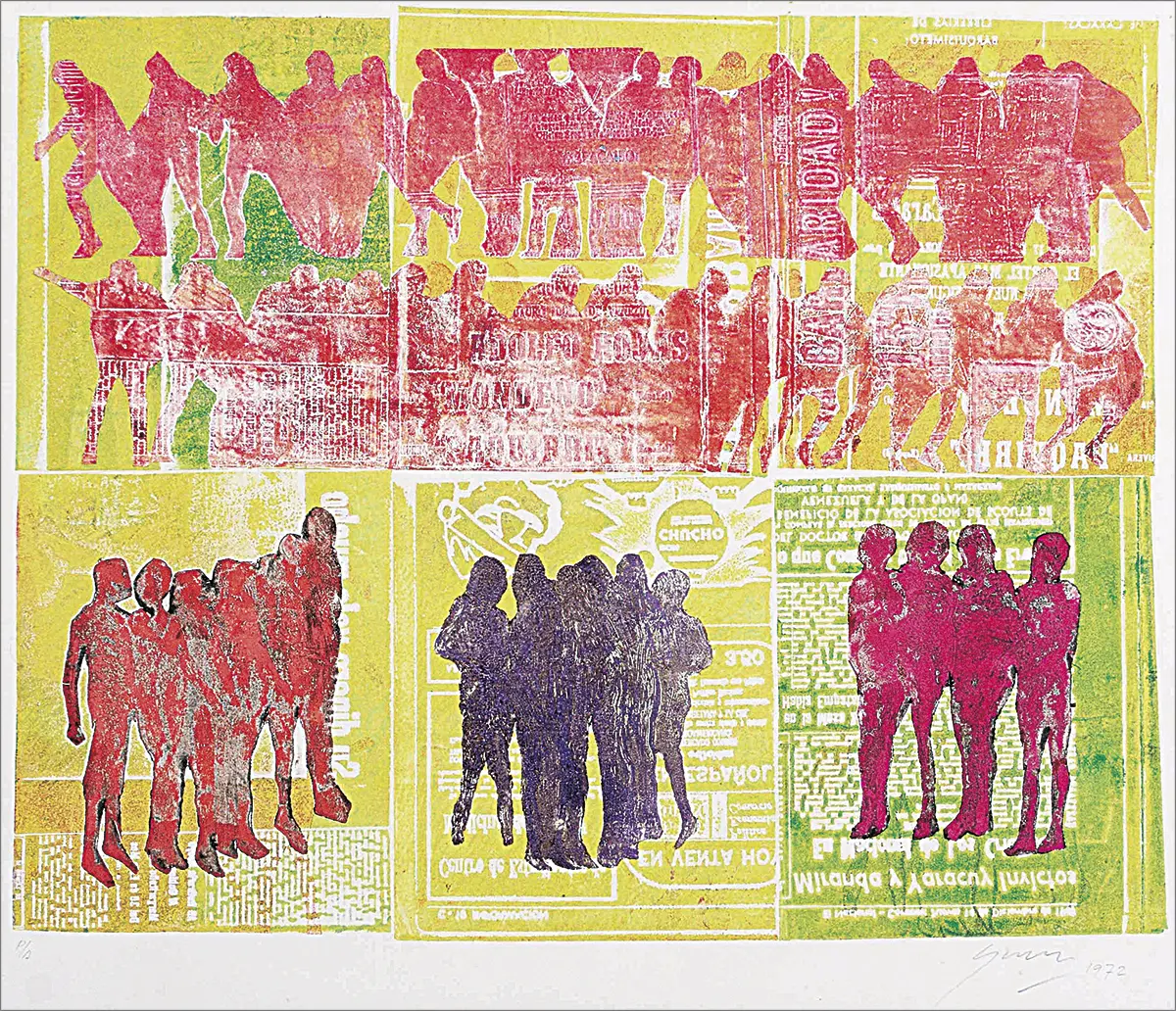
Social issues acquired a greater role in his work of the 1970s when the artist consolidated his investigations in printmaking by adopting transposition in the late 1960s. This is a method by which an image is transferred to paper and then reworked, mixing the procedures of inking and printing. This technique, the artist explains in the show’s catalog, consists of “reproducing and intervening the image of one work and superimposing it onto different support. It is like a collage achieved by ripping and dislodging what I’ve done on a different surface. It is working from one surface to another surface. Like a kind of mutual reproduction. I reproduce this and reproduce it with that. I gather it, and this creates a kind of verification of what I am doing, of a language. That was, more or less, the discipline I acquired and my way of identifying with a language of my own.” Transposición gráfica (Graphic Transposition) and En el círculo férrico (In the Ferrial Circle) from 1972 are two examples of these combinations in which chromatic resonances flow from one plane to another, creating a circuit of visual clashes that enliven the figure/ground relationship. The incorporation of ever-bolder colors and the formation of imagery based on popular elements continued in Guevara Moreno’s work during the following years, as can be seen in Samán, el cerro y la ciudad (Saman, the Hill, and the City1980), a serigraph in vivid colors that transforms Venezuela’s landscape into an image of identity, both of the artistic tradition and of the geography that forms our regional idiosyncrasy. Other serigraphs further exemplify this, such as El Ávila está servido (Avila is Served) and El color de la ciudad (The Color of the City), both from 1980. By the 1990s, Guevara Moreno was working with digital techniques. The artist revisited and reinterpreted some of his previous works, especially those from the early years of his career, such as Cooplanal from 1995.
GLADYS YUNES YUNES