
The work of Lygia Clark (1920-1988) is essential for any understanding of the artistic proposals of the 1960s and 1970s in Brazil, years when the paradigm of art moved away from works fundamentally based on the object and focused on other possible artistic practices. Despite the acknowledged relevance of her production —which moved from painting to modulated, folded, and manipulable planes, and from relational objects to the Structuration of the Self1—, it would be difficult for a show posited from the standpoint of current exhibition parameters to foster a deep contact with the most radical part of Clark’s oeuvre, for which one would need new ways of mediation and presentation to the public.
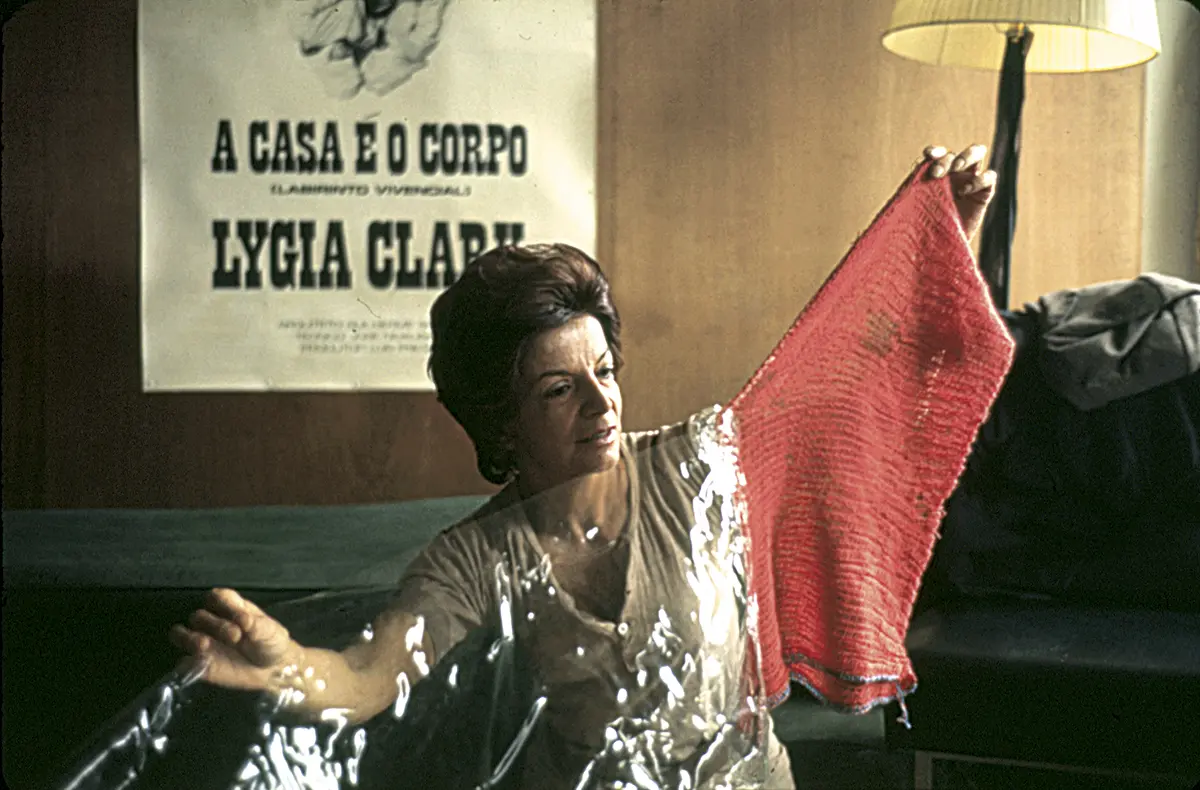
In that sense, the project Lygia Clark, from the Object to the Event, developed by psychoanalyst Suely Rolnik in 2002, seeks to activate the artist’s 26 years of bodily experimentation (1963-88) through interviews captured mainly in Brazil and France, where Clark lived: they represent testimonies by people who had contact with the artist and with the Structuration of the Self, a practice of the artist in her Rio office between 1976 and 1988. According to Rolnik’s text in the show’s catalog: “The Structuration of the Self took place, one person, at a time, in one-hour sessions, with the regularity of two or three times a week, lasting for months and even years. Lygia used relational objects to touch the bodies of her ‘patients,’ as she herself called those who agreed to go through the experience. Naked, they lay on top of one of those objects, the Grande colchão. In the words of the artist, by propping themselves on that couch sui generis, the patient’s own weight ‘already created a furrow’ to ‘accommodate their bodies’. And thus the session commenced.” With his interview project, Rolnik wants to describe an ambiguous, little-studied territory of life during that period of military dictatorship in Brazil, and what was the experience under Clark’s production, in order to bring to the surface essential issues in her work and place them in dialog with contemporary issues.
With the same title, the show was presented in Nantes at the Musée des Beaux-arts (October-December 2005) and in Brazil (January-March 2006,) the latter being an extension of the first project, in collaboration with French curator Corinne Diserens. The show comprises 138 objects, one installation, and ample audio-visual and photographic documentation of actions by the artist, as well as 24 of the 56 filmed interviews previously completed by Rolnik. The emphasis placed on the bodily phase of Clark’s oeuvre is evident in the chronologically descending arrangement of the show: it begins with the projection of interviews, followed by galleries with photographs, videos, and documents referred to the Structuration of the Self, as well as original objects created by the artist and their respective replicas to be manipulated by the public; later, there is a gallery with earlier relational objects, such as O Eu e o tu – série roupa-corpo-roupa (Me or You, Clothes-Body-Clothes, 1967), or Óculos Anteojos (Eyes-Spectacles1968), and their replicas. Clark’s works from the 1950s and early 1960s, such as, among others, Superfície modulada n.5 (Modulated Surface, 1955), Espaço modulado n.4 (Modulated Space No. 4,1959), Casulo Capullo (Cocoon, 1960), are presented, at the end of the show, alongside her Bichos (Bugs, c1960). Trepantes (Climbers, c. 1964), and some projects and books that took her to those works. In the next gallery was a comfortable environment where the videos with the testimonies were at the public’s disposal.
While the interviews seek a current approximation to the essence of Clark’s proposals —different from shows that presented the objects used in the sessions as protagonists of the work, transforming them into fetishes—, the series of testimonies surprises us with an inevitable mythification of the artist. After some interviews, we reach the conclusion that the Structuration of the Self could only have been achieved by Lygia herself, in possession as she was of a “strength” and a “presence”, according to what many interviewees had to say. This fact, despite being paradoxical, could contribute to an optimistic reflection. When an artist’s presence becomes an irreplaceable part of the work of art, like that of the participant —impeding the production of registers that don’t include them—, we reach a point where preserving or collecting some artistic practices in a traditional way becomes impossible; they have a short lifespan, just like we do. Incorporated into a museum, an art object would lose its political, social, or religious function; reduced to the condition of an object for aesthetic appreciation, it becomes undeniably incomplete and even incomprehensible, in the case of proposals like Structuration of the Self. Besides the fact that such objects are transformed into fetishes and feed into a growing consumer market, we can assume that projects like Lygia Clark–From the Object to the Event propose a new public understanding that they do not function in isolation from other elements, such as, in this case, the presence of the artist and the “patient.” If this is so, why not wait until the revision of works of this nature is finally able to provoke changes in the standards of the exhibition based on autonomous objects, presented in a single space and apprehended at once?
NOTE
1. The artist’s proposals around the body and otherness are experiences that take up two-thirds of her career, culminating with the Structuration of the Self. Clark’s work breaks out of the limits imposed by its actualization in the object and becomes an event in the receiver’s subjectivity.
ANA PAULA COHEN