
Over the years, González has managed the difficult balancing act of remaining consistent in her overriding themes and issues while displaying a versatile range in her materials, formats, and subject matter. With these new works, González continues to probe the relationship between different types of systems and uses a personal vernacular of postminimalism often grounded in some sort of architectural form to explore childhood, sexuality, and relationships. What newly informs these recent works is the time González spent in Italy as a recipient of the Rome Prize Fellowship.
One of the unexpected results of González’s stay in Rome was a reawakening of her latent Catholic upbringing. Of particular interest to the artist was the pervasive presence of reliquaries. It may strike some people as odd that a contemporary artist, one whose work is grounded in minimalist form and conceptualist rigor, would find something of value in such an archaic and openly religious practice, but reliquaries actually fit quite neatly in González’s more consistent themes. Their power is spiritual or conceptual; their core, the relic, is usually grounded in the body; their form is often architectural; moreover, there is a personal, childhood-memory aspect to these objects for González: their Catholic origins evoke the religion of her family and her childhood in Cuba until the religion was banned by the government.
Driven by these overlapping ideas of personal memory, spirituality, architecture, and the body, González created a new group of works that ranges from digital prints to architectural models and sculptural installations. Internal DupliCity was centered on a series of sculptures arranged in a grid upon individual white pedestals. Each sculpture featured a basic form suggestive of vernacular architecture (barns, houses, etc.). Each wooden form was painted a rich red, suggestive of blood. Every red form was then surrounded by an enlarged casing of frosted Plexiglas, which rendered the red forms vaguely indistinct and out of focus and suggested the “skin” of the piece or the reliquary for the relic within.
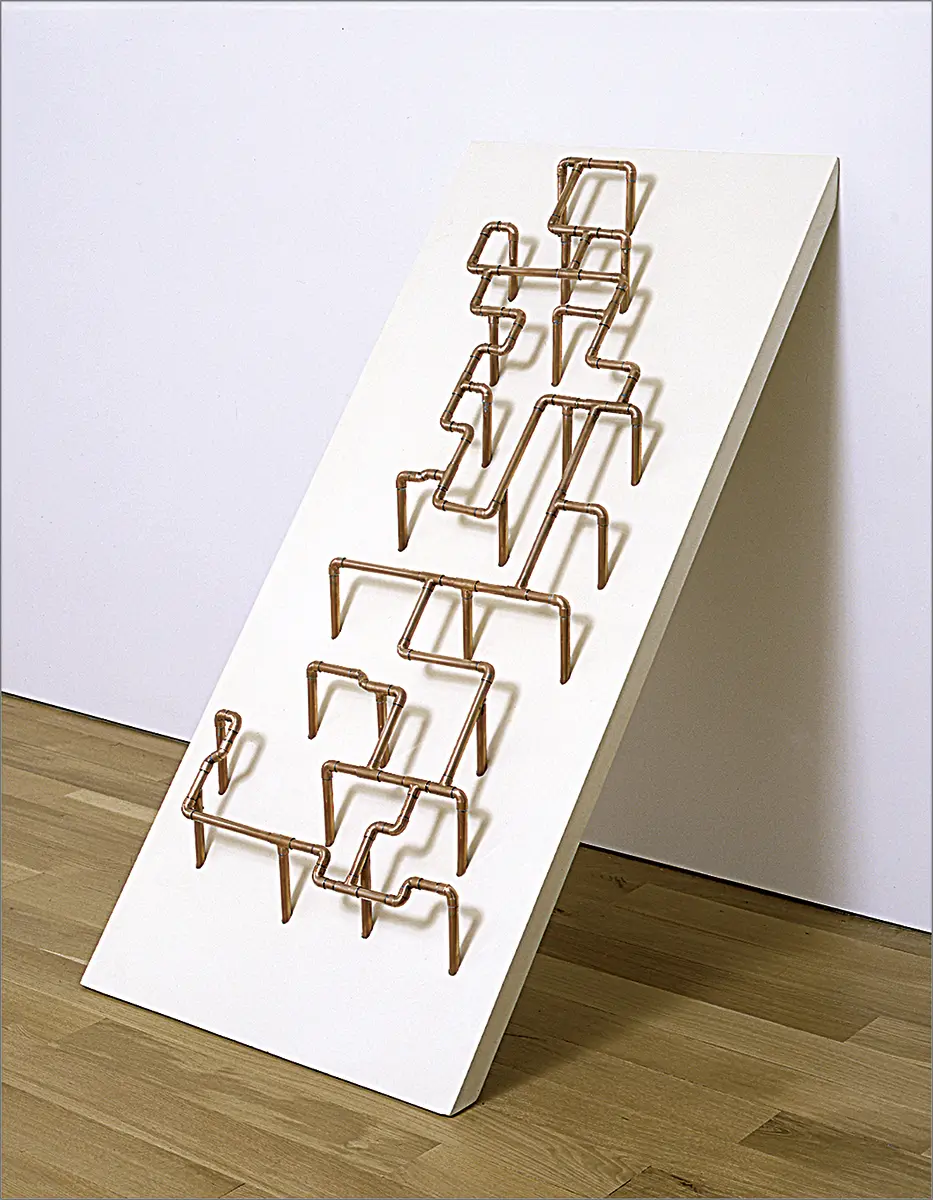
The Catholic themes were carried further in Supine Tendencies. This exhibition featured leaning planks that supported a gridded network of interconnected copper pipes. This work, titled Self-contained (plumbing), looked like a mathematical, abstract industrial sculpture or some sort of actual systemic grid for a building or machine and seemed to most strongly evoke the minimalist tradition. However, with González there is always a twist; in this case, the template for the pattern of holes in the board that the pipes were attached to came from San Lorenzo’s martyrdom slab—the holes in the original slab were where the saint’s corpse’s blood was drained away. Thus, the pattern referenced the body, the copper plumbing suggested blood vessels, and the contemporary looked back to the ancient.
This dialogue between newness and tradition was also apparent in the graphic works in each show. Rendered with digital printing and looking rather clinical, they often suggested sacred icons or instruments of martyrdom, like St. Catherine’s wheel or a torture rack. There was also a tension in the works between the hand-drawn and digitally rendered. There was an intimacy to these works and a subtlety to their shapes and colors that suggested personal introspection and quiet contemplation, much like reliquaries themselves often do.
With these two exhibitions, González once again managed to mine an artistic territory whose particular combination of practices and themes is becoming increasingly and uniquely hers. At the same time, she continues to explore new forms and sources of inspiration. As her voice grows stronger, her vocabulary continues to expand.
JOHN ANGELINE