
The year 1979 marked the return of democracy to Brazil after fifteen years of military dictatorship. It was also the year in which the rural vehicle Belina, by the Ford Motor Company, was first presented. This automobile was notable for its interior space, and it was especially appreciated by growing families during the prosperous 1970s. This kind of confabulation and association of information was present in Matheus Rocha Pitta’s installation Drive-In, in different layers of meaning and reference, sometimes intentional and taken from the theory and history of art, at other times fortuitous and linked only in the viewer’s imagination. As expected, the Belina ’79 was also a part of this work. In his first individual show in a gallery, the artist superimposed procedures and discourses, combining videos, photographs, site-specific materials, sculpture, representation, and reality in a grid that enveloped the space of the exhibition and opened up to the viewer’s own references, inviting one to add personal threads to the metaphorical weaving in process.
Rocha Pitta’s work was installed in two spaces of a traditional antique shopping center in Río de Janeiro. The first was a contemporary art gallery in a commercial neighborhood characterized by the age of the objects available; the second space was in the underground parking garage of the same shopping center. Inside the gallery, a video monitor on a car seat showed horses “parked” in the underground area; the views were fixed and varied in length and were recorded from inside an automobile with the headlights used for lighting. The camera/automobile/horse equation was distorted inside the parking garage, and one felt invited to unmask the strange relationship established between the three elements. How did the horses end up there? Why were they filmed? The almost incidental appearance of the image, its questionable quality, and its circumstantial lighting made one think of a possible documentary, of images found in archives, or of more or less absurd possible uses for horses in parking garages—besides the range of art-historical references to Pedro Américo and Janis Kounellis.
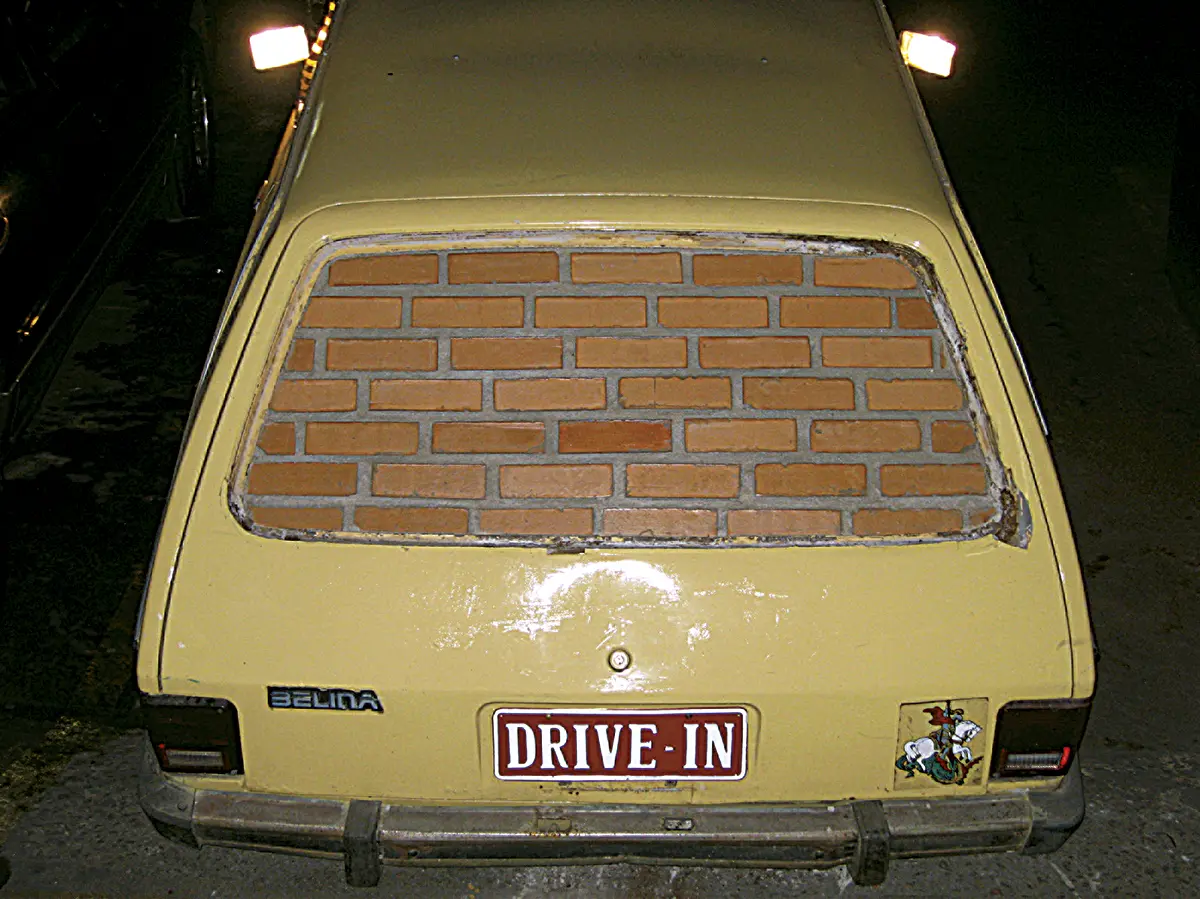
In what was the stage for his video, the underground space, the artist parked the Belina. The whole back section of the automobile was closed off with bricks and concrete. Inside the grotto/car, the back seat was removed; it was not clear if it was the one provided for visitors to sit on while watching the video in the gallery. On the walls of the car/cavern, the artist exhibited his collection of newspaper clippings about horses and weird horse-related news: “Calvary to save an agonized horse,” “Stolen horses cross Avenida Paulista,” and others; a Prada ad; and equestrian magazines. These clippings were pasted directly onto the concrete wall in the car, referring to Plato’s cave projections as well as to adolescent bedroom walls pasted with magazine images of pop and TV idols. The car’s rearview mirrors were replaced with intense spotlights that shone into the garage. A hole was opened on the wall and the resulting black-velvet camera could only be touched by one hand at a time. “Strange image and strange prisoners,” one might say, as Glaucus paraphrases Plato in the myth of the cave.
What was generated by the artist’s proposition was at least one double conundrum provoking a short circuit: the object of a stationary automobile transformed into a cave; the video of moving horses confined inside another cave. However, before confronting the horses or descending to the automobile, one found a discreet surprise at the entrance to the gallery. The artist darkened the typically well-lit space of the art gallery, and one could see with difficulty a series of photographs. Rocha Pitta photographed chalk drawings superimposed on evocative textures found on the walls of the shopping center’s garage. Described at the end of a review or starting the exhibition in the gallery, these images inverted the discourse’s logical order, and the strategies of inversion and discontinuity traversed the whole exhibition. The diagrams inscribed on the walls of this third cave alluded to the methods that pervade the work. Represented there schematically were: a) the articulation between the exhibition spaces; b) the articulation of object and image; c) the articulation of theme and representation. These images were part study, part commentary. For the artist, they were “conceived anthropological documents. We can call them ‘studies a posteriori.’”
RODRIGO MOURA