
Between February and March of 2006, Miguel Río Branco again exhibited his work in Madrid. The twenty-seven photographs presented at Galería Oliva Arauna were not a pavane for Havana, as perhaps the Cuban writer Guillermo Cabrera Infante would have wanted. In his novel La Habana para un infante difunto (Havana for a Dead Infant), Cabrera Infante paraphrased the title of Maurice Ravel’s 1899 piano concerto Pavane pour une infante défunte. What was in Río Branco’s works in Madrid was something much more poignant than what is in Ravel’s pavane. There was nostalgia and even that sweet melancholy that Paul Verlaine spoke about, that is, those two states of the anguished soul that Cabrera Infante was able to so masterfully invoke in his extraordinary novel and that Río Branco’s photographs—taken in the Cuban capital between 1994 and 2001—equally conjure. But in Cabrera Infante’s novel, Havana is the long remembrance of a city lost to its author, who as a provincial child was dazzled when he arrived in the city and discovered for the first time that a house could have a staircase and that the staircase could be marble. In Río Branco’s photographs, Havana is above all a cemetery of American automobiles of the 1950s. This era remained suspended in time in Havana if one believes the photographic documents presented by Río Branco, an artist given to emphasizing the suspension of time and the decay provoked by that suspension. In this case, Río Branco attempted to avoid the entropic effects of that suspension, centering the focus of his Cibachrome prints on the everyday repair operations so important to Havana denizens who want to keep their ancient cars up and running, cars that in the First World are authentic museum pieces. These cars are objects of contemplation and veneration by the public and collectors who are in the end indistinguishable from the public and collectors of classical antiquities or of works of the historical, artistic avant-gardes. The people of Havana—who suffer chronic public transportation problems—try to keep their cars working well beyond the limits of the cars’ useful lives, all without having replacement parts, which have long ceased to be produced by the automakers that, at any rate, are located abroad. There certainly is dedication, ingenuity, and cunning in these operations; when combined, these qualities are capable of enabling authentic feats. This is typical of those who, aware of how little they have, are nonetheless willing to attempt miracles.
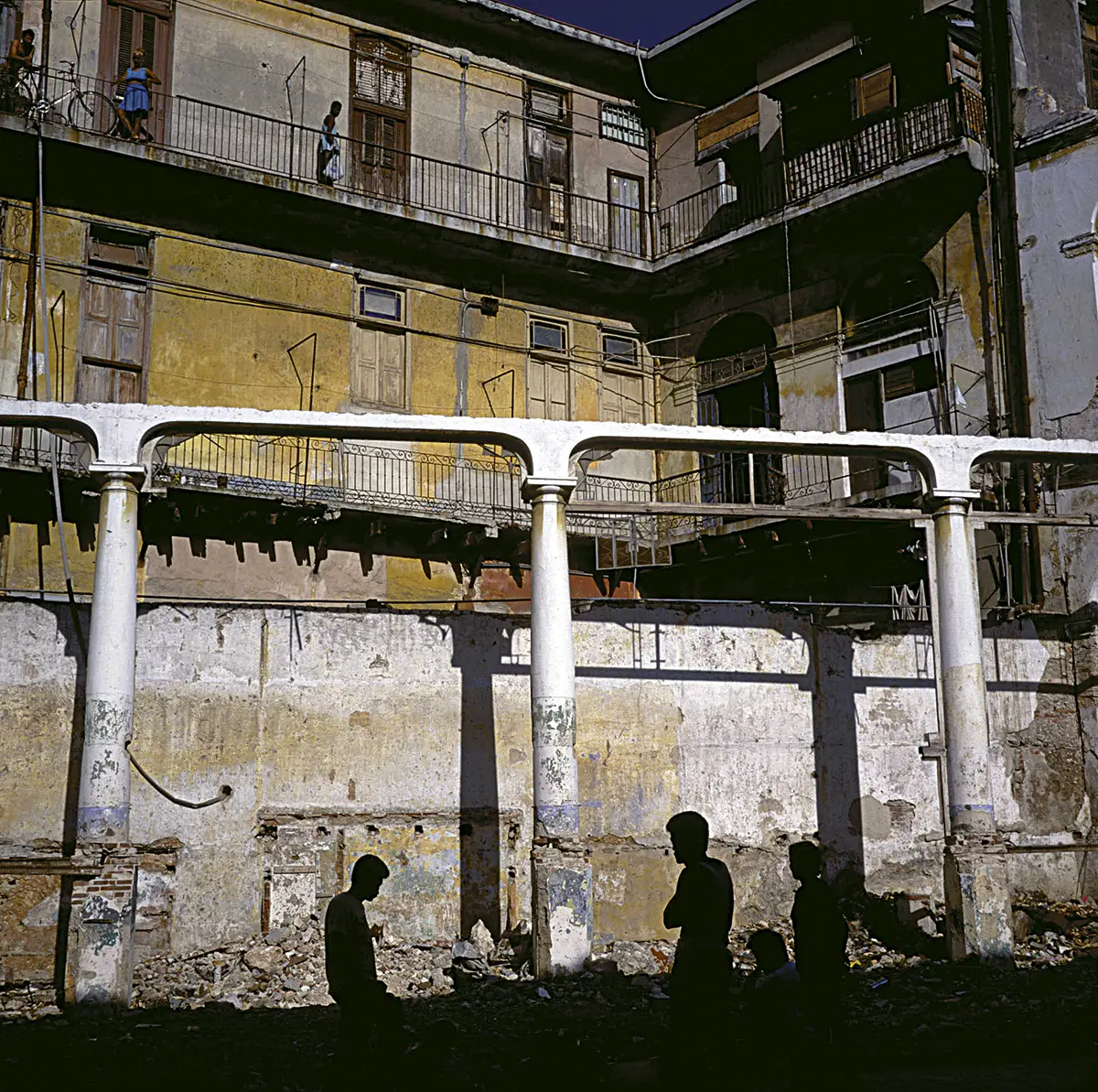
But it is that vital, transforming aspect, as necessary as it is desirable, that escapes Río Branco’s photographs. He is not solely responsible for this lack; it is also the fault of a medium like photography, so devoted to the suspension of time through the congealment of images. Seeing Río Branco’s show resulted in another melancholy exercise like those I have engaged in during my visits to Havana, walking around Old Havana’s meager streets, unable to understand why so many magnificent buildings and houses crumble down without anybody—not the authorities nor their inhabitants—able to salvage them.
Río Branco’s Havana photographs can function very well as an introduction to the more revealing works of Carlos Garaicoa, which are bent on discovering in the very structure of the city’s architecture the keys to its current ruinous state. Garaicoa sees in those ruins the failure of the modern project, first articulated in the “century of lights” that provided the title to a great novel by Alejo Carpentier and which was taken to impossible extremes by Communism. Perhaps Garaicoa is closer to the truth than the Cuban government, which tends to blame any ailment affecting the island today on the implacable American blockade. But I doubt this and refrain from judgment. I let myself be moved by the sweet melancholy that takes shape in Miguel Río Branco’s Havana suite.
CARLOS JIMÉNEZ