
Theater and spectacle have always been the means by which Tania Bruguera has engaged her audiences. But, in her recent exhibition titled Beckett . . . Did you ever see my eyes? on view from January 6th to February 4th at the Rhona Hoffman Gallery in Chicago, Bruguera gave a rare glimpse behind the curtain and showed the processes involved in crafting her dramatic large-scale installations.
After adjusting to the darkness of the gallery, the visitor looked across a space filled with groupings of small-scale video monitors, maquettes, and pedestals for sitting. The six groupings were placed just far apart enough from each other to distinguish them, and they were arranged somewhat organically in the gallery, without adhering to a visible system or grid. Each maquette was lit with a single, bare, low-wattage light bulb and each monitor played a popular Hollywood movie. The buzz of the movies’ soundtracks soothingly filled the space, their discrete lyrics and dialogue only becoming discernable when one sat on the designated viewing pedestals. Seated on a pedestal, one looked across a maquette to view a movie. All of the movies were shown in their entirety on continuous loops.
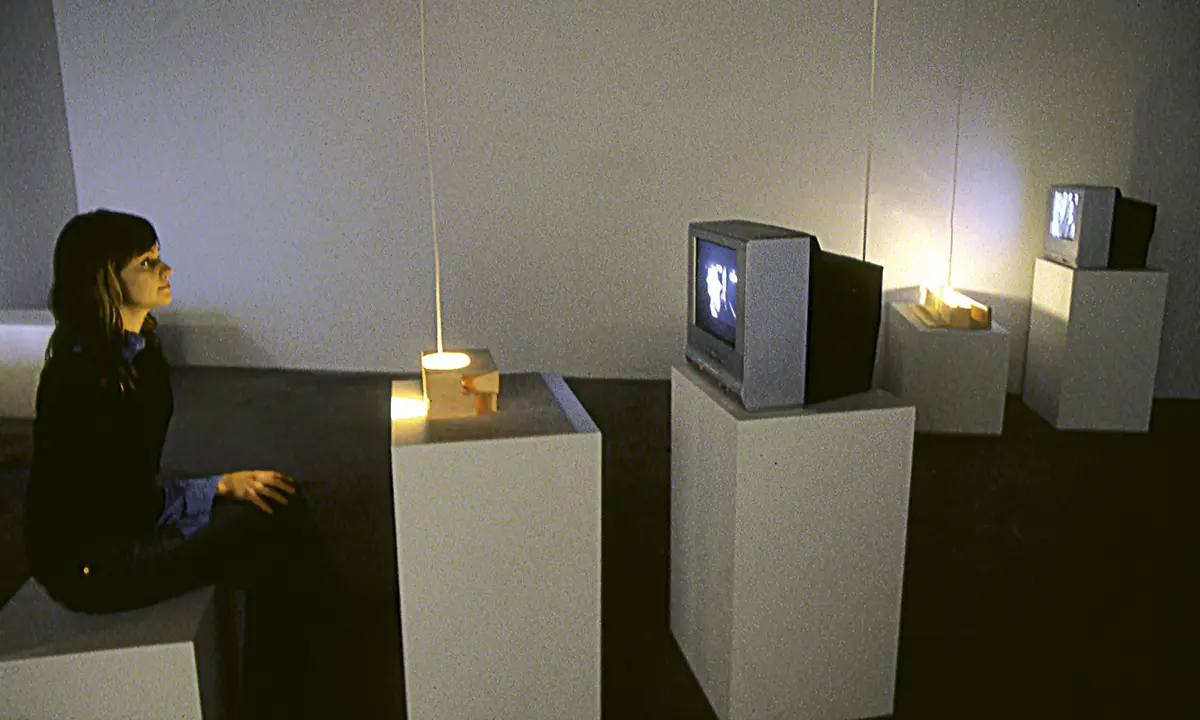
The maquettes were studies for Bruguera’s installation projects and they presented dramatic scenarios in which tiny figures occupy confounding or isolating architectural spaces. In one maquette, a figure negotiated around, labyrinthine room. In another, scrims divided a rectangular room, making it possible for the Lilliputian figures to see each other but not for them to physically occupy the same section of the room. The maquettes resembled dramatic sets and reminded viewers of the play that inspired Bruguera to create this series, Samuel Beckett’s Endgame, and of the emotional and physical confinement of Beckett’s drama.
The movies provided the emotional element in the installation. As stark and stylized as the maquettes were, the movies—all of which are known enough to be familiar—conveyed the emotions of human love in all its messy forms. Themes of power, disappointment, and destruction were evoked by Bruguera’s choice of the films Blue Velvet, Monster, Gia, and Last Tango in Paris. But, feelings of hope, idealism and even redemption were also inspired by her selection of The Bicycle Thief and Harold and Maude. However, in all of the films, love is ultimately compromised by perversion, violence, and social injustice, among other problems. Easy identification with the characters acting out these themes encouraged one to bring these emotions to Bruguera’s maquettes, which, after all, occupied the spaces between the viewer and the video monitors.
The viewer was thus alternately engrossed in the experience of viewing these familiar movies and uncomfortably self-conscious of this experience. The fact that sitting on a white pedestal, one became another aspect of the work added to a sense of vulnerability. In the full-scale version of one of the maquettes that Bruguera simultaneously mounted at the Museum of Contemporary Art in Chicago for the exhibition “Not I: A Samuel Beckett Centenary Celebration” from January 13th to April 23rd, 2006, one took the place of Bruguera’s tiny figures, and one’s vulnerability literally became a public spectacle. For this installation, Bruguera orchestrated a situation in which one was prompted to read a quote from Endgame, “I’ll give you just enough to keep you from dying,” into a microphone located on a balcony overlooking the museum’s large entry-hall (the text was printed in large type onto the floor of the entry-hall). Instead of projecting across the space, though, one’s voice traveled through a cable stretched across the long hall and was emitted from speakers located on another balcony. By displacing one’s voice, the installation frustrated any effort to communicate or simply to be heard.
In the context of Bruguera’s career, the recent exhibition at the Rhona Hoffman Gallery showed how she is working to evoke increasingly complex and subtle responses from her viewers. Since Bruguera emerged in the late 1990s as one of the most compelling of a group of young artists in Havana, she has shifted her focus from the experience of living in Cuba to more universal themes. Known for her physically taxing performances, such as The Burden of Guilt (El peso de la culpa), in which she consumed dirt while wearing a lamb carcass, Bruguera has lately been, to great effect, creating installations in which viewers are asked to make themselves vulnerable and, in the process, to examine their own relationships to issues such as power, violence, and agency.
HARPER MONTGOMERY