
Soy la ciudad (I Am the City) is the most recent show in Barcelona of works by the Venezuelan artist Alexander Apóstol. The selection encompasses seven video works in different formats that are conceptually and discursively interrelated in very eloquent ways. Each one of the works exhibited is largely a representative fragment of the absurdities that guide the social and political narrative in Venezuela. All of these works translate the paradox of a cultural situation that is essentially arbitrary and on the border—a scene where the alert observer will witness the national drama of a country that is a caricature of its own caricature, a rictus of modernity, and a drifting slippage.
Soy la ciudad, which lends its title to the show, and Moderno salvaje (Wild Modern) seem the best works in this exhibition. With referential and conceptual acuity, these fearless works become convincing metaphors of the conflicts that are current topics of debate and the questions for a cultural polemic that surges not only in Venezuela but also in Latin America as a whole.
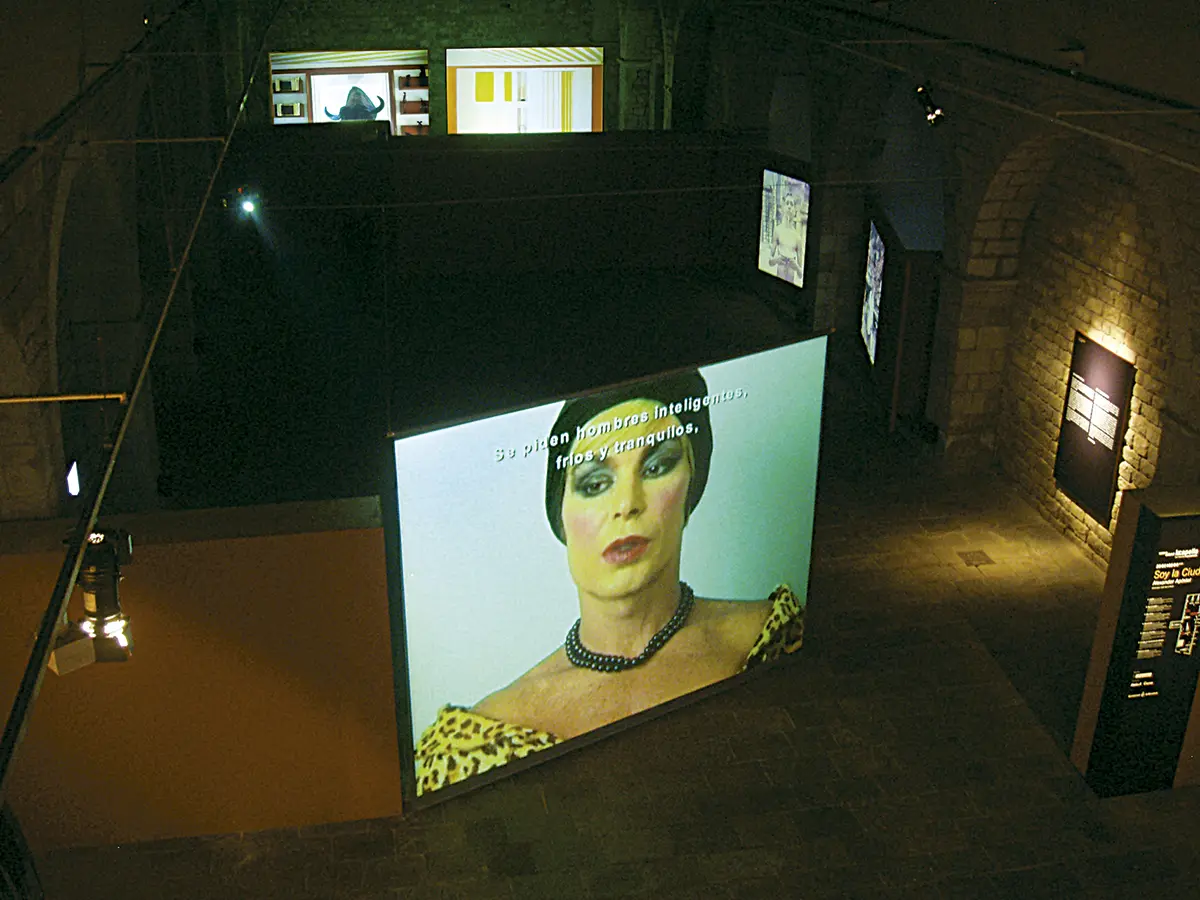
In the first work, a drag queen gazes fixedly into the camera and recites in a muted voice, texts about the ideal home by the architect Le Corbusier. The scene is as pathetic as the cultural reality of the whole geography marked by ideological contradictions and indomitable ironies. The badly applied makeup, a cosmetic undoing in the most ambitious sense of the term, is the most accurate and effective tropological resource to call attention to the crisis, the falsity, and as such the levity of the crumbling modern paradigms that gained space in the recent history of the city of Caracas. What was the imposition of the modern on Latin American cities eager to appear worldly but a grand mise en scène for the best cross-dressing performance? The add-ons, the cosmetic corrections to the urban landscape—juxtapositions that revealed the anarchy and falsity of a model of profound social crisis where poverty and bounty were irreconcilably antagonistic spheres—reveal the efficacy of cross-dressing as a process to diagnose a reality based on the ferocious and paradoxical cult of simulacrum.
Each work in this exhibition functions autonomously and establishes simultaneously a strong connection to each other. Seen in this light, Moderno salvaje has a tremendous complicity in the discursive plane of Soy la ciudad. In Moderno salvaje, there is no figure of a cross-dresser but instead the architecture of a cosmetic process. Here, some hunting trophies are in drag, through a simple mechanical action, as geometric artworks of the lowest quality, which satisfies the counterpoised tastes of the first proprietors of this authentic mansion, built-in 1957 by the architect and designer Gio Ponti. This work is the most literal and potent evidence of the airs of power, arbitrations of taste, and unbridled delirium of an oligarchy that saw in kitsch modernity its paradigm for redemption and symbolic superiority. This work is at the same time risible, pathetic, and genius, carrying a deeply cruel discourse into the conversation alongside other works in the exhibition, such as Documental and Them as a Fountain. These works accurately narrate the spectacular failure of the modern model and the exhaustion of the barbarous city that extends and fertilizes its areas on the margins of the former, becoming a cruel mirror of the modern, the other side of the coin.
Both works explore the most dramatic aspect of Caracas’s socio-cultural reality: the mechanism of resistance and utopian conviviality in the ever-growing peripheral and marginal sectors that configure and alter the outlines of Latin American cities. Alexander Apóstol seeks those areas of contemporary Venezuelan society that express the paradox of many urban centers in the Third World. He makes evident the tension generated in the urban field between the unbridled obscenity of luxury and the agonized survival of poverty. His chicos-fuentes have obvious but well-resolved references to Bruce Nauman’s work. He shows families that have been mistreated by the cruelest and precarious situations yet are absorbed in watching TV, listening to demagogic discourses about well-being and progress. Both of these representations express the misery of a social design where the oligarchy fattens its coffers and lateral subjectivity cries in the margins.
This show reveals a subtle change in Alexander Apóstol’s discourse: the displacement of his focus from the public/urban space to the disconcerting intimacy of a domestic interior. The series of works in this arena investigate the power relations and the paradoxical universes that emerge in domestic interiors marked by insurmountable inequalities. Alexander Apóstol’s narrative traverses a wide range of subjectivities, from the dazzling habits of the highest classes to the survivalist alternatives of the deeply marginal sectors, through the classic model that reveals the conflicts of the middle class.
Alexander Apóstol’s proposal abandons a nomadic vocation for frivolity to move deeper into the interpretation of the cultural constructs that result from arduous processes and negotiations between the orders of ideology, politics, anthropology, sociology, and culture. Therein lies another virtue of Apóstol’s work: his deployment of art not as a hedonistic landscape for the most infertile of enjoyments but widening its uses and transforming it into a tool for the exploration and understanding of the contemporary dilemma.
ANDRÉS ISAAC SANTANA