
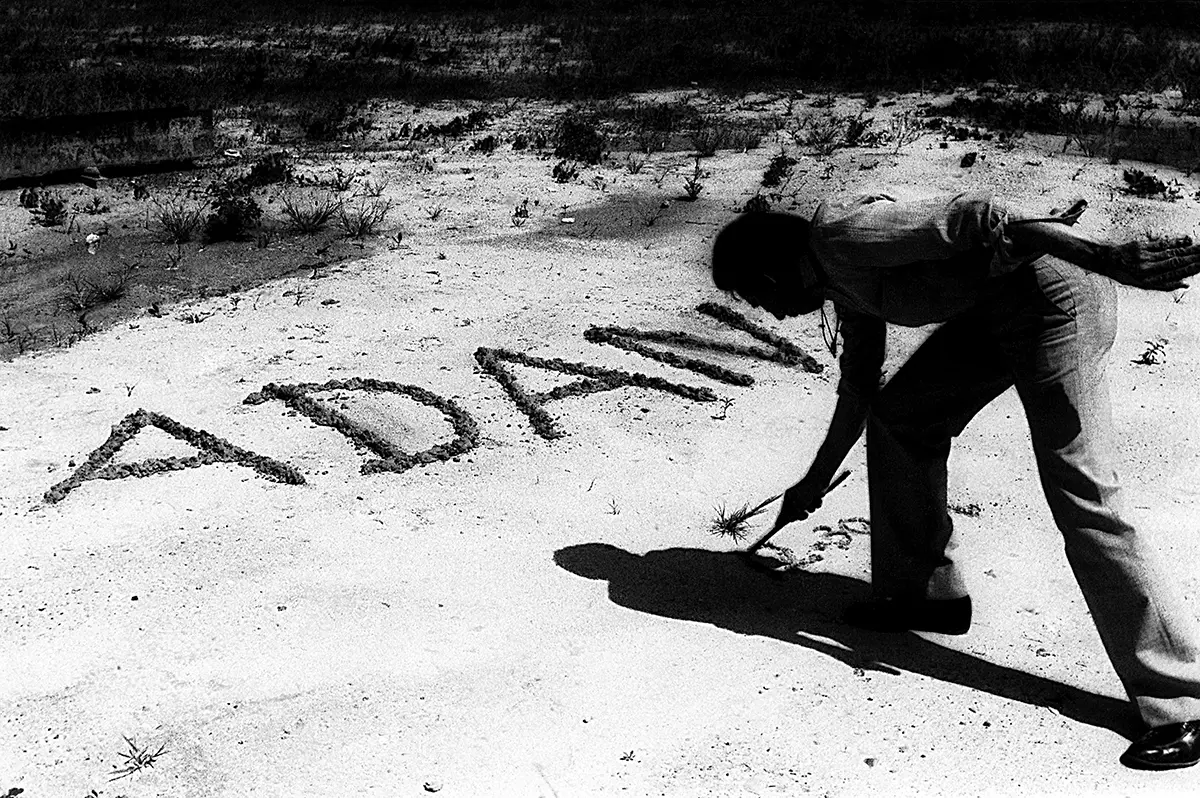
Caracas’s Galería de Arte Nacional presented a well-deserved tribute to a master of Venezuelan art, Alirio Oramas (born 1924), with an anthology of works dated between 1946 and 2005. One hundred and ten works told the story of the artist’s oeuvre; on an opening day, the performance Eva-Adán (Eve-Adam) was presented. Since his beginnings as a student at the Escuela de Artes Plásticas de Caracas, Oramas proved himself a rebel against the rigidity of the academic canons of artistic instruction, arguing in favor of personal and creative freedom. He translated this issue over many decades into a body of work and in his intense activity as a promoter and teacher. Especially important was his 1948 directorship of the Taller Libre de Arte, a space created for the practice of and reflection on artistic activity that left a deep impression on the development of local art. In 1974, he was named Director of the Museo Armando Reverón, Macuto, and he has had numerous individual and collective exhibitions.
The work developed by the artist is versatile and capable of exploring various languages, like actions/performances such as La creación de Adán (The Creation of Adam) and El camino a las estrellas (The Road to the Stars) and contemporary installations, and reveals the contributions that he has made to the arts in Venezuela. He was among the first to adopt geometric abstraction as a path toward universality in the early 1950s; it was in 1951 that he won the National Arts Award for four works, the highlight being Cometas y papagayo (Kites and Parrot). In the 1960s, he directed his interests toward ideas such as informalism, and later, in the 1980s, he joined contemporary avant-garde movements. Although this process could be perceived as a series of leaps between various trends, in Oramas’s case it is a continuous creative process marked by fundamental coordinates and an absolute coherence in his oeuvre.
One important point made by this show is that Oramas practices in the most intimate universe of painting. His proposals reside in the facts of his personal and artistic life, and he utilizes an immense intellectual reserve and a deep knowledge of the history of art, art practice, and its mysteries. The most private elements of his existential and domestic interests are concentrated in each of his works. By titling this exhibition Del misterio a las revelaciones (From Mistery to Revelations) Oramas offers the key for a reading of his visual and conceptual discourse. Evidently, he locates his interests in the esoteric universe as the foundation of a profound spiritual life. This has driven him to produce natural or urban landscapes that are fantastic in character and poetically symbolic. However, it could be emphasized that Oramas is a figurative painter per se. His works share an abstraction that, although his shapes are often recognizable, tends toward concepts in a language of forms that intertwine the geometric and the figurative. Regarding Oramas’s interest in a metaphysical realm, his paintings don’t necessarily posit description or narration. Their content is in the paintings themselves; the viewer searches on the surface for signs to decipher the message hidden in the shapes and colors.
Oramas's abstract or figurative images do not have time, but they do have space and color. These two elements are essential to the configuration of the work and demonstrate his dependence on color, which is not strident or visually loud. For him, color carries the composition to its climax and summarizes the theme, expressing the emblematic, pictorial poetry of his aesthetic interests. Throughout his life, this Venezuelan artist has been the protagonist and spectator of fundamental events, one that has impacted his life as a human being and artist and also the lives of his contemporaries.
BÉLGICA RODRÍGUEZ