
Anal is is the new individual show by Mexican artist Ana Quiroz. The show opened on April 25 at the Kunsthaus gallery, in Wynwood. It comprises eight works, two of the installations that are strategically arranged in the gallery.
The main idea behind this show is the idea of human obsession, repetitive and compulsive behavior. In fact, using the word “anal” refers to the well-known, widespread metaphor used to label people who display compulsive behavior. Intentionally, some of the works might seem repetitive, a way of replicating such behaviors. One of these works is Eces, where Quiroz reproduces the same shape five times. Another work that uses this resource is The blind leading the blind, representing a spermatozoid “race.” Indeed, another aspect of Quiroz’s work is sexual in character, sometimes implicitly as it is here, sometimes in the shape of her works, and sometimes more explicitly, where she mixes forms with social themes, as in Pederasta (Child Molester). This work is resolved on the basis of a simple phallic shape that may be simple in terms of its conceptualization but is very effective in its connotations and accusatory message.
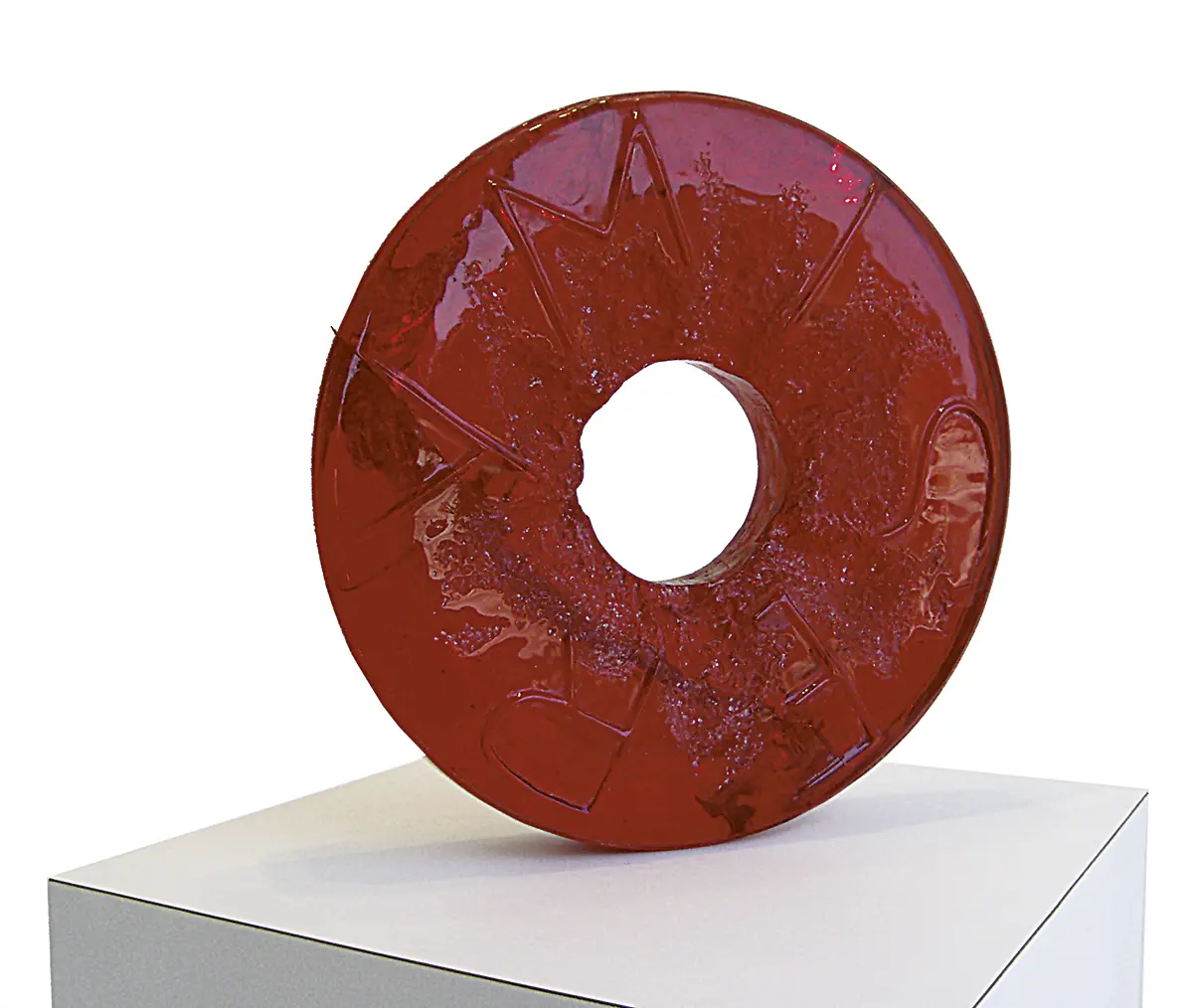
In terms of technique, Quiroz has chosen to work on glass that is recycled, cut into small pieces, and reassembled into various shapes. The inherent contradiction of these works resides in their visual beauty and the danger they represent to the touch. These materials were consciously selected by the artist because they allow her to emphasize the perpetual duality of her work, a kind of yin/yang.
Ana Quiroz’s work is characterized by its almost visceral irony. She plays with dual meanings, with semantics. Quiroz is an artist whose work is extremely intellectual, based on her personal philosophy and her geopolitical position. Hidden behind works that are entirely organic and seemingly naïve is the artist’s whole complex philosophy. Quiroz speaks of human miseries, rebels against the established social order, and comments on the consequences of both. The reading of Quiroz’s work is largely based on her life experiences in a Third-World country, where social differences are clearly marked and spatially outlined. Lifesavers-misery belt, one of the works in this show, was conceived in accordance with this principle. Here she uses a resource taken from Pop Art, the magnification of commercial products and their use as symbols. Taking as her starting point an icon of American popular culture, the candies are known as “lifesavers,” Quiroz takes us to a different context. These candies usually have an inscription reading Lifesavers, which Quiroz substitutes with one reading misery. For her, this is an allegory of civilization and the contradictions it generates, inherent to the development itself, such as for example overpopulation. For this giant candy, Quiroz has chosen a bright red color, an attractive signalization, not easy to miss. On the basis of a radical call to attention such as this piece with its aggressive color, once again she brings to bear her surrounding reality, that of a large city encircled by a belt of small urban settlements in deprived conditions, one of the most acute social problems in Third World countries.
Ana Quiroz’s work is highly conceptual and has strong social connotations. In fact, in general, her discourse is anchored on that platform. A complex oeuvre whose meaning may slip undetected in a different context. It is like a pebble in our shoe, like a spider web trapping the unadvised, who approach it perhaps attracted by its shapes or colors without suspecting the complexity of what is about to be revealed.
IRINA LEYVA