
The exhibition Twelve Churches by Bernardo Salcedo is unsettling because it is situated at the border of space we will call “the other face” and is determined by the clarity with which Salcedo indicates the importance of verticality in the conception of a work of art.
Art, a manifesto used to make statements about critical issues such as politics, sex, and religion, finds in Salcedo’s proposal a very interesting scenario that has been elaborated to show the second meaning of things. Bricolage and visual metaphors have been constants in his work, and the unexpected lack of either makes Twelve Churches so unsettling.
In this exhibition, twelve thoroughly worked objects transform the raw matter of their construction from inner content into the outer shell. It is a series that seeks each work’s individual aesthetics, allowing each to share a platform of creation. In essence, each retains and exalts three basic aspects of religious architecture as present in the colonial altarpiece, the source for this series: verticality, specifically referring to the relationship between human beings and a superior being; the color gold, a splendor that directs one’s thoughts toward the sacred; and the notion of the church as a space for the containment of souls.
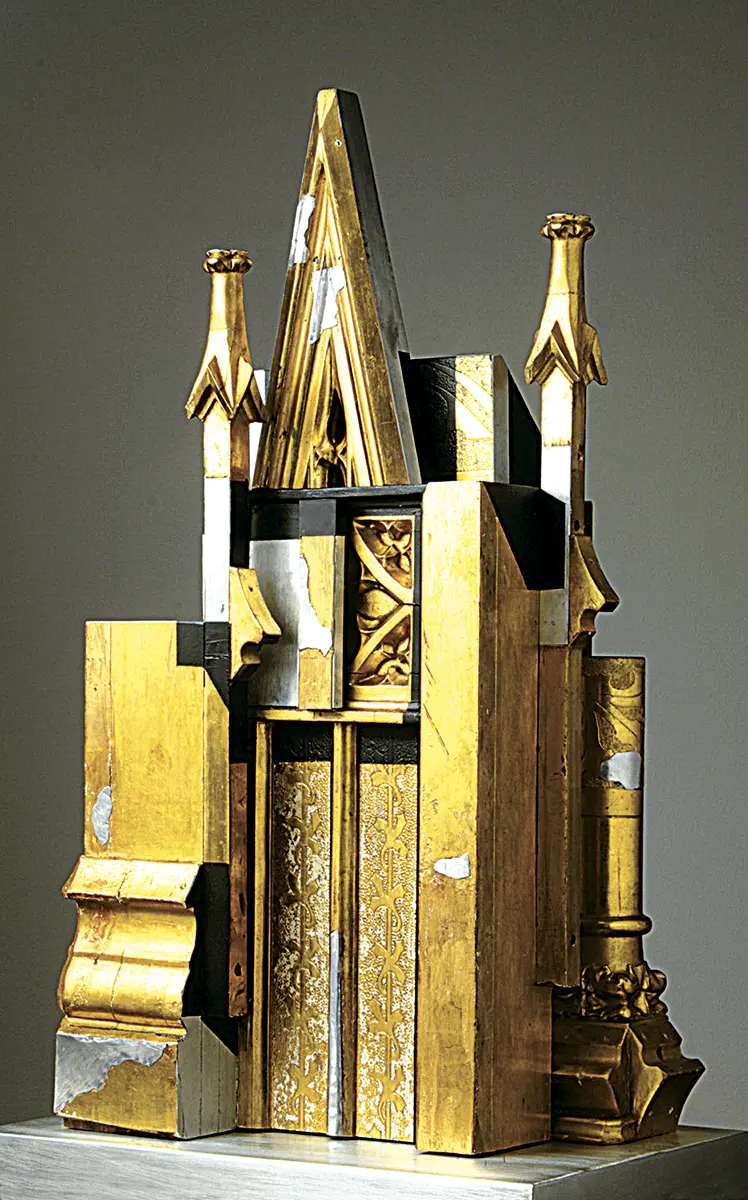
The strong aesthetic presence of these three aspects could lead to a misinterpreted reading. A good model-maker of gothic buildings would also have masterfully worked these three variables, but “the other face” of Bernardo Salcedo’s series is what is interesting.
What one finds in Salcedo’s work is the intuition and handling of the a priori knowledge with which these aesthetic particularities connect to the viewer. One wonders about the habit of looking to the skies, not the horizon, to seek a superior being, which establishes a vertical rather than a horizontal movement. Another question raised is why an intense color like fuchsia does not make one think of a sacred object. Lastly, how do churches invite and force one to control the volume of one’s voice? These kinds of learned information in many cases have been transmitted without words from generation to generation. This proposition highlights “the other face” of Bernardo Salcedo’s objects.
Interestingly, Twelve Churches is installed inside the Alonso Garcés Gallery, which has been converted from an old church. Therefore, redundancy must be deployed to convey the result of this series exhibited in this particular space, which is a container of containers. Understood from the perspective of art, this interesting wordplay acquires a certain meaning, but from an architectural position, there is a new variable that, again, is unsettling.
Salcedo’s objects have been characterized at a scale that allows the viewer to absorb at a glance a number of the faces of his works. This reading totalizes the object and invites one to explore it. But Salcedo’s works retain the feature of “the other face.” This refers to the impossibility for an artist who makes three-dimensional objects to control the path followed by the viewer in front of his work. This action becomes relevant when the objects deal with such topics as the relationship between humans and a divine being. Twelve Churches is a well-conceived proposition that questions the object by appealing to information held by each viewer and refers specifically to the recognition of the object’s sacred, vertical, and golden character.
ESTEFANÍA SOKOLOFF