
Observatorium, the Cuban artist Carlos Estévez’s most recent individual exhibition, opened on April 8, 2006, at Alonso Art in Wynwood. The show comprises twenty-nine works; of these, twenty-seven are collages and two are sculptures. One of the show’s most significant aspects is the artist’s exploration of collage for the first time, which started with a diversion of a birthday gift. Estévez gave himself some old books, and his “inner child” soon had him cutting and pasting “little figures,” which he later transformed with drawings, resulting in these collages.
Although the viewer wants to identify some elements from Estévez’s previous iconography, such as marionettes and a peculiar way of representing human bodies, Estévez has turned his attention to the natural world. In these works, the relationship between the artist and the naturalist is very close. Animals and fish on wheels gain strange mobility in En busca del mundo interior (In Search for an Inner World), a structured fabrication of the surrounding world. Estévez explores the mysteries that define the very existence of human beings and their relationship with nature. In the same way, he reflects a fascination with the perfection of the animal world.
Seeing these collages, one can’t help but be reminded of drawings by Leonardo da Vinci that mix human anatomy with natural elements and invented machines. Among Estévez’s works that illustrate this principle is Borboleta, which combines a helicopter and a butterfly: the helicopter’s body has the butterfly’s wings and legs. By association, Estévez demonstrates how nature’s functional principles have been applied to a technical problem. Herbolario emphasizes the dependent relationship between man and nature and the similarities between certain parts of the body and their plant counterparts. It is a reminder, a simple call to attention about where we come from and where we are headed.
The two sculptures in this exhibition are made with objects created by the artist and objects he finds in antique stores and auctions. Estévez is a collector of various objects, bringing together a kind of cabinet of curiosities among his materials and in his works.
The idea of Camera-man was expressed first in a collage, but Estévez wasn’t satisfied with a two-dimensional representation and needed to bring it to three dimensions. This work consists of a head leaning on a tripod. Projecting from the head are lenses in various sizes, focusing on different points. With these lenses, Estévez represents the way that eyes register different aspects of the surrounding reality to be archived in memory, in a sort of personal record.
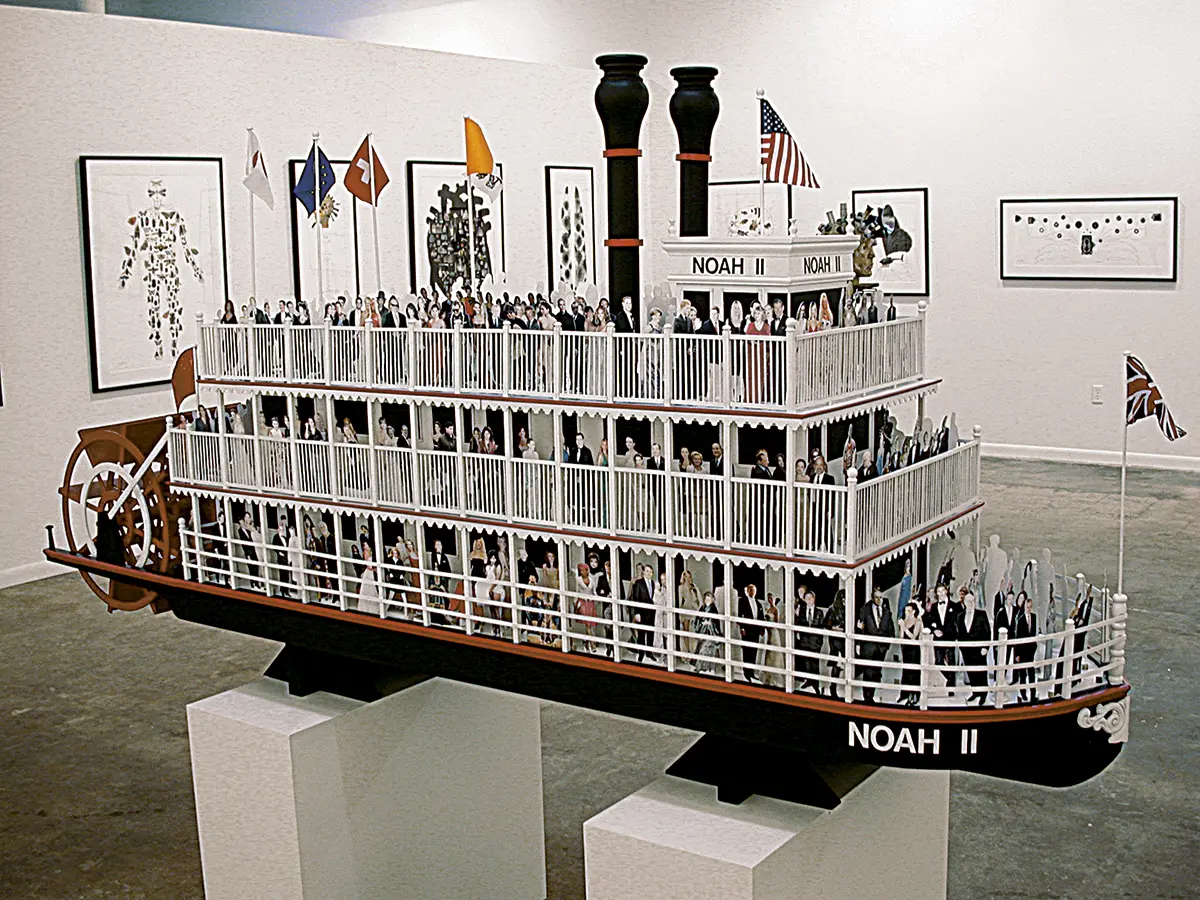
El Arca de Noe, the second sculpture, is one of the show’s central works. Over the centuries, the story of Noah’s ark has been one of the most represented and popularized biblical episodes. In this work, the theme has been displaced from its religious context to a social context. Its protagonists are not the pairs of animals but contemporary celebrities, politicians, and media personalities. With this work, Estévez comments on the existence of a social group whose power is “beyond good and evil,” a power that renders them practically untouchable and places them on a different plane of existence. Using the allegory of the cataclysm at the end of the world, he shows us Noah’s hypothetical conundrum: whom to choose? This work is a social commentary about the social reality, where the qualities that should determine one’s “salvation” are not necessarily determinants.
At once self-assured and attentive, Observatorium proposes a different way of looking at the world. It features a many-angled gaze, as in Camera-man, where the association is based on shapes and colors, creating a new environment or an alternative, vital organizing principle.
Inevitably, Estévez continues to be inclined toward philosophical and universal topics such as knowledge and human existence. His works function as existential explorations where he recreates his beliefs, fears, and hopes, all fused within ideas that are conveyed in the chosen materials. With painstaking patience, Estévez confronts each one of his ideas, organizes his thoughts, and reverts them in each work.
Estévez’s work possesses the ancient flavor of medieval manuscripts, of the cosmic representation of the world in ways that are at once simple and extremely complex. His work expresses the mystery of the unknown and the evident, the synthesis between chemistry and alchemy.
IRINA LEYVA