
After an absence of more than a decade, Carlos Quintana exhibited at Galería Habana an exhibition titled Lateralidad cruzada (Crossing Sides) from January 27 through March 10, 2006. This presentation comprised a group of fourteen works: mostly large format, mixed-technique paintings accompanied by some charcoal drawings, all selected from among his most recent production.
The image that many had of the artist’s work was linked to his El nuevo clásico (The New Classic) at the show in 1991 at Galería Habana and to three works last seen in the collective show Misa por una mueca (A Mass for a Gesture) at the Centro de Desarrollo de las Artes Visuales in 1993 before he moved to Spain and worked with the Ángel Romero Gallery.
At the time, his characters were almost always solitary protagonists. Women with dog heads posed a disarticulated sensuality, as did the humanity of his male figures, who marked the brutality and the inner violence that accompanied them. Offspring of the instinctual and the irrational, and of imbalance and nonconformity, these were beings in a singular carnival of suggestive hybridizations and mocking poses. Not satisfied with this, Carlos Quintana perversely and cynically played with the feminization of masculinity and vice versa. It was his way of sketching the universe of otherness with a significantly more open than one relating only to an individual’s sexual preference. He asserted the right to be against any order by zigzagging in the face of the linear, putting perfection in a state of crisis, deathly wounding any containment, and giving faith free rein.
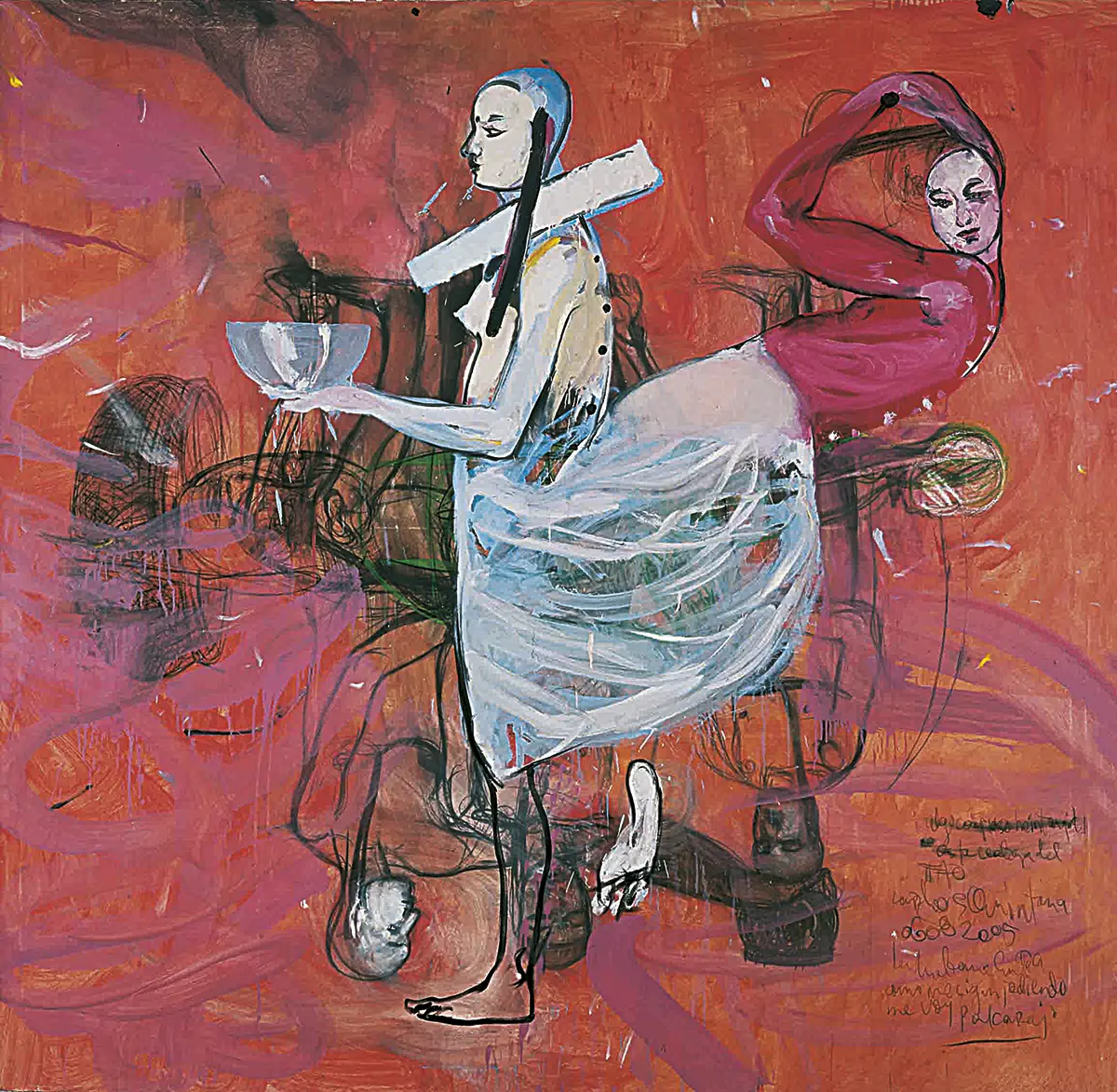
As before, neo-expressionism persists as the center of Quintana’s discourse, as seen in Lateralidad cruzada. His attentiveness and a deeper exploration of the mentioned angles were mirrored in the works Mr. Indiferente (Mr. Indiference), Pureza y quietud son normas del mundo (Purity and Stillness are the Lwas of the World), La gente mala y la gente buena (Bad People and Good People), Ciego Montero como me gustas, como te quiero (Montero the Blind, How I Like You, How I Love You), El arte y la trigueña también (Art and the Brunnette Girl Too), Como me sigan jodiendo me voy pal carajo (If they Continue to Fuck With Me I’ll go to Hell), and Alimentación (Feeding).
In a general sense, Quintana’s symbolic production starts with the conjunction of drawing and painting as fused elements that come apart only in brief moments. His entire process responds to impulses that emanate from within. These impulses have remained on canvases and drawing papers for a long period and have taken him from a unique exercise of the portrait—one closer to what can be considered his “visions”—to the complex groups he has been executing for a number of years.
Attempting to define or explain Quintana’s work is to unmask a slippery gesture. The works almost always possess an ambiguous nature, raise the mysteries of the subconscious, and use emotions as indispensable materials. On the other hand, they recreate a symbolism linked to the ritual of Afro-Cuban religion mixed with that of Eastern cultures. His cooking pots, Buddhas, sacrifices, and samurais have their roots in the artist’s beliefs.
The common formal denominator in the exhibited works is a vigorous stroke. This stroke often emphasizes turbulence or becomes a caress. Carlos Quintana’s works happen. They are evidence of actions that take place through him, as if he were a medium, as he mentioned some time ago. Unattached to time or to history, the actions impact the viewer on supports that are determined by the idea or the circumstances. Their reality assaults and charges the viewer. This reality can be violent or possess an overwhelming nobility and weight, like the pensive head outlined in white in Estoy extrañándome a mí mismo (I Am Missing Myself).
The way that Carlos Quintana executes his paintings and drawings is a manifesto of freedom, irreverence, and discomfort. Instinctively, an intimate part of him appears in his representations. The domain of the public is gathered inside what appears to be a private sensibility and space. In the middle of this paradox, the viewer is able to reflect and construct on the basis of one’s own visions, a deliberately slippery and chaotic moment that reaffirms a world of which all are apart.
This world and this portrait underlie the occasionally incomprehensible interstices of Quintana’s gestures. In the present, when one finds multiple notions and images of contemporariness crashing against each other, Quintana’s collage makes reaching quietude impossible and comes closer, with increasing force, to a trembling consciousness of the human condition, of human longings, dreams, and torments.
CARIDAD BLANCO DE LA CRUZ