
Sound has always been an important element of Clemencia Echeverri’s video installations. In Casa íntima (An Intimate House), women’s voices and domestic sounds take the viewer inside quotidian ruins, old stately houses that, due to the modernization of the city, are on their way to extinction; in Apetitos de familia (Family Apetites), the noise of gunpowder, the voices of humans, and the shrieks of pigs set the mood for cultural celebrations where festivity and violence coexist; in De doble filo, sounds transport the viewer from a comforting domestic environment to one of menace and insecurity; in Un animal exhausto aún puede pelear (An Exhausted Animal can Still Fight), a piercing sound intensifies the slicing of the spurs worn by fighting roosters; in Cal y canto, the voice of a street peddler calling for bottles and paper accounts for the sound of the city. In Echeverri’s most recent video installation, Voz, resonancias de la prisión (Voice, Resonances From the Prison), which was started in 2003 and concluded in 2005, the pre-recorded voices of several men and women become the central element.
Echeverri states, “In 2003, I traveled to England to continue an art project. I wanted to get in touch with Colombians that were in a difficult situation in that country. Initially, without pre-established reasons and with some apprehension, I visited a number of Colombians interned in various English prisons, and later in Colombia."1
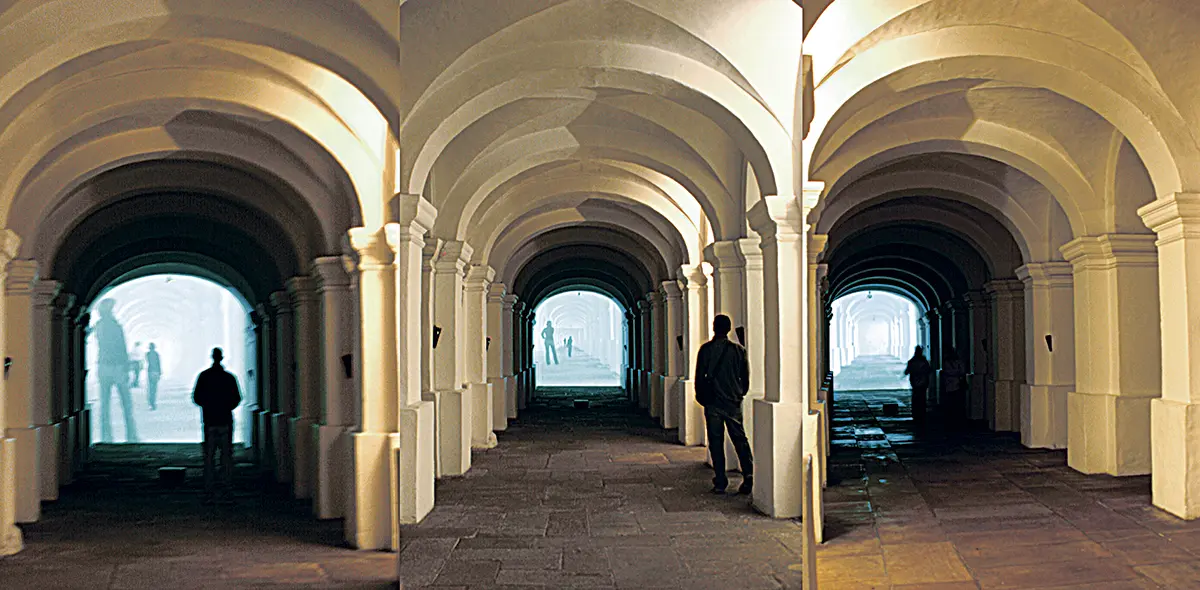
The two central elements of the video installation, sound, and space, emerged from that experience. Entering a prison made Echeverri feel as if she was entering an “isolated and artificial” world cut off from common life and dominated by the sound of “restless keys,” sounds that resonate through long, silent, hermetic corridors. Later there are the voices of the interview subjects, “voices perhaps without childhood, without parents, without affection, without education, full of abuse, full of humiliation,” that are recorded in long dialogues between the artist and the prisoners.
In her narratives, Clemencia Echeverri conveys the subjects’ desire to “establish some contact” with memory, with the past of those men and women that are separated from regular life due to different circumstances. “They visit the places of their childhood, their parents, their education, their affections. Sometimes it is difficult to carry on. They cry, they stop and make relationships. They erase, evoke desired and unfortunate encounters. At times, there is quiet. Some tell stories, some revise, laughter is heard: ‘In my home, the floors were spotless because Mom was so strict.’ Through memory, they revisit lived spaces. Time passes in silence. They leave there to start at the beginning, to retell it in detail, to retrace it, and anger appears: ‘In my home it was different, all was poverty and violence.’ They return through the years and cry. They find brick and mortar in layers, a wall, school, another wall, home, parents, family. The encounters grow. . . . They see the mother that sometimes attends to them and the father who enforces and does not pay attention. . . . ‘I hated him, hated him, hated him. My father used to hit my Mom a lot. I used to give him drops of Dinogan to knock him out.”
These personal experiences resulted in the sonic and visual intervention that took place on the first floor of the Museo Nacional, the old Bogotá Panoptic, built by architect Thomas Reed in the nineteenth century. In the first floor galleries, one first saw an excellent work of architecture, a memory of the building’s past that remains thanks to the new function of this vaulted white space. Creating an intervention of the place through a video, Clemencia Echeverri captured the image of that same space and projected it on the actual wall, evoking the past and creating a space that unfurls beyond the physical walls and real-time. As the viewer followed the unending gallery, censors were activated in the lateral vaults and the voices of the interviewed men and women began, evoking a differently remote past and revealing the circumstances of their imprisonment.
The object included in the show comprised two forms that slowly folded open. In the foreground, a metal fence opened, and beyond were impeccable white walls with arches that stretched toward infinity; upon opening, the two lids were left next to the transcriptions of the recorded voices. When both lids were open, there appeared the ruins of a space that in the past housed the experiences of so many men, whose voices still echo in the voices of today’s prisoners.
NOTE
1. All quotes are taken from texts that are part of Clemencia Echeverri’s project.
MARTA RODRÍGUEZ