
Courtney Smith’s first solo museum exhibition in New York destabilizes the order of things. Her furniture-based sculpture currently at the Chelsea Art Museum deals with diametrically opposite concepts such as order and chaos, geometric abstraction and organic forms, repulsion and attraction, unity and disjunction. Her work also suggests a game of building and deconstructing, reminiscent of a child’s construction with LEGO blocks. The result of this game can be naïve or extremely refined. In Smith’s case, she is able to accomplish her task by transforming original, functional furniture into elegant pieces of sculpture without a designated function.
In the piece Você e Eu (You and Me, 2004), Smith cuts up an original rosewood chair by the renowned Brazilian designer Sérgio Rodriguez. She then incorporates geometric shapes of plywood into the rosewood cutouts, creating an abstract surface. The dark tones of rosewood and the chair caning, both from the original chair, dramatically contrast with the industrial, sparkling whiteness of the plywood blocks, giving the piece a feeling of strangeness. The viewer can still recognize the shape of the original rosewood chair in the final work, but nevertheless, that object can no longer be called a functional chair. Smith’s conceptual games evoke connections to the works of North American artists such as Joseph Kosuth and Richard Artschwager. Minimalism is also at stake here but, instead of taking away any context or meaning, Smith lets the viewer recognize her original sources and even induces the spectator to find meaning in the pieces through their titles.
In her choices of titles, such as Você e Eu (You and Me, 2004), Sim ou Não (Yes or No, 2004), and Tin Tin por Tin Tin (2003), Smith suggests that there is a dialogue going on between two people. The last of these is named after a song from the Brazilian father of bossa nova, Antonio Carlos Jobim. Tin Tin por Tin Tin in Portuguese means to explain everything in detail or to create an inventory of things. Tin Tin por Tin Tin is made of twin armchairs from the 1960s, disembodied into 110 pieces and then enclosed by modules of plywood, creating an abstract design of geometric shapes with no fixed configuration. Smith brought the cutouts of the original chairs to the U.S. inside her luggage—like a smuggler—and while in New York, she fused them with materials such as Formica or plywood.
In Reis (2003), an elegant wooden chest is invaded by blocks of plywood that replicate the original form of the drawers. After the initial piece is almost totally overrun by the plywood modules, the drawers can no longer be opened, and the piece becomes a decorative object of art, instead of a functional piece of furniture.
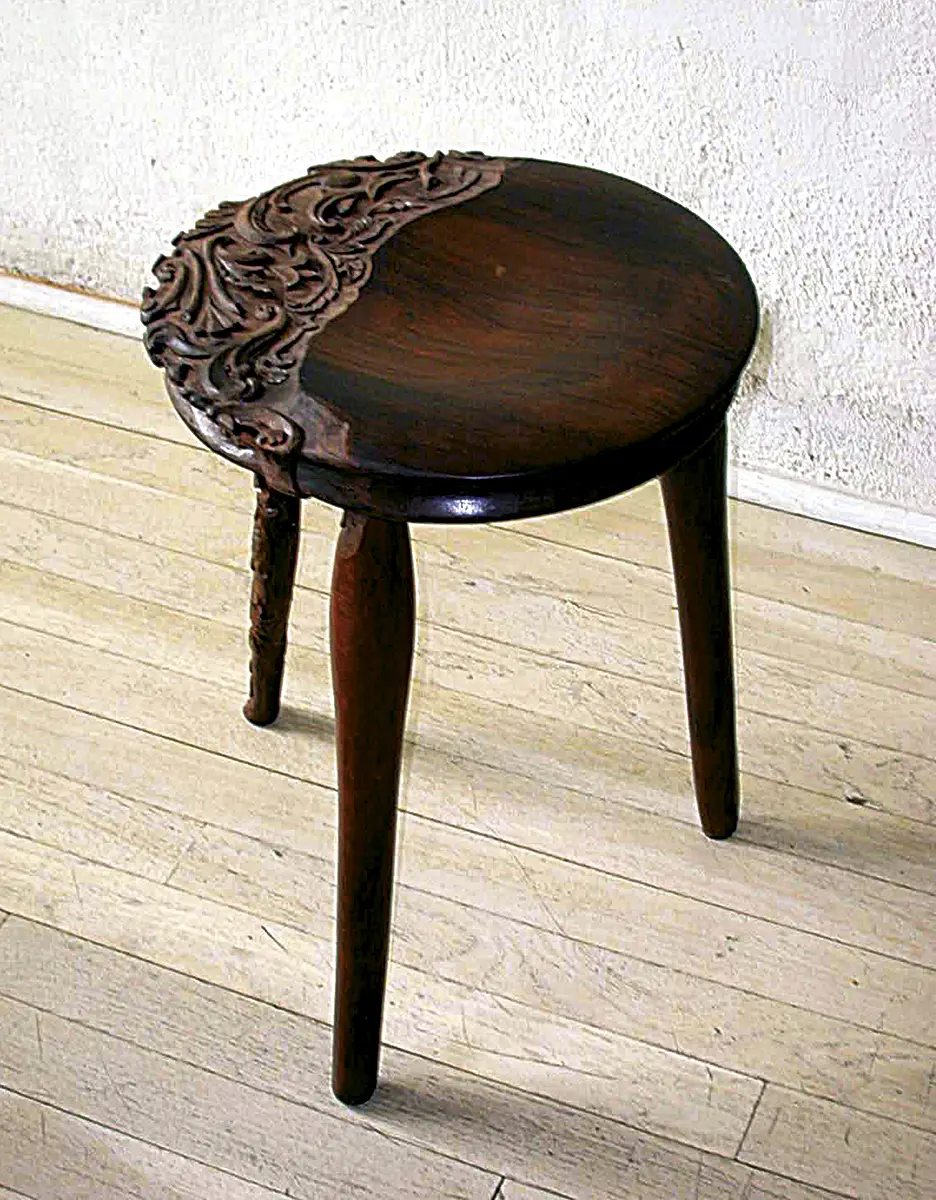
In her next series, instead of inserting one object into another through cutting and pasting with organic and industrial materials, Smith played with carved wood. She hired a skilled craftsman to carve baroque decorative designs into original pieces of furniture, such as a rosewood stool called Bonito (2002) and a chair titled Noir (2002). Instead of looking attractive, these handmade elaborate designs give the appearance that termites have been eating up the original furniture. They remind one of tattooed skin or an invading organism taking over and destroying the host piece, little by little.
The exhibition is composed of sixteen sculptures dating from 2003 to the present. One of Smith’s latest works, Junk House (2006), is made of 1000 bricks, all discarded from her earlier pieces. They are juxtaposed against each other, creating the shape of a house. Since there is nothing sealing these blocks together, or cementing them to the floor or to the walls, they effectively create a house of cards. After the show is over, these blocks will be packed again into boxes where they will remain until they find a new destination. The next time they are shown, they will be transformed into a totally different shape. In cutting, sawing, jointing, carving, and interlocking different parts and materials, Courtney Smith gracefully plays the role of a bricoleur, a term introduced by Levy-Strauss to describe a "jack-of-all-trades."
CLAUDIA CALIRMAN