
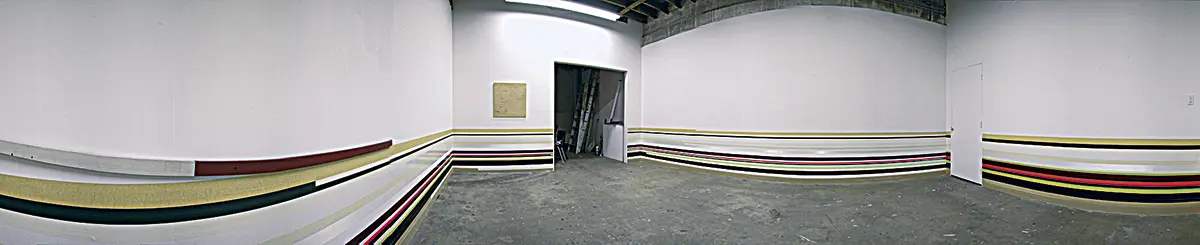
Danilo Dueñas presented his most recent installation titled Velocidades (Velocities) at Locus Projects, Miami’s first alternative space. During the last decade, this venue has acquired special attention thanks to its exclusive dedication to showing installations, video, and photography.
With Velocidades, Danilo Dueñas applied the same principles that sustain his painting to the space’s four walls. At the same time, his installation is built on the goal of his painting, which is to go beyond the plane, to become equal with reality itself.
Danilo Dueñas is a Colombian artist whose work is built on the construction of the geometric, not through an idea of perfection or utopia but through opposite concepts. The recycling of wood and other materials, including the modification of the exhibition space, plays an important role. Danilo Dueñas delineates the geometry in architectural spaces. The gallery walls are the support on which he assembles various kinds of materials, most of them gathered on the way to the gallery, and such objects as desks, metallic shelves, doors, etc. But alongside this three-dimensional assemblage, Dueñas also experiments with adhesive tape, which produces an experience that is more pictorial.
Both strategies aim to work beyond these dimensional categories and even the geometric. The resulting works fall within what Donald Judd termed “specific objects,” something that is neither painting nor sculptures proper. In the end, an installation takes over the walls to reach its true goal—the mind of the viewer and its control of reality.
In Dueñas’s geometric constructions, the specific does not exist, but the destruction of one idea of the geometric is intuitively surveyed within a given space. The final result is a geometric construction, but one of a different order, one that is adjusted to its impulses or to an experience of residual architectural space.
It would be erroneous to catalog Dueñas’s work within rigid structures. Nor does his work fit within what María Iovino defines as soft structure. Dueñas’s structures have the same rigor of survival structures, those that form countless shantytowns throughout Latin America. His installations extend into subsequent installations. Thus, the next installation is a continuation of the previous one, even if it differs in materials or their disposition. This occurs unexpectedly, and Dueñas acts with blind faith to compose an authentic experience according to his principles. This leads him to hold on to currently unpopular practices, like the neo-plastic tradition and his painstaking process that extends the time of the execution of his works, which appear casual and spontaneous.
Velocidades comprised industrial adhesive tapes in many colors; these ran around the perimeter of the gallery space and ended abruptly on a wooden element, almost like a samurai sword, that violently interrupted the horizontal festival of colors. Alone on another wall hung a wooden square, found in a warehouse and soiled by time. This square functioned as a visual obstacle to the dynamic sensation projected by the tape. Velocidades perhaps reflected Danilo Dueñas’s interest in Formula One racing, a sport that his son is pursuing. However, the title could also relate to the tradition of the concept of velocity in a painting created by the Chilean painter Roberto Matta after World War II, which gave painters such as Jackson Pollock the idea for a new expressive monumentality.
As it was with the Latin American audience, Danilo Dueñas’s installation in Miami was disconcerting, but even more so. In Miami, the public avoided the gallery—there were none of the predictable elements, such as video, photography, or drawings, no objects that the public could pragmatically view. Velocidades could also be understood as something to be seen quickly, not expecting to be understood.
EUGENIO ESPINOZA