
A few months shy of the age of eighty, Ennio Iommi inaugurated the surprising exhibition La cocina humana (The Human Kitchen), during a year that is the sixtieth anniversary of the creation of Arte Concreto Invención, of which he was among the main drivers. One of the most salient features in Ennio Iommi’s career has been his perpetual spirit of radical rupture, which has been formed over time through diverse expressions and shifts in the direction of his work. Although today’s postmodernism is not characterized by the presence of advanced avant-gardes, each new Iommi show seems to renew the group’s old proclamation, “Our works have revolutionary content” (from Revista Arte Concreto Invención, 1946).
At Galería Del Infinito Arte, his installation emerged from a densely ironic sculpture, Hombrecitos pasando por la ley del embudo (Little Men Passing Through the Law of the Narrow Side). In this work, five robot-like depersonalized individuals climbed a ramp with determination and purposefulness, but a cruelly realistic funnel transformed their intentions into results that were decidedly grotesque: a group of frontally placed, large meat-mincing boards alluded to segments of an irritating external reality.
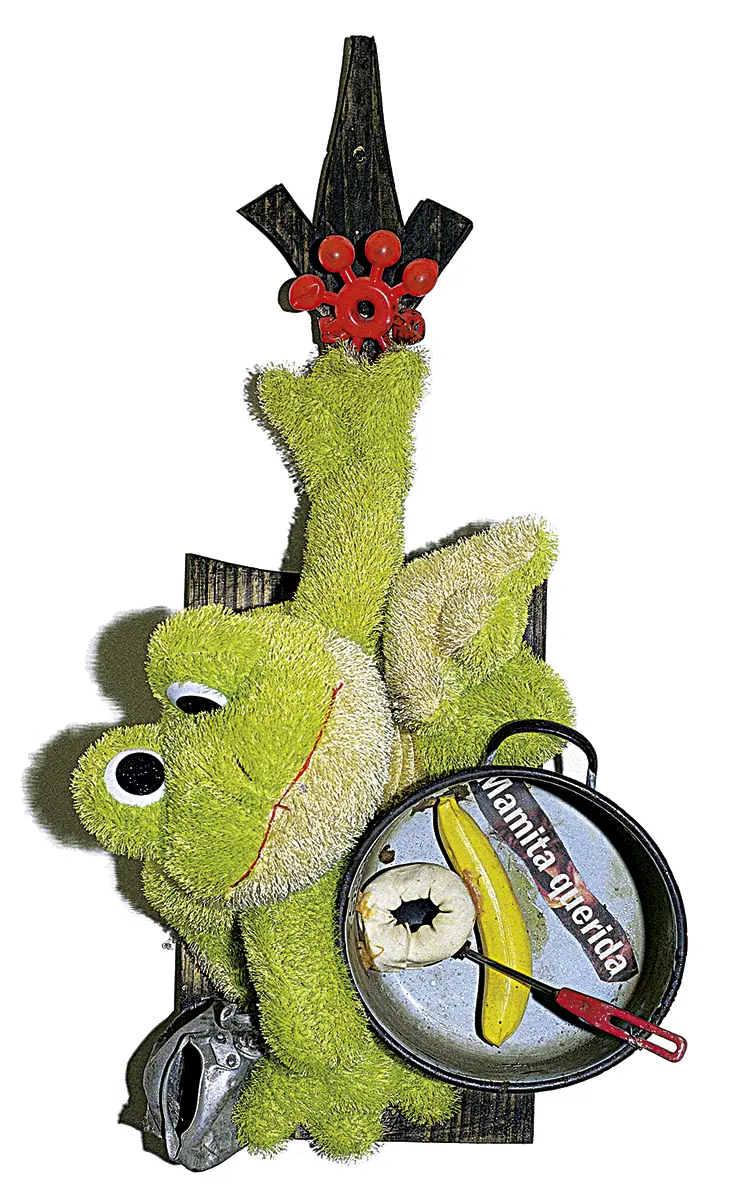
Elena Oliveras, the curator, presented a series of theoretical reflections in the text Radiografías de lo humano (X-Ray Copies of the Human) and in Estética de lo feo, (The Aesthetics of Uglyness), a second version of the text for a new installation of the same work which opened in May at the Complejo Cultural Santa Cruz in Río Gallegos, a city at the southernmost tip of the country.
The artist, as described in the small manifesto that complements the show, is concerned with “representing the contemporary world” and how to do it. The term “cooking” describes one of the most ancestral habits of the human species, the preparation of foodstuffs for basic subsistence. Here, its connotation is positive, but the expression has become so culturally pregnant with other meanings to the point of being associated with degenerative relationships like anthropophagia, a concept sharply alluded to by Oliveras.
There is a whiff of nostalgia in the choice of meat-mincing boards, which suggest an older time and manual skill, both in the labor of preparing food and in art. They also implicitly refer to a quotidian state of affairs. Each group includes a varied profusion of juxtaposed objects that allude to certain themes, such as Estilo Pilar, a local interior decoration show in a gated bourgeois neighborhood. ArteBA, Buenos Aires’s art fair, points to an aspect forced by consumer society, a permanent opposition between being and appearance. There is the notion of an x-ray, in which external forms are “cooked” in an interior that is not always shown.
The show’s structure rests on three main ideas: a concern for the representation of the surrounding reality, which can no longer be represented by the old forms of beauty; the role of art in this act of meaning; and an ethical proposal as background. Oliveras deepens her proposal in the second text by explicitly mentioning Hegel’s disciple Karl Rosencraz’s Aesthetics of Ugliness, published in 1853. This concept becomes inescapable in reference to what human beings, by turning themselves into rabid consumers, have done to the current state of the world.
Power, consumption, and technology are used misguidedly and result in a world that is ugly. But at the same time, ugliness serves Ennio Iommi to create art objects that provoke reflection. This is why he says, “Seeing a painting that represents the god and is virgins is today a complete naïveté.” Ennio Iommi’s proposal is not a total autonomy for art but rather a certain functionality of art. He directs the work toward the viewer, not only for the viewer to decide whether it is art or not but also to provoke a reflection toward situating oneself vis-à-vis reality. It is, in the end, something like an aesthetic of ubiquity. It is not in vain that the last of the boards, at the end of the series, lucidly includes a mirror with the ironic inscription: “Identity or life, your choice.” At the end of the exhibition’s thorny trajectory, an introspective tone dominates, returning some of the beauty that is invisible yet necessary as a counterbalance to the abundance of ugliness. The artist’s implicit intention in his aesthetics of ubiquity in the present world seems to be an ethical decision.
MERCEDES CASANEGRA