
Using light and flexible chains that hung from the ceiling, Héctor Zamora (b. 1974, Mexico City) played with scale and perception in the gallery space while his hanging sculpture challenged the viewer’s sense of orientation. The space enveloped the visitor in a territory of inverted perspective, which provoked the sensations of a vacuum and tenuous presences as the lightly grazed chains swayed in silence like hammocks.
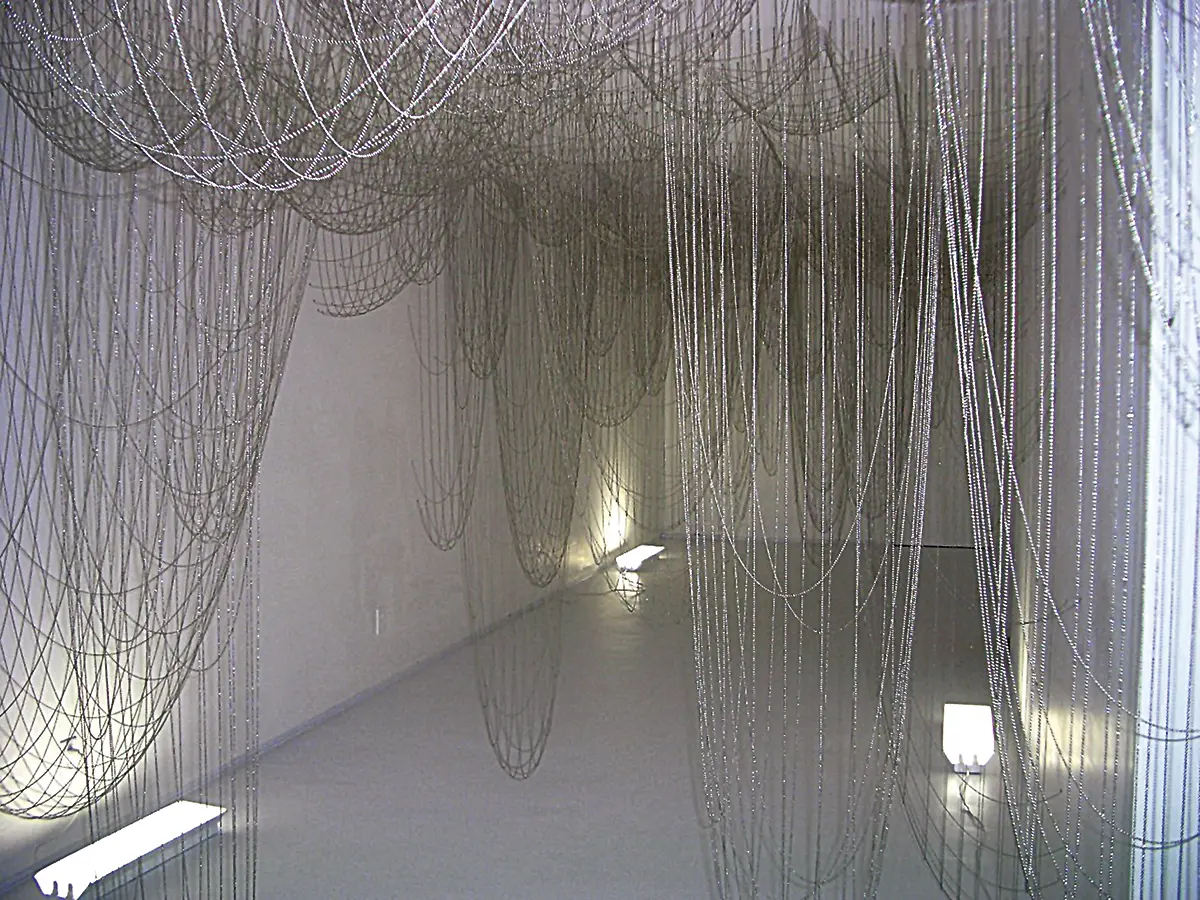
The ceiling of the Enrique Guerrero Gallery was entirely taken over by cascades of chains that Zamora positioned according to a previously determined geometric structure, resulting in a tangible and accessible yet poetic work of art. The visual effect produced by Líneas de suspensión, ensayo sobre la geometría (Suspension Lines, Essays on Geometry) included a subtle reference to some works of Op Art from the 1960s, although here the viewer moved inside and around the work while the chains remained practically still. Lightly touching the hanging filaments produced a soft swaying that gave mobility to the whole work.
Immersed in an appropriated and modified space, one’s perceptual abilities were affected. The hanging chains surrounded the viewer, causing an effect like a weakening of the psychological boundaries, fusing the viewer and the surroundings into a single identity. The effect occurs in real space; the coordinates are determined by the body of the organism that fuses to the recreated, represented, or simulated space. Incapable of demarcating the boundaries of his own body, a psycho-asthenic human being abandons his own identity and embraces the space beyond, camouflaging himself into the environment.
In this environment, the viewer perceived a limitless field because the white cube was covered with chains with ends that are difficult to locate. The spatial structure deteriorated due to the curved, interwoven paths that the thin material traced in the air. One’s perceptual abilities were altered in multiple ways: at once, the viewer experienced sensations that were kinesthetic (with an awareness of the position and activity of the body in space), kinesthetic (with an awareness of movements through space), tactile, and even acoustic. Part of the experience confused spatial parameters; it was difficult to discern between exterior and interior, material and immaterial, and surface and depth.
The thin, hanging threads invited the viewer into an amorphous environment, despite the perfectly aligned structure. It seemed paradoxical. Perfect geometry provoked the sensation of weightlessness. Luxurious curtains, chains of pearls, solid cascades allowed the viewer to walk between crystalline walls, trying not to touch, move, or dislodge them. There was a magnificent tension between fragile microspheres that hung firmly and floated lightly.
Héctor Zamora transformation of a white, almost empty space generated this topographic exercise developed with the use of catenary curves, as he explained to the press. This curve was that adopted by a perfectly flexible chain, suspended by its ends and subjected to a uniform gravitational field.
The body of the viewer became attached to the chain’s curved line and experienced a perception between inertia and tension. The viewer was repelled and attracted at once by the force of acceleration that emanated from each form. Suspension, weight, gravity, time, and space were the physical elements that allowed Héctor Zamora’s geometric lines to bring one inside an artificially built realm for the enjoyment of each sense organ.
LUZ SEPÚLVEDA