
Throughout his career, Hernández Diez has used everyday objects and materials to create a series of constructions with almost ghost-like presences that are difficult to perceive if we don’t pay attention to what the artist is proposing. What in principle can seem empty (those giant plastic fingernails, for instance) becomes a referent that triggers all kinds of not easily digestible associations (the sort of woman who wears her nails like that, and all of this in the socio-cultural context in which it unfolds.) In that sense, there is always in his work an unsettling element that provokes a certain discomfort in the attentive viewer, and that, above all, saves it from becoming a simple, more or less pertinent witticism.
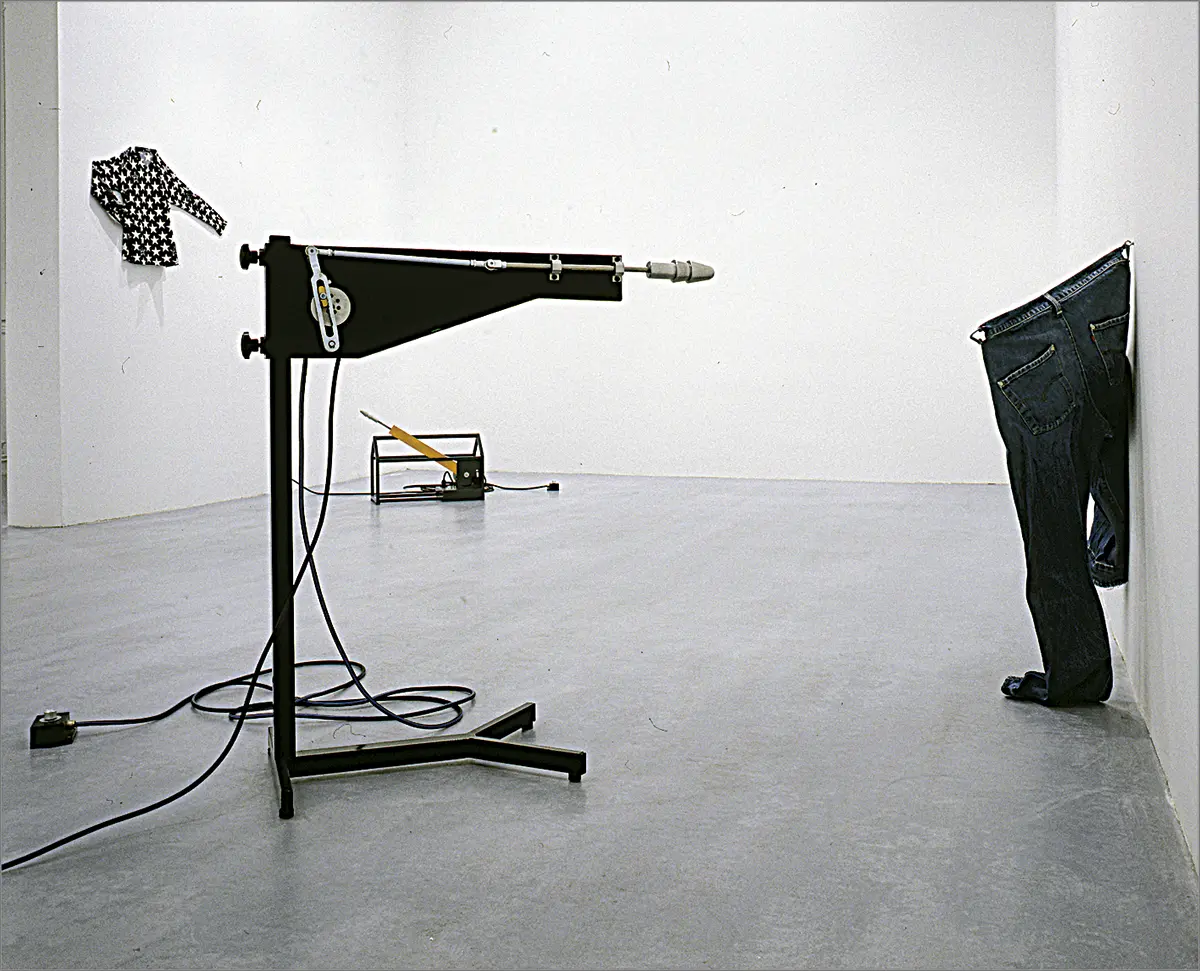
Walking this line is undoubtedly perilous, more so when one deploys formal resources like installation, which can always be read as a simple mise-én-scene whose content is transferred to the action that might or might not take place there. Hernández-Diez has saved this situation on more than one occasion by putting in play his fascination with machines, as he does again in Revoluciones por minuto (Revolutions per Minute). The press notes describe four installations, although it bears pointing out that these four mechanized constructions refer more to absence than to spatial occupation. The reference made by Spanish critic Mariano Navarro to Duchamp's single machines is not gratuitous. Three of the show’s works consist of clothing items connected to more or less sexualized mechanisms in perpetual motion. There is certainly a contemporary interpretation, not necessarily deliberate, of the Nine Malic Molds of Duchamp’s Large Glass, which comprised nine different and empty suits or work uniforms and were part of the imaginary mechanism invented by Duchamp. In the case of Hernández-Diez clothing items, there is an interplay between the idea of the uniform —blue jeans as the most common item in our times— and the subjectivity of its absent wearer, because these are not any old blue jeans. Hernández-Diez clearly indicates that these are his own; the title of the work is My fucking jeans. This is the virtual element that breaks or rather clashes with the entire mechanical construction that pulls and pulls and pulls on the pants without ever being able to rip them from the wall. Metaphorically, it is perhaps the jean’s owner who is trapped in that circle of perpetual motion or who feels pulled once and again by an incessant force.
It is more or less the same with Mi talón de Aquiles (My Flaw), where the machine pulls on a sock heel, or in My fucking dreams, where a star-print shirt seems intent on fleeing from the thread that holds it and joins it to the ever-present motion machine. In both cases, perhaps a tad more poetic than the previous work, the simplicity of the objects and constructions —even the mechanisms are trimmer and neater— hides a wide array of interpretations and evocations. The feeling of estrangement they provoke was already present, also in a very subtle manner, in his series of gym shoes that spelled the names of great philosophers and thinkers. What at first sight could have seemed just a funny joke, also came across as a hidden message generated by the total clash of the two universes that came to a head in these simple accumulations of shoes. The same occurs here, with a sort of fundamental contradiction between a sock —an everyday, unimportant, even disparaged item— and the sleek, precise machinery that makes it move. But it is not only that, the reference in the title, to Achilles’ heel, transforms this sad sock on a wall into an object that may be undignified, but is fitting as a metaphor for the myth about the weakness of the demigod.
The show’s last installation, La vida que mi mamá quería (The Life My Mother Wanted) —a table/pedestal and on top of it what we assume is a nightgown and the model of what we assume is a luxury car— moves away from the previous three by referring directly and linearly to the aspiration for a certain state of well-being and luxury, but it lacks the subtle tension present in the other works.
The terrain traversed by Hernández-Diez is, as I have mentioned, risky, and in this brief show, we can corroborate both the virtues and the defects of his aesthetic and conceptual options. At any rate, it is a good example of the lights and shadows that inform today’s art.
ISSA MARÍA BENÍTEZ