
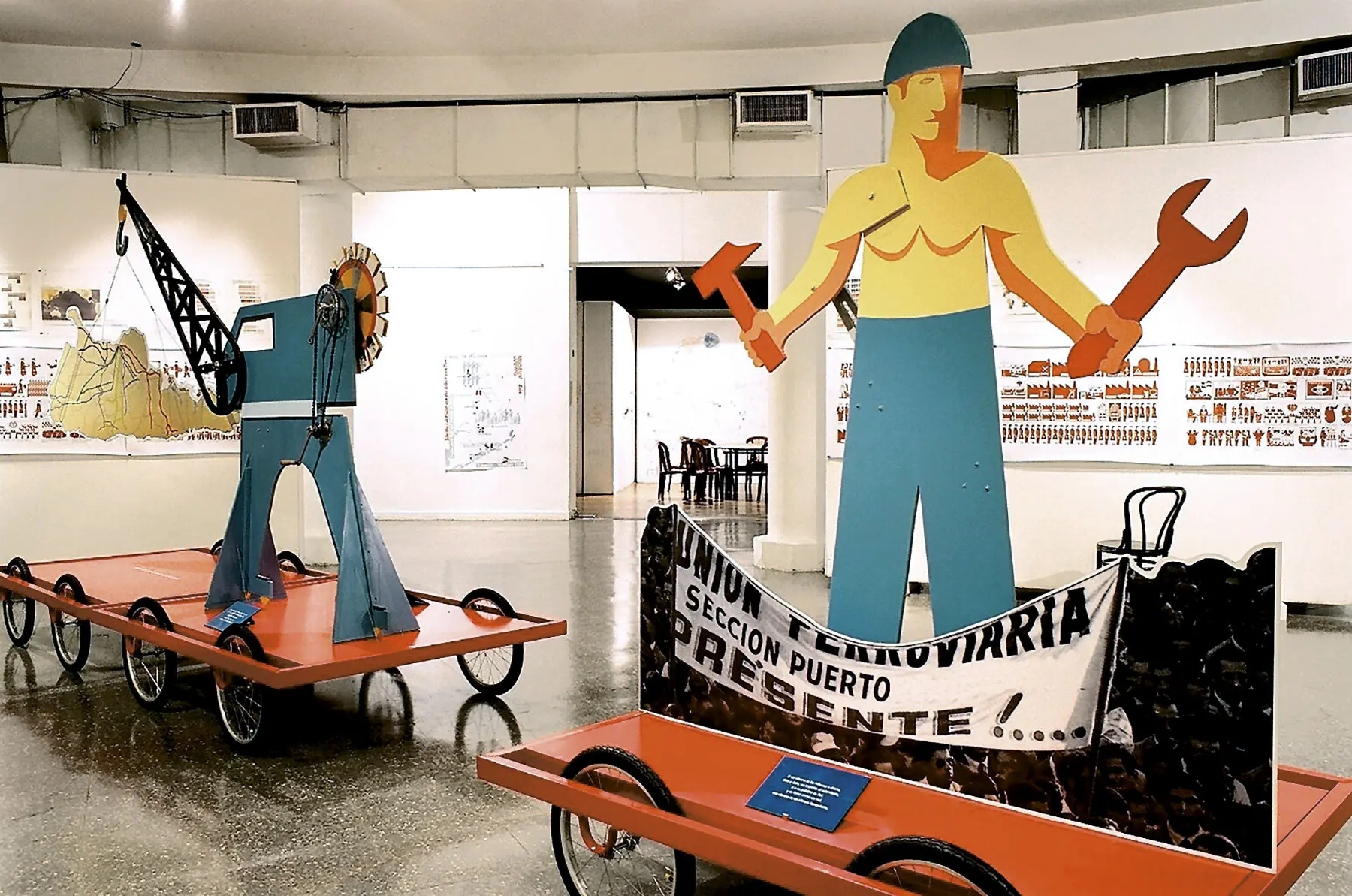
What is normality? Is normal someone who eats from the garbage, has no schooling or employment, and lives without shelter, abandoned by the authorities? The show La normalidad is the third stage of the project Ex Argentina (Example, Argentina,) initiated as an interrogation of the crisis that exploded in the country in December of 2001. The traveling show opened in 2002 at the Ludwig Museum in Germany and moved to museums in Rotterdam, Barcelona, Miami, Vienna, and currently to the Palais de Glace, in Buenos Aires.
Ex Argentina grew on the basis of research carried out in the country by Alice Creischer and Andreas Siekmann, German curators and artists who, like many in the central countries, were moved and came to corroborate what they were seeing in their TV screen: disillusionment and frustration, corruption and impoverishment, that generated armies of the excluded, impatience, and violence. This is a project of the Buenos Aires Goethe Institut, financed by the Kulturstiftung des Bundes (Germany.) Under the general direction of Gabriela Massuh and with Loreto Garín, Eduardo Molinari, Federico Zukerfeld, among others, as artistic coordinators, the proposal was documented in a book titled Ex Argentina. Pasos para huir del trabajo al hacer (Interzona-Walter König).
From its very title, then show questions the “normality” supposedly represented by the market economy and globalization, the concentration of mass media and the distortion of information, privatization and unemployment, child labor and violence against women, police abuse and racism, and contributes to the awareness of these situations in order to have an impact on them.
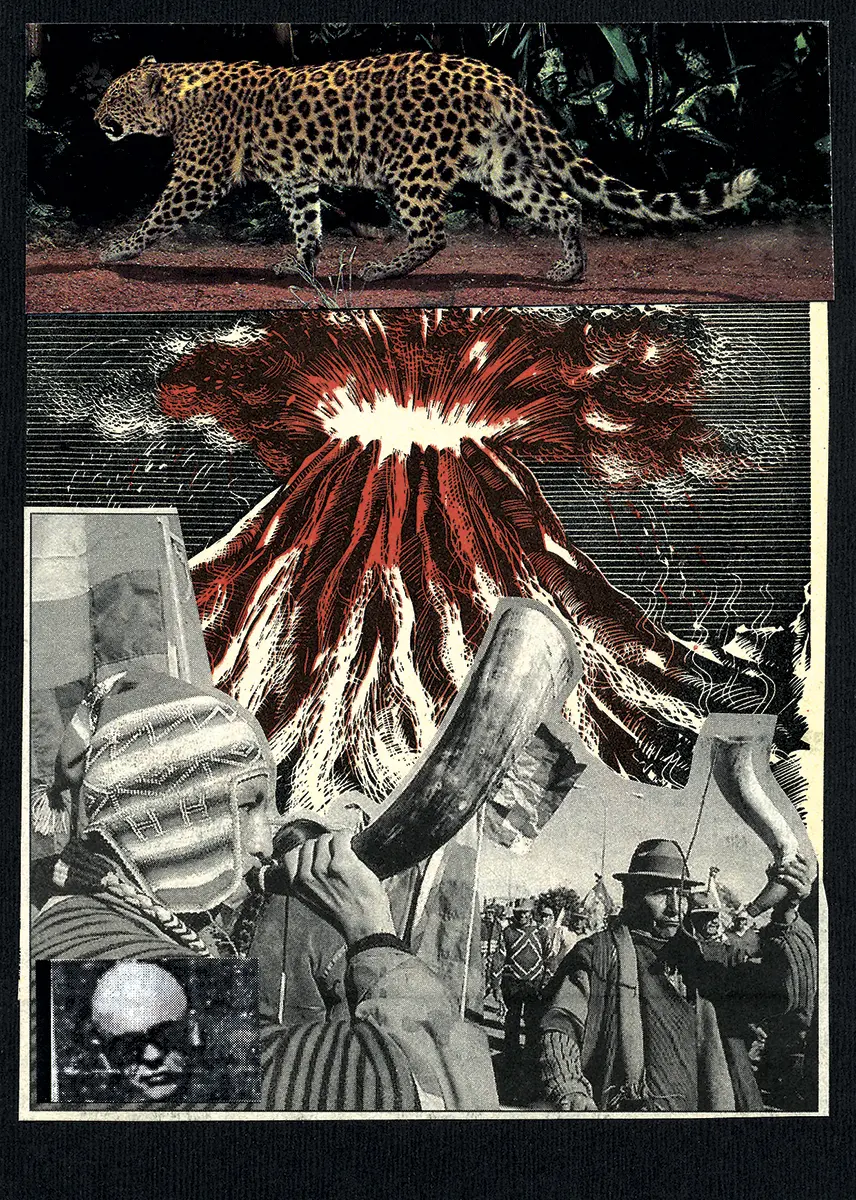
The architecture of memory and archaeology of personal experience in the works of 45 individuals and art groups from Argentina, Brazil, Russia, Chile, Holland, France, and Austria. The artists work without prejudices on an artistic production of high symbolic value through graphics, photos, drawings, paintings, videos, objects, books that allude also to the regrettable conditions in which large human groups live, and not only in the country.
These visual activists” review national history and national tragedies, building a critical bridge to the present. They explore identities and contexts, working over and resignifying preexisting materials. The various artistic practices link notably and subtly intimate repertoires and social reflections, spiritual suffering, and historical investigations.
The show, which questions many international situations, avoids spectacularity (the “Benetton effect”) and articulates around four central axis: Negation, cartography, Militant investigation, and Political narrative. Forceful, it demands concentration on the part of an unadvised viewer, who will find in these artistic investigations —depending on each one’s eye— coincidences, certain and forced parallelisms, infantile reductionism, and plenty of valuable information.
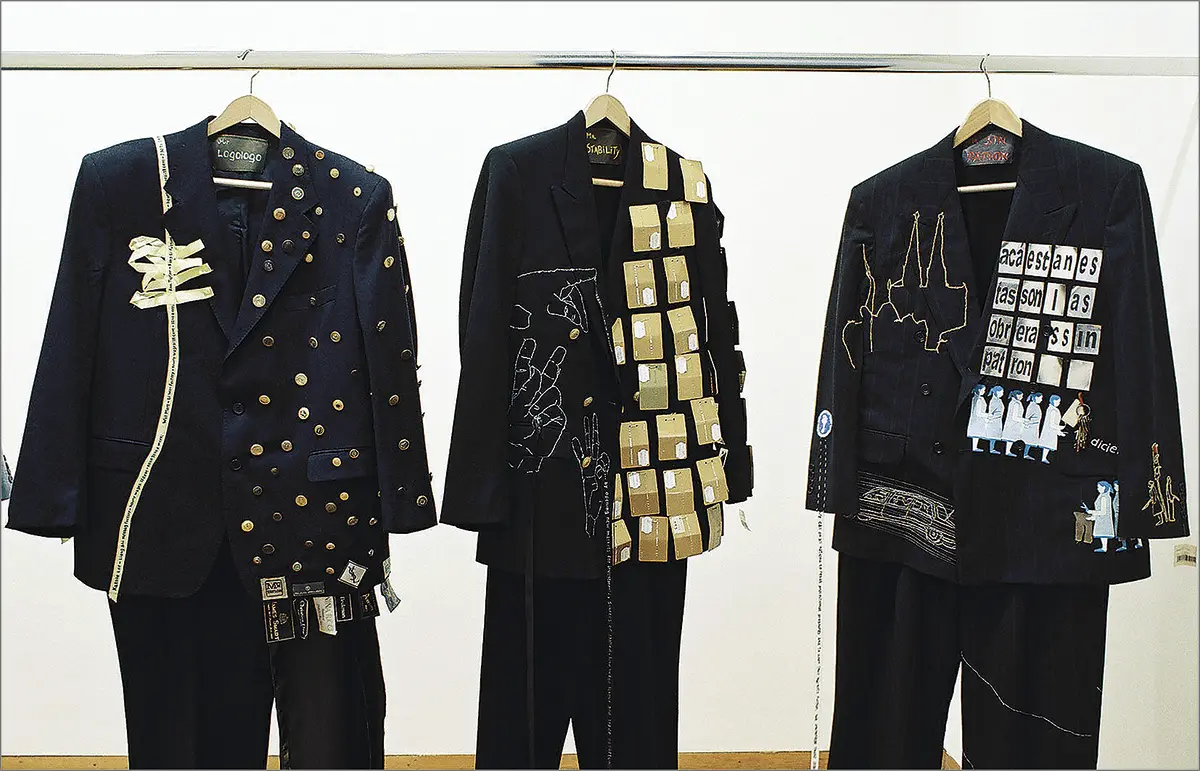
Here we will review some works that debate the Argentinean context in La normalidad, arranged in the two floors of the circular Palais de Glace. This meaning-generating art involves itself actively in the movement of factories and companies recovered by their workers, such as Brukman Textiles (Bauen Hotel, Chilavert printing house, Zanon ceramics,) some of whose workers collaborated with Berliners Creischer and Siekmann in the manufacturing of the ten suits exhibited, which tell stories of struggle through their embroideries.
The photos and objects in Parque Problema, an installation by Eduardo Molinari/Jürgen Stollhans, with Pedro Hasperué, and Sol Arrese’s photos next to the community- and infrastructure-rebuilding projects by Juan Carlos Fernández (a leader of the General Mosconi Unemployed Workers Union,) direct their attention to the long list of the social and economic problem that will result from the privatization of the state petroleum company in the General Mosconi region, province of Salta.
The self-managed Ferrowhite Museum preserves the daily memories of railroad workers in the port of Bahía Blanca, Buenos Aires province, and originates a rolling exhibit that transports stories of the emptying-out of the productive infrastructure.
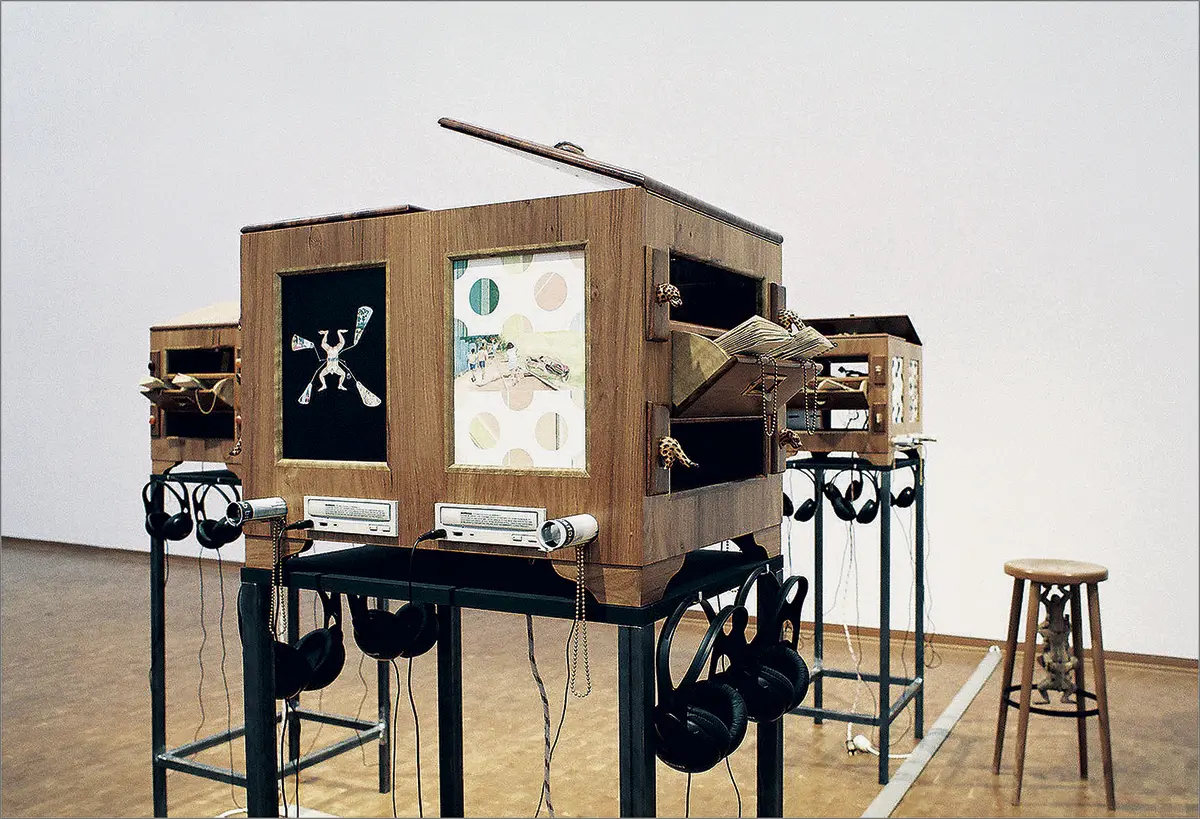
Sonia Abián and Carlos Piégari researched a neighborhood in Posadas, Misiones province, during a year, and imagined Aparatobarrio, three wooden pieces that, like index-card cabinets, communicate the voices and experiences of their inhabitants. In collaboration with other artists and as a follow-up to Aparatobarrio, Abián and Piégari turn their magnifying glass on the issue of social exclusion, in their installation Supermarketgate; as a case in point, they reveal the hypocrisy of a judicial system (and a society) that sentences to prison a rape victim who, in a state of shock, killed her child at birth, while granting freedom to the rapist.
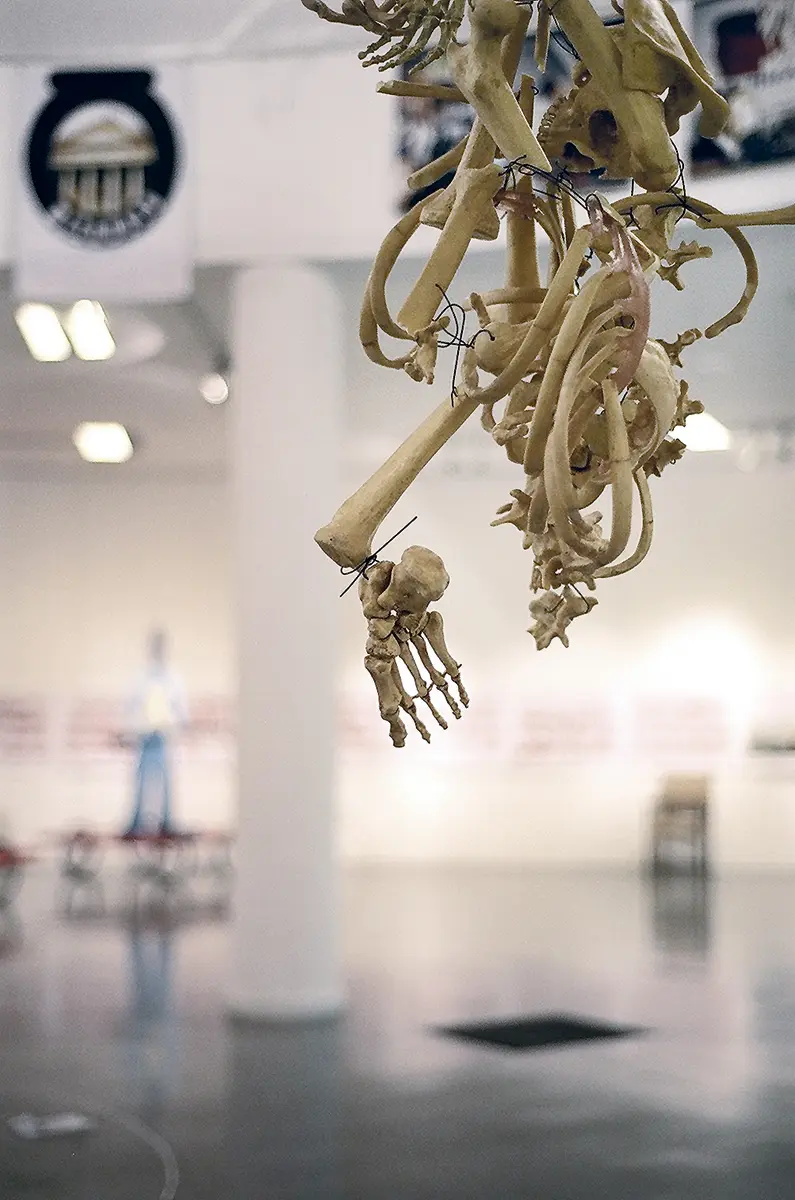
The recognized artist León Ferrari points to the scandal of poverty with a sculpture comprised of a large disarticulated skeleton with polyurethane and wire bones, placed in the manner of the abstract pieces that dominate the entrance to some buildings housing finance corporations. Playing with double meanings, Ferrari seems to be telling us that there are corporations that spread hunger among the people and that many pedestrians no longer even perceive poverty: it is so entrenched (like contemporary artworks in public spaces,) it is so “normal,” that people don’t stop to look at it anymore. It was precisely Ferrari who, alongside other dissidents from the Instituto Di Tella and Rosario-based artists of a politicized avant-garde, promoted in 1968 with their group Tucumán Arde (Tucumán was and remains one of the country’s poorest provinces) a series of actions in sites distant from art institutions. Here we find historical materials and work by Dutch artist Matthijs de Bruijne that refer to today’s Tucumán.
Equally, the public can see the photos, posters, and other documents of Colectivo Situaciones, Mesa de Escrache Popular, Grupo de Arte Callejero, Etcétera, formed by poets, visual artists, and actors who research, publish, and take over public spaces to give visibility to conflictive situations through art auctions, such as the first escraches (non-violent rallies) in front of the houses of human rights abuses linked to the country’s most recent military dictatorship (1976-1983.)
The show is completed by a cycle of Argentinean video-activism, including No olvidamos (2004,) by the Grupo de video del Movimiento de Trabajadores Desocupados Aníbal Verón, which presents and profile and describes the death of Darío Santillán and Máximo Kosteki at the hands of the police (2002 murders that changed political life in Argentina.) The meetings and debates are held also in separate locations ——Chilavert Artes Gráficas, FM La Tribu, Hotel Bauen, La kasa de H.I.J.O.S. (regional capital)— and promote decentralization.
Besides the dilemmas of its radicalized agenda, made evident by the works on exhibit, La normalidad raises other questions.
Is this art, or is this politics? A possible answer for this false, long-standing dichotomy was offered by American philosopher Arthur C. Danto in May 2002, in The Art Newspaper: “Being an artist today means making philosophy by visual means. (...) Today there are no aesthetic limits or mandates for a work of art (...) The purity imperative that defined the last stage of Modernism is not particularly relevant to current artistic practice and sensibility” (“What you think is what it is.”)
Has the inclusion of political issues in the artistic field become fashionable? This isn’t new, either, but following traumatic developments in the countries of the region —and also under the influence of international exhibitions, like the last two editions of the influential Documenta, in Kassel, Germany, and the 50th Venice Biennale in 2003, which had neatly political agendas—, more and more artists tend to reflect about the here and now. Thus, the visual arts —like Ex Argentina/La normalidad— take part in a debate in the social, economic, and political field that involves vast sectors and questions how, why, and for whom they produce today.
Do these visual activists become domesticated when they exhibit in institutions? Many of these artists, who join the political with their artistic practice, have a critical position regarding the workings of the art world, with its system for the circulation of money and influence, its stars and dictatorial curators coming mostly from the central nations. Some artists join the art circuit and criticize it from within, Others, after an experience like Ex Argentina, which has traveled so much throughout Europe, run the risk of being tamed, engaged only with the circuit they criticize: most will probably go back to the sources that generated their provocative works in the first place.
VICTORIA VERLICHAK
Art critic and journalist. Autor of Martha Traba. Una terquedad furibunda, among other books.