
The first work we encounter, upon entering the gallery, is a small smelted-bronze object hanging from a nail, somewhat above sightline. Amor e ódio a Lygia Clark bases its shape and dimensions on a gauntlet as if the instrument were attached to its image on a mirror, real object, and spectral image made of the same matter. Duplicated, the gauntlet loses its original function and substitutes the threat of aggression by the possible union of two hands in a kind of greeting. The placement of this work and its noble material inhibit the touch, while the bronze preserves the oxidized traces of fingerprints. This ambiguity between participation and contemplation announced here and reaffirmed in the work’s title is also seen, punctually, in other moments of the show. But what grows with every step and builds meaning throughout the show is the coexistence of street culture with references to the history of contemporary art.
At the center of the main space, a fountain-like that one sees always surrounded by tourists in Italian cities, or like those miniatures recommended by feng-shui, offers visitors a constant flow of the local firewater. The fountain, historically a recreation of nature inside the space of the city, has been built here using urban detritus, gathered from the area around the gallery in two days of foraging. Sliding over fiberglass tiles and falling on a canvas tub covered with black plastic, the river of cachaça once again invites participation, while the garbage through which it passes inhibits it.
To both sides of the fountain, to digital cameras pasted to the wall with a somewhat exaggerated amount of silver-tape show an archive of images in which we can clearly see the gaze that Marcelo Cidade (the last name means “city”) extends upon this and other cities, the details that inform his thinking and his work. On the wall opposite to the fountain, a grey sweatshirt functions as the center towards which a number of upward-moving arrows converge, and from which more arrows project, through the neck and arms: an allusion to the artist’s process, who uses his urban explorations to gather the information processed in his ideas and actions.
On the upper floor, a series of photographs register some of those actions, gestures that underline with a layer of silver coloring situations encountered around the city. An abandoned automobile and a concrete garbage dumpster are entirely covered in silver tape. An awning on an unexpected location and the remains of a cut tree are painted with spray in the same color, an illuminated gray, as a slight increase in the brightness of the cement surface that characterizes urban centers.
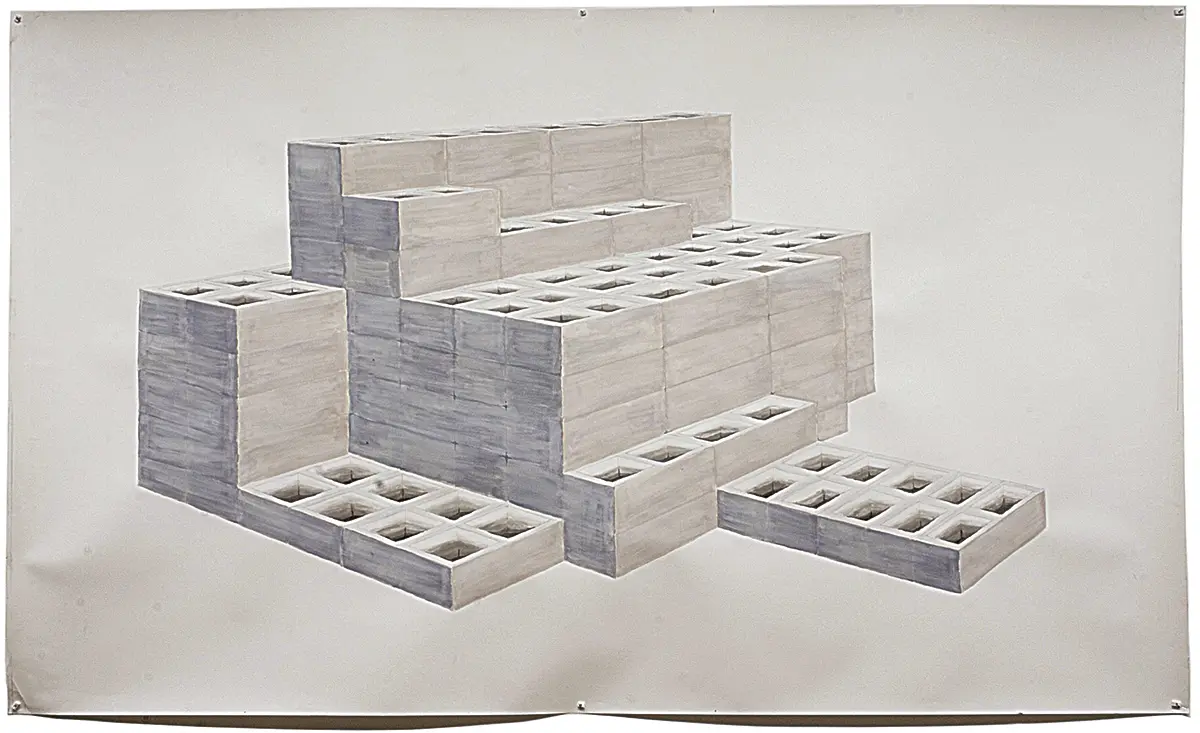
Re:definição de projeto arquitetônico is a series of 150 x 250 cm watercolors that show piles of construction blocks in a slightly larger than life-size. The configurations they assume are casual, as happens in one of the works, where the regular piles of blocks or bricks are progressively sculpted by workers according to the needs of the permanent architecture. What the watercolors make evident is the similarity between those ephemeral sculptures, with their geometric modules and their colors, and modern and contemporary architecture. We see clearly the piled-up blocks, but we cannot avoid seeing them, at the same time, like small apartment blocks, built by negation, by the absence of elements that are taken away for the construction of the real buildings.
Fogo-fato also points to shapes produced in the city as a result of necessary or arbitrary actions. This series of photographs sets side by side and without distinction registers of traces left on walls by bonfires, and of paintings in black spray with which Cidade simulates those traces. Once again, the work of art we see in the gallery builds a bridge to the outside, taking us to the street. As in the photographs described above, the artist doesn’t limit himself to registering something he sees but also intervenes directly in the urban space. This time, the approximation of the registers of his action to the found traces of real bonfires reinforces, in the gallery environment, something that before was only suggested. On the other hand, many of the walls where the artist is able to execute his interventions, and those where real bonfires are lit to warm the night, are crumbling and covered in graffiti. In this way, the photographs bring to the exhibition space, almost against the grain, something that is at the base of this work and of the artist’s production in general: the urban culture produced and encountered in the streets.
CARLA ZACCAGNINI