
Árboles y lunas (Trees and Moons) is the title of the show presented by the painter Marco Miliani (born 1933, Venezuela) at Galería Durban Segnini. This series of landscapes is by turns nostalgic, metaphysical, and romantic and presents a kind of stillness, solitary and quiet, as a preface to a dream that lives in the artist’s subconscious. Stylized shapes from the wild tropical environment are distilled in the work and metaphorically summarize the artist’s introspection. As the critic Perán Erminy points out in the catalog, this series is “the artist’s . . . pictorial diary, which is at the same time a dialog with painting itself, with himself, and with the everyday world that carries on without major incidents or anguish...”
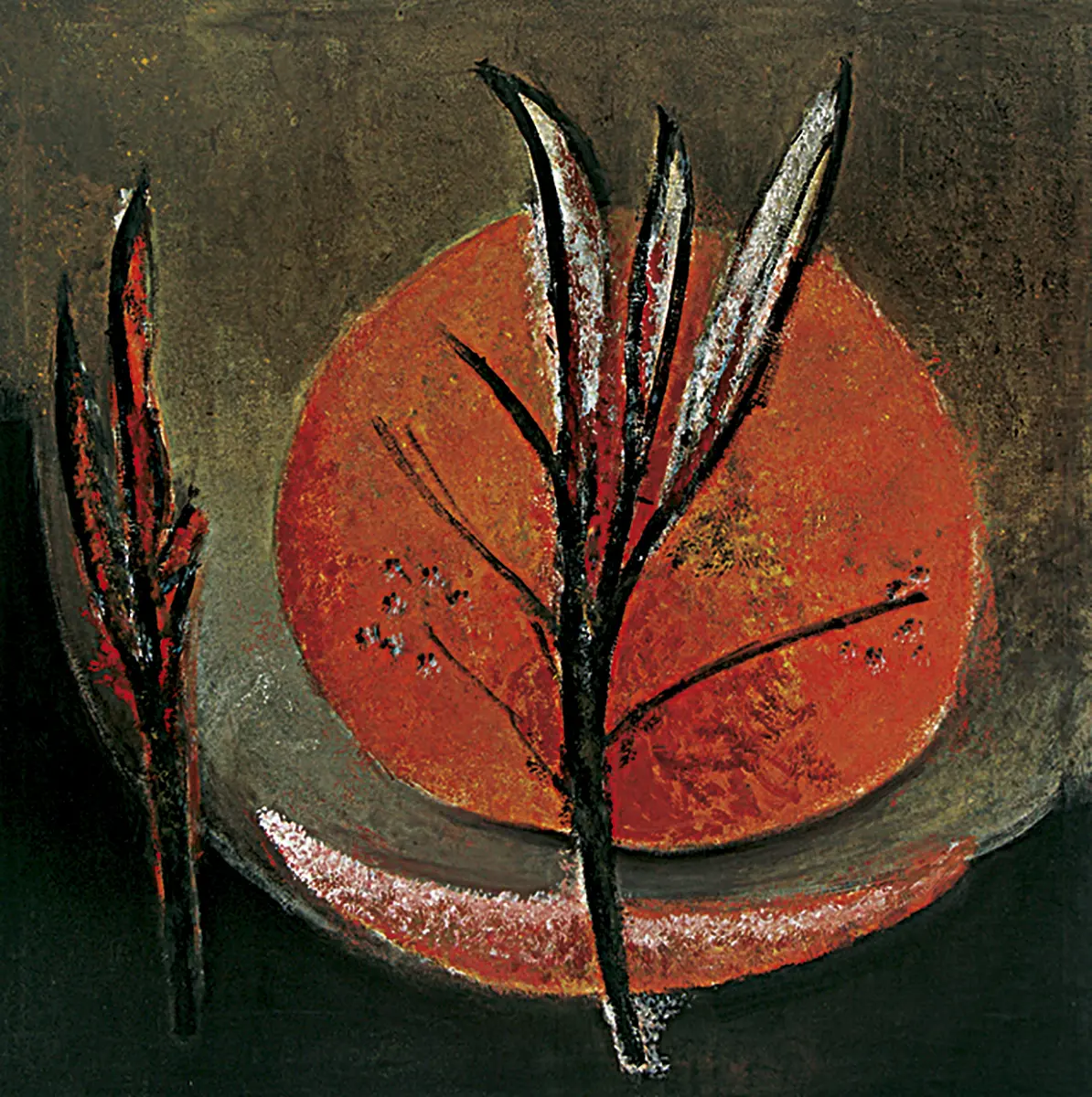
Miliani is an architect by profession, which comes through his handling of the pictorial space. He started painting at the same time as he started studying in the architecture program at the Universidad Central de Venezuela in 1953. Kandinsky and Klee were his initial influences, and in 1953 he gained a place in Venezuela’s artistic and intellectual arenas. Miliani lived for long periods in cities like Maracaibo and Mérida, active as an architect, draftsman, watercolorist, painter, and printmaker. His experience in the artistic field has allowed him to creatively experiment in several directions—expressionist or lyrical abstraction, surrealism, informalism—only to synthesize all of this into a whole creative work. Although he finds inspiration in the visible world, it is clear that the tree simplified into lines/branches that project toward the viewer is an abstraction of the forest constructed as a plastic structure, as emotional and symbolic meaning. In an intelligent and poetic act, the artist breaks the unity of the landscape, transforming it into metaphors of nature. In one work, personal evocation and artistic interpretation join to produce a dynamic image of soft penumbras, even if the iridescent, mandala-like glow of a yellow moon seems to contradict it. These are paintings that seem like evocations of the artist’s intimate self. Miliani is a quiet, soft-spoken man, a man of smiles rather than guffaws, a man of calm demeanor, always at peace with himself. There is a close relationship between the artist and his work. At seventy years of age, this Venezuelan artist displays a fresh, young vision that captures the present instant in the timelessness of what endures. Quick, confident brushstrokes, sober colors in blotches, and gestures on the canvas focus the theme toward symbolism with lyrical effect. Miliani acts as a romantic who looks at nature from a poetic vantage point, a perspective that is nostalgic in spirit and of strange beauty.
Miliani’s materials are diverse, as are his techniques, which allows him to give the surface of his paintings a certain material and visual texture. Abstraction and figuration, two seemingly antagonistic universes, coincide in a work in which the theme of trees and moons is perceived as a synthesis of nature and the moon. Were it not for Miliani’s titles and for the figurative representation of stylized branches and trees, the rest of the color-loaded images of Miliani’s backgrounds could be perceived as geometric or lyrical abstractions. In the theme’s strict hierarchy, the aesthetic of this series of paintings is based on the exploration of inherited and acquired cultural traditions, as well as the intimate reality of natural and human landscapes.
The timeless space of this intimate and universal landscape is expressed through color and its visualization in textures; color unifies the structural relations between all the elements that compose the work. Miliani assumes the reality of a natural world that is categorized into parcels of a limitless universe. Árboles y lunas (Trees and Moons) is the symbolic landscape that reveals the artist’s most recent works: Rituales (Rituals), Encuentro de los signos (The Encounter of the Signs), and Ciudad de hojas (City of Leaves). It is another dimension of landscape art in Venezuela—intimate and metaphysical in character, in communion with an impassible realism inspired by the existential experience.
BÉLGICA RODRÍGUEZ