
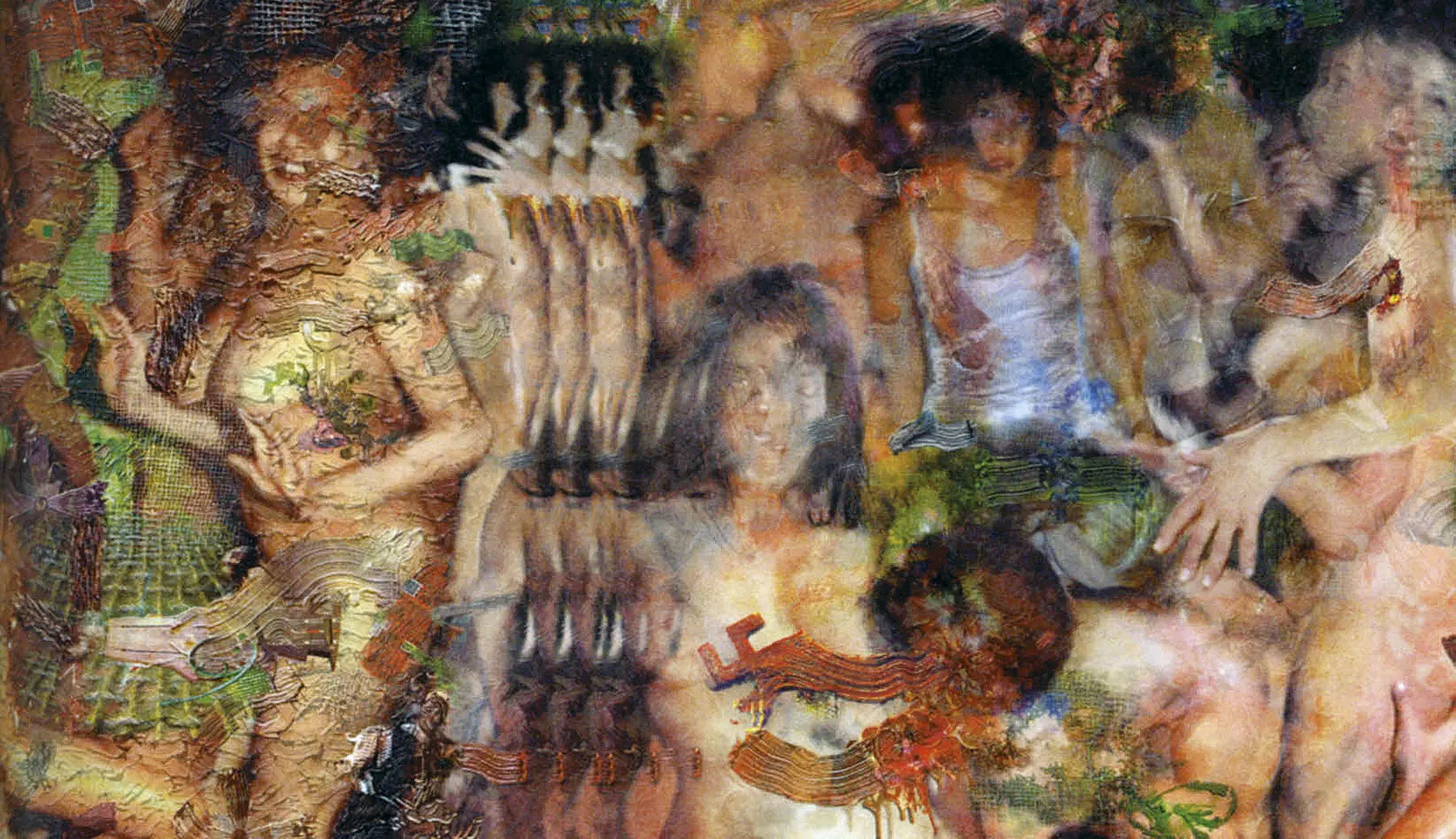
A one-hundred-meter-long work by Fabián Marcaccio snakes along with the Daros Latin American exhibition rooms in Zurich. The piece, part of the series Paintant Stories started by the artist in 2000, occupies the space in a monumental way. It combines painting, photography, and digitally processed imagery with sculptural silicone casts and areas of heavy impasto.
The painting is inhabited by the spirit of reality in permanent mutation. The virtual and the real world coexist in Paintant Stories as well as the materiality of the object and its digital representation.
Fabián Marcaccio was born in Rosario, Argentina in 1963 and has lived and worked in New York since the early 80s. His monumental multimedia works have been installed in public and private spaces around the world, sometimes occupying the inside and the outside of galleries at once, breaking through the limits of windows and walls. His contribution to Documenta 11, a Multiple Sites Paintant, dealt with socio-economic concerns directly related to the dramatic economic crash suffered by Argentina in 2001. A visual analysis of economic colonialism, the work was specifically linked to that historical moment and presented charged imagery drawn from Internet sources.
The neologism “paintant,” coined by the artist to refer to the act of painting, distances the work from “action painting,” the mythologized drama of the artist’s body interacting with the surface. Instead, it relocates the performance element in the viewer’s body. This approach, closer to the concerns of historical Kineticism, brings perception and mobility together in the manner of David Alfaro Siqueiros and his particular development of mural painting. Of course, Marcaccio owes a great deal to the moving image and the discontinuous modes of vision brought by contemporary media, as well as to Siqueiros, who experienced intellectual communion with the cinematographic language of Sergei Eisenstein.
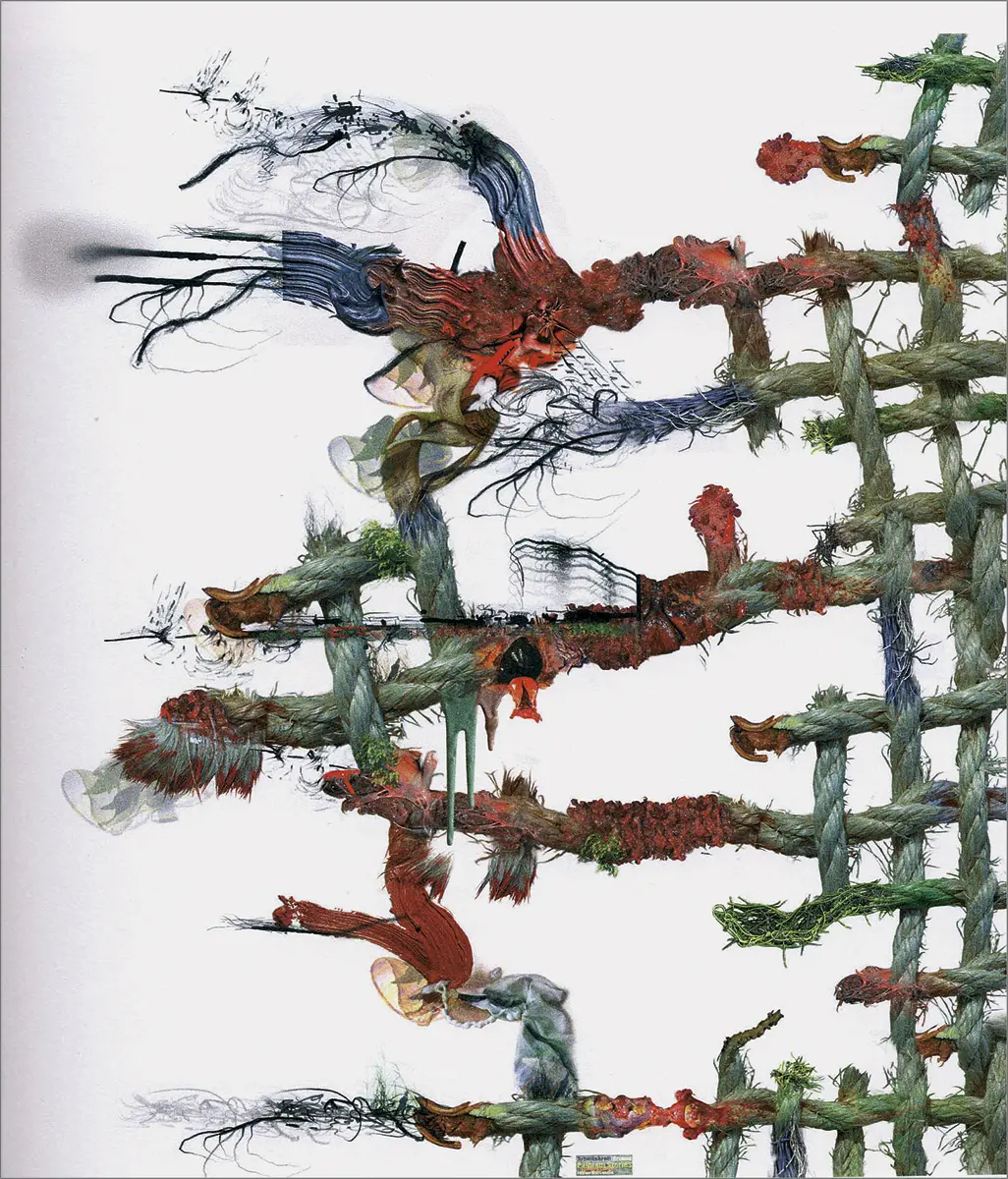
Navigating through the titanic physicality of the Daros Paintant is a near-mythological experience. When the work is approached closely, the fleshy entrails of Jacob’s whale come to mind: a feast of dense, multilayered sections of digital images depicting the inside of the body, human figures, events, symbols, and substances from the real world, followed by sections of purely digital rendering of paint matter, intersected by the real matter of pigment and silicone casts. The base matérialisme of Georges Bataille also come to mind, with his obsessive interpretation of reality from the crudest of phenomena to the most sophisticated: scum, polluting agents, body fluids, and viscera, the hidden side of the human body in its fleshy exuberance intermingled with microscopic views of the vegetal world. All of this is accompanied by oversized brushstrokes that are omnipresent as crucial elements of the composition and by the grid, the mother of all representation.
The gigantic brushstrokes distributed along the different sections of the work seem to emphasize the symbolic soul of a painting, and its digital make-up becomes a celebration and a tautology at once. So is the presence of the grid. The basic structure of drawing and three-dimensional computer modeling becomes, like a certain pictorial genesis, the primordial form from which everything else on the picture plane sprouts, like a volcanic eruption.
The imagery in this huge work is vast, and the viewing tempo created is as overwhelming as surfing many computer windows through multiple screens at once. Figures from pornographic websites are scattered through the work in either an inconspicuous manner—reduced in scale and hidden behind prison-like grids made of bars of rope—or as central to the composition. In one of the most elaborate sections of the work, the seedy world of porn sites is fragmented, mutated, and metamorphosed into an interpretation of Les Demoiselles d’Avignon, Picasso’s ultimate painting breakthrough. This section of the painting, constructed from manipulated images of porn stars, is tagged at the bottom with the text “Demoiselles of Continuous Multiplications and Singularities.”
This appropriation is exemplary of Marcaccio’s homage to the history of painting. Erudite and eloquent, he reinterprets the inventions of Cubism and the transgression of the surface performed by another Rosario-born artist, Lucio Fontana. Marcaccio revisits Spacialism as well as Pop Art by destabilizing and juxtaposing collage, three-dimensional elements, painting, and digital images from the Web in the same picture plane.
Interspersed with this apparently microcosmic chaos, one finds bird’s eye views of everyday world events: the violence of war, mass concentrations, bomb explosions, and symbols of totalitarian power. Views of the material world in an off-beat succession of panels are structured in different sections of the work, all assembled into one multi-faceted narrative and tagged with allegorical titles: Media Crimes against Humanity; Luxurious Poverty, The After Taste of Representation; Your Everyday Fascism. These slogan-like declarations act as markers of meaning in the Paintant kaleidoscope.
Layered like Russian dolls, Marcaccio’s Paintant Stories deploy fragmentary plots that contain subtle but clear references to fanaticism, unrest, and other social diseases, accompanied by the persistent rope grids that sustain the visual explosion in need of a structure.
When passing through the exhibition rooms, one is inevitably immersed in a sensation similar to traveling at high speed. It is as if one was embarking on Julio Cortazar’s La vuelta al dia en ochenta mundos (The Tour of the Day in Eighty Worlds): a journey of multifaceted visual stimuli that haunt the eye and the mind in abject and lush ways, a panoramic view of reality’s fragmentation and life’s breathtaking synchronicities.
Marcaccio sees his painting as a process that fossilizes fleeting images, but, despite the proverbial speed of the virtual world, the genre of painting is still moving slowly. Only time will tell whether his way of representing the rapid world around us has become a new language or site for painting.
GABRIELA SALGADO
Independent curator based in London.