
When Rafael Ferrer placed his blocks of ice in the Whitney Museum in the late 60s, he made it clear that he was not only a daring, provoking, and bright avant-garde artist—who embraced with great honesty and originality what was happening in visual art during one of the most important decades of the 20th century—but that he was ready for the same kind of spotlight that had shined in the 50s and the 60s on his brother, the Oscar-winning actor Jose Ferrer (Cyrano de Bergerac, l950). Ever since, Ferrer’s artistic career has been a capricious but intelligent smorgasbord, a sequence of creative experiences, happenings, discourses, and periods where he has produced both very intimate work of enormous lyricism and true masterpieces in paintings, sculptures, dimensional experiences, and installations, many of which are now in some of the best private collections all over the world or are exhibited in museums such as the Metropolitan in New York.
In his February–March exhibition Etcetera at Galeria Petrus in San Juan, art lovers were able to see vintage Ferrer. Marked by the essence of his beloved Puerto Rico and the beauty, contradictions, and magic of the Caribbean in general, this master again combined his naïf/primitive resources, his literary talents, his interest in urban art discourses, and his postmodern existentialist condition. The artist lives in New York, but the pieces in the exhibition were conceived in a wounded but still beautiful Vieques, the controversial island that recently freed itself from the U.S. Navy presence’s bombings and ecological destruction.
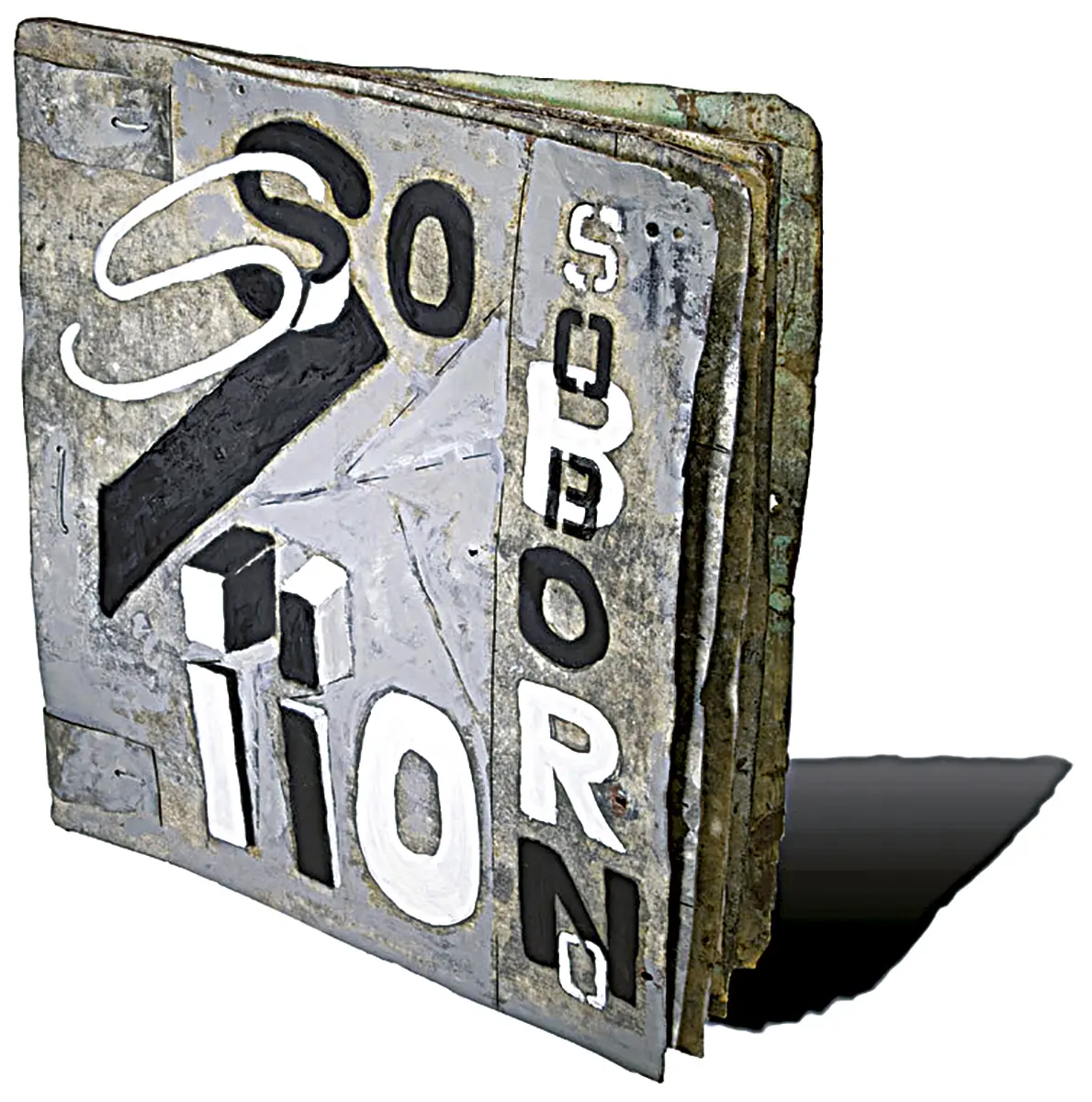
In his last major exhibition in San Juan, he introduced some of his new protagonists: enigmatic three-dimensional maps of the island of Puerto Rico made with metal, fig-trees, and other materials. With depictions of tropical scenarios and delicious fruits, they were reminders that he is an important painter. In the recent exhibition, the artist wanted to share his work as an experienced iconoclast and chronicler, one who has been creatively experimenting for more than fifty years. He presented minimalist jars made of metal and enamel, austere metal renditions of the Puerto Rican flag, written warning notices on zinc where kitsch, melodrama, and cynicism embraced, and his breathtaking three-dimensional metal-enamel-graffiti heads—faces, forces, or deities that could be seen as an abbreviated Caribbean pantheon, ruled by the laws of freedom and sensuality.
The most important, dramatic, and meaningful piece in this exhibition was Pizarras, a wall installation made of ninety-six miniature blackboards. The number is two short of ninety-eight; in 1898, Puerto Rico became a war trophy after the Spanish-American War. These powerful messages could be read individually or as one entity and guided the viewer to experience Ferrer’s views—cynicism, parody, or prayer—about the ethical and aesthetic flights and abyss that define us today.
In this exhibition, Ferrer played with ideas of sex, sexuality, Puerto Rican machismo, guns, war toys, African/Haitian formulas, urban syntax, the aesthetic of numbers, and the power of the words coño, puñeta, and museo de mierda. He constructed books and made fun of tourists. He condemned wars, praised beauty, and questioned fame and fortune. He is not afraid of the echoes of Duchamp, Dada, Dubuffet, Rauschenberg, or Twombly. But above all, he is not afraid of himself because he has accepted himself as a true poet.
MANUEL ÁLVAREZ LEZAMA